Author: Lukayo

  • Musings Monday: On Healing Justice & Sacred Activism (Part 2 of 5)

    Image Description: A stick of upright incense in a bowl on a wooden table. The smoke curls in the shape of a heart against a black background. The title on the image reads: “On Healing Justice & Sacred Activism” with the URLs “lukayo.com” and “patreon.com/lukayo“.

    (This article is one of a 5-part series written in the spring of 2017 for a spirituality and social work class.)

    When I center myself, my body falls back into myself, into my aches and pains, but also into my hopes, my connections, my Will. When I center myself, I connect to the land, to my ancestors, to my spirit helpers, to the legacy I want to leave behind when I move on to the next world. When I center myself, I notice myself, I notice the world outside the scope of my wounding, into a vision of what is and all its brimming potential. When I center myself, I am giving myself time, and kindness, and care. 
    When I center myself, it also reminds me of how, outside these moments, I am disconnected from my body, from the land, from food. It is a lifelong struggle, fraught with agony that allopathic doctors will try to describe using colonial terms like “depression”, “eating disorder”, “(un)healthy immigrant syndrome”, “body dysmorphia”, “pre-diabetic”, “irritable bowel syndrome”, “gluten sensitivity”, “lactose intolerance”, and on and on and on. I am exhausted with these names they call me that cement the poison in my body instead of celebrating my resistance and resilience.
    Hanh (2000) writes that “each morsel of food is an ambassador from the cosmos” (p. 7) and hooks (2009) feels connected to her ancestors when she “can put a meal on the table of food” that she grew (p. 39). Part of my spiritual practice at this moment is learning how to grow plants, to speak to plant spirits, and know their story. My healer/teacher, who I will call Ate Agila, has advised me to stick to foods from my homeland. My spirit helpers, specifically the Owl, explained to me that any being taken as “food” for two-leggeds/humans is part of a bawi (debt/spiritual connection) that was honoured in a ritual of exchange and sacrifice. Foods outside of my homeland, I may not have paid the price for, or my ancestors may not have made the appropriate exchange/deal. This makes a certain sense when you look at the foods I am allergic to, or have become increasingly more allergic to as the years pass. We had water buffalo, not cows. We definitely did not drink cow’s milk, my ancestors. We had no wheat or corn– we ate rice. I still can eat eggs from chickens, who are descended from red jungle fowls, a being originating from my part of the world, perhaps from our ancient sacred being, the Sarimanok itself. For chicken in our dialects are called “manok”. 
    I do not spend enough time with the earth, this I know. I attempt to repair some of the relationship by having an altar to the elements, with shells and rocks from this land and from my homeland. I give offerings to it regularly, as well as to the animals I’ve killed myself (chickens and a pig). But I want to be able to grow food that I can make a meal of. I want to be able to eat miracles, not my terror and sorrow and pain. 
    It is a brutal, vicious circle of feeling disconnected from the rhythms of the earth and the relationality of my people, that drives my body to strife and despair, which is soothed by a mindless consumption, which brings on more pain, which disconnects me further from my body and from the land, which pushes me to eat more…
    This reminds me of when Simpson (2014) wrote of the “hyperindividualism that negates relationality” in the colonial education system of Canada (p. 9). Though I would never dare to presume that my decolonization journey as a Bikol person in the diaspora on Anishinaabe and Haudenosaunee (and Wyandot) lands are equivalent to the indigenous resurgence of Anishinaabeg, I still feel the weight of colonial and settler colonial systems on myself and my people. I am implicated in coloniality, benefiting in one context while oppressed in another. Thus, for me to restore a relationship with my body, I must restore my relationship with food, and for me to restore that relationship, I must restore my relationship to the land, and thus, the caretakers and stewards of the land. I have been blessed in this life for having teachers/Elders of Turtle Island that are Anishinaabe, Haudenosaunee, Mikmaw, Sauk-Fox, and Cherokee– Two Spirit people who have welcomed me in ceremony and adopted me to certain rituals and responsibilities. […] I hope to continue good relations, by supporting the work of the Haudenosaunee at the Six Nations Reserve. I plan to give semaa to those there that are building an Earth Ship. My visions and dreams have told me that this is where my path leads, to working with the Earth for the good of Two Spirit and Trans/Queer Black People and People of Colour. 
    Simpson (2014) asserts that “the land must once again become the pedagogy” (p. 14), and I spend time listening to the Earth and asking her what she wants. She wants me to acknowledge the sovereignty of her caretakers. To mourn all the pain she is enduring. To not let my connection to her be severed, weak as it is. In a vision, the ghost of the land spirits my great-grandparents in Bikol had harmed came to me, and asked me to make amends by pledging myself to the revitalization of the Earth, by being a Warrior and a Guide. So I have accepted, if the curse on my ancestral line is meant to be broken, it would be in this way my family can make amends. I am researching local conservation efforts, cleaning up waste whenever I can, and calling on my relations, like my father and my chosen family who are gardeners, to assist me in reconnecting. I hope to at least grow a mint plant from a seed this summer. In another vision, my great-grandmother Lola Colo (Sabrina Oppiana Estrella), asked me to grow herbs and make them into oils, to follow in her footsteps as a healer. She tells me that it’s not just the sacred nature of the coconut that makes the oil, or the herbs that I grow myself, or the fire that heats them together, but the prayers to each being, and the prayers of love that must be said when the beings are applied to a human’s skin, asking these different agents of creation to repair, restore, and heal. For “when we love the earth, we are are about to love ourselves more fully. I believe this. The ancestors taught me so” (hooks, 2009, p. 34).
    Works Cited
    Hanh, T. N. (2000). Mindful eating. In The path of emancipation (pp. 7-8). Berkeley: Parallax Press.
    hooks, b. (2009). Touching the earth. In Belonging: A culture of place (pp. 34-40). New York: Routledge.
    Simpson, L. B. (2014). Land as pedagogy: Nishnaabeg intelligence and rebellious transformation. Decolonization: Indigeneity, Education & Society, 3(3).

    If you like what you’ve read and want to support healing work among my Elders, teachers, and communities, please subscribe to my Patreon. Link to the original article here: https://www.patreon.com/posts/26448785
  • Troubleshoot Tuesday: 3 Signs That You Need to Disengage From Work

    Image Description: A close-up of a road sign that means “no entry”. It is a red circle with a white horizontal stripe on it. Inside the stripe is the title “3 Signs That You Need to Disengage from Work”. Below the title is the URLs “patreon.com/lukayo” and “lukayo.com” in white.

    One reason I decided to write on this topic is as a reminder to myself because I don’t know when to rest. I know when to collapse, when to push myself to exhaustion, when to succumb to sickness, when to grudgingly acknowledge that I need help– but rest? I can go into a lot of reasons why this is so, whether it’s a trauma response, internalized ableism, a learned response to the crushing pressure of competitive capitalism, or my own frenetic brain energy that dominates my body’s gentle signals. But this article isn’t about that. It’s addressed to other workshop facilitators, presenters, and community organizers who also have the same kinds of trouble like me, the types that can notice when a friend is silently grieving or when a community asks for accomplices, but does not notice when they themselves have simply Done. Too. Much.

    Here’s to the rest of us.

    Sign #1: You’ve forgotten the last time you’ve eaten balanced, regular meals, and had rejuvenating sleep, for seven days in a row. 

    This is kind of the basic groundwork needed for most human beings on this planet to function– or so I’m repeatedly told over and over again by relatives, medical professionals, mom-friends, dad-friends, Ancestors, and my cat. Okay, Lukayo, (you ask) but what if you’re a disabled, chronically ill person? Well (I would answer), I too am in a similar situation, and meals and sleep are hard due to my conditions. I would also ask you to think real hard about the fact that if you have a hard time sleeping or eating, should your priority be workshop facilitation, or going to your medical appointments and working on recovery/treatment? Might be time to disengage. Which brings me to…

    Sign #2: You keep setting aside what’s important and not urgent for what’s urgent but not important.

    This is one of the things I read in the book The 7 Habits of Highly Effective People that was helpful because it really put into perspective this crisis mentality that I’m in, that there’s a difference between important and urgent. Important is what’s true to your value system, your larger goal and purpose in the world, and how you align your actions with that. Urgent is something that is time-sensitive. Some things are both important and urgent, and definitely should be worked on right away, like a grant application for community-run program that is sorely needed and that you’re emotionally invested in. Some things are neither important nor urgent, like watching Youtube videos that mildly irritate you but you do it because you’re bored.

    The tricky thing is the important-not-urgent and the urgent-not-important. The first is something like doing martial arts every day to support your body’s strength and stamina and self-protection, while the second is an angry feedback Tweet on a presentation you did. Do you stop doing this important thing that’s part of how you feel healthy and safe because you’re stuck in a crisis mentality that jumps from one urgent thing to another, regardless of importance? Are you answering every angry or dismissive review of your work personally and spending tons of time and emotional labour crafting perfect paragraphs on people’s Facebook walls? Might be time to disengage.

    Sign #3: You keep making more mistakes than you have time to repair them.

    Also related to the previous example and Signs #1 and Signs #2, because if you’re not getting a lot of sleep or eating what you need, then, like me, you tend to not check-in with community members when you need to, or forget important slides in your Powerpoint, or double-check that you printed out your notes. Then you’re perpetuating a crisis mentality as you’re trying to put out fires that start and end with you. It starts to get into a cycle, too, where folks become more disappointed with your work, and you try harder by de-prioritizing sleep, food, and the important-not-urgent stuff, which can cause more mistakes, which creates more pressure to repair them and work harder… you get the picture. Time to disengage.

    So what should you do? Is the answer to always disengage?

    Disengaging from your workshop facilitator life or community organizer role is easier said than done. We’ve got families to feed, medications to pay for, surgeries to fund, and dreams to fulfill. If you can’t fully move back from your work, consider disengaging for a little bit to re-think your priorities and schedule them back into your life, while finding ways to delegate what isn’t important to you or what doesn’t absolutely need your supervision to do. Maybe someone else can aggregate all the social media feedback for you and can come up with a strategic response? Maybe someone else can make that poster for the event or print out your materials? If delegating tasks doesn’t seem feasible, then consider disengaging to weigh outcomes and risk. Is what I’m doing sustainable? Will I burn out and land myself in the hospital, which would take more away from my life than if I just scaled down my work to a workshop per month, one steering committee, and going on social assistance?

    This stuff isn’t easy and I don’t have all the answers, mostly because if you’re running workshops and doing community organizing, chances are you’re part of communities that are in constant crisis, and that crisis mentality is catching, even if you’re aware of it, even if you don’t want to be a part of it. I find it easier when I have other folks who are also trying to disengage, regroup, re-prioritize. We can work collectively to remember that rest is a form of resistance (check out restforresistance.com for more inspiration along those lines).

    What signs do you notice that help you to disengage before you hit burn-out? What are your troubleshooting strategies around doing too much?


    If you like what you’ve read and want to support healing work among my Elders, teachers, and communities, please subscribe to my Patreon. Link to the original article here: https://www.patreon.com/posts/26493515

  • Musings Monday: On Healing Justice & Sacred Activism (Part 1 of 5)

    Image Description: A stick of upright incense in a bowl on a wooden table. The smoke curls in the shape of a heart against a black background. The title on the image reads: “On Healing Justice & Sacred Activism” with the URLs “lukayo.com” and “patreon.com/lukayo“.

    (This article is one of a 5-part series written in the spring of 2017 for a spirituality and social work class.)

    I watched the incense unfurl, twisting and coiling in beams of sunlight, my gaze intent on the shapes, my mind a two-fold step– I followed the movement of smoke and used it as a means to cleanse myself of the incessant chatter of thoughts. When thoughts came to me, I watched its movement as I did the incense. I observed the twirling and contracting of ideas and my body’s responses. I noticed the sharp pains and dull aches, the quivering fears and brisk bullet-points of things-to-do, the observations of observations. While images wafted into my consciousness, gentle chants of “I am here, I am witnessing” or a single violet flame or the feel of my wooden staff (crowned with tourmaline and black wire), any or all of these grounding techniques returned my attention to my being, my wholeness, my Self. My body-focused prayers of Dignity, Community, Ancestry, Legacy, and Commitment began each 10-minute period of reflection, silence, and meditation. I carried meaning with me like the staff I held in my hands. The chant of ulililang kaluluwa, galang kaluluwa, bathala, bathala, bathala was the sacred meaning-making of the coconut smoke that wreathed my body. My attention and meditation a silent chant; the flow of life within and without like wisps of coconut incense.

    This daily practice reminds me of who I am. My trauma — my soul wounds — sometimes spread through my body, mind, and spirit like a poison, fracturing my wholeness, yanking my behaviour into incomplete performances against threats long vanished. Rage, terror, grief– these cords that pull me to and fro, mindless and in agony, refusing to let me rest, dream, care, or seek comfort. But when I do this daily practice, a practice combining ancestral teachings, energy healer training, and an exercise given to me by my somatics trauma counselor, I am whole again. My soul wounds are given some time to heal. I am reminded of what I am before the wounding, beyond the wounding. I am shown what still remains after destruction and loss. From this point of stillness and meaning, I move through the world connected and compassionate and myself. From this seed, I can grow.

    Canda and Furman (1999) write about three steps regarding our responses that are part of being in reflective silence (p. xxiii). Remen (1999) discusses “healing the shadow of a culture” through rituals of grief and gratitude (pp. 38-44). Kumar (2004) introduces concepts of nourishing soil, society, and self from the teachings within the Bhagavad Gita (pp. 74-82). To me, these are all connected. My Commitment to Justice, Protection, Nurturing– they must first grow in reflective silence. Understanding my responses interpersonally and to systems of oppression can be a step towards connection and compassion, or towards the cultural shadow of mastery and control. For my own growth, I aim to redirect myself to the former when I notice that I am responding mechanically to the latter. So often in social (justice) work, it becomes more of the righteous and who is in control instead of healing, education, nourishment, and transforming our responses beyond the familiar subroutines of oppressive dynamics.

    It is a dream of mine to heal cultural shadows with rituals that honour loss and celebrate what we have in life. Influenced by the work of Renee Linklater’s (2014) Decolonizing Trauma Work book, I have already begun the outlines of what it means to work with the cultural traumas of my own people, the Bikol people in the diaspora and in the homeland, and of the various Filipino diasporic peoples within the settler colonial state of Canada. It occurs to me, when reading Remen’s work, that there are complicated intersections of wounding– that a Filipino doctor will have the wounding of the medical culture as well as the colonization of the Philippines on her spirit. A disabled trans Bikol poet, like myself, must handle the woundings of medical culture in a different way (the receiving end of the power dynamic as opposed to a medical professional’s institutional power), but still share the wounds of colonization, while having different wounds specific to cissexism/transphobia, and the Bikol people within the larger context of the Philippine islands. As a wounded healer, Remen’s words has given me new insight, like the first time I read of the individual symptoms of soul wounds (what allopathic Western science calls “trauma”). Now I can see the variety of cultural wounds that exist. I begin to feel the connections, the swelling tide of compassion inside, the nourishing desire for rituals to heal, to grow, or just to witness such grave and vast losses.

    Kumar connects the Gita’s teachings to my own Bikol ancestral teachings, of the interconnectedness of all things, similar to the Bikol word bawi, which can mean debt and connection to the land, the spirits, the dead, all living things, each other. A parabawi, one of my many ancestral gifts and modes of healing, is the person who mediates between their communities debts to the rest of the world, be it plant, animal, ancestor, deity, or the spirits within themselves– mistakenly sometimes only seen as a simple exorcist. But my training as a parabawi, my understanding of bawi, teaches me that we must nourish and replenish and give back, through offering and right relationship, what we take every day through our mere existence. Critical social work is just another mode of the healing that is part of my heritage and the service I delight in, that I have a responsibility to administer, that I know is part of how I give back. I am stimulated and inspired by the examples Kumar outlines– it spurs the urge to plant trees while having more sleep and solitude retreats and fasting. My heart responds to these road signs along my path to transformation and healing. From that inner peace, I hope to give forth compassion. From that return to wholeness, I hope to offer guidance to others on their own healing, on their own return to a whole self.

    Works Cited

    Canda, E. R., and Furman, L. D. (1999). Spiritual diversity in social work practice: the heart of helping. New York: Free Press.

    Kumar, S. (2004). Soil, soul, society. In You are therefore I am: A declaration of dependence (pp. 74-82). Totnes, England: Green Books.

    Linklater, R. (2014). Decolonizing trauma work: indigenous stories and strategies. Nova Scotia: Fernwood Publishing.

    Remen, R. N. (1999). Educating for mission, meaning and compassion. In S. Glazer (Ed.), The heart of learning: spirituality in education (pp. 33-50). New York: Jeremy P. Tarcher/Putnam.


    If you like what you’ve read and want to support healing work among my Elders, teachers, and communities, please subscribe to my Patreon. Link to the original article here: https://www.patreon.com/posts/26446788

  • Fresh Friday: Bitoon

    Before the word “trauma” was taken from the Greeks
    By the English and brought to
    Luzon and Bisayan shores
    via American false promises of salvation
    My people knew it already
    In the stories of creation
    I knew it already
    In the rhythm of my family’s name

    When I listen to these social workers
    and doctors and psychiatrists
    Speak on their theories of wounding
    I sense they cannot begin to imagine
    The layers of what being called “Estrella” means.
    This colonizing Spanish word,
    with my English-Canadian tongue,
    I tell people it is the Bikol Bitoon (BEE-TOE-OHN)
    with a hard-headed snap
    “I am Lukayo Bitoon– it means Trickster Star”.

    But what it means is more than just a “star”
    What it means is light and heat, loss and rage,
    So much emptiness in vast spaces
    So much grief in mistakes that can never be undone
    So much power and grace reaching through time
    What it means is trauma
    And so much more than trauma

    Bitoon was the youngest grandchild of Languit and Tubigan
    Torn asunder into millions upon millions
    Of glittering fragments
    Torn asunder from misplaced rage,
    From a betrayal she had never been a part of
    To know Bitoon, to even see a fraction of her,
    Above us, shining through what seems like impossible distances,
    Is to know trauma and what happens after

    Astrology and astronomy have become my love languages
    My prayers to my oldest ancestors
    My conversations with Bitoon as I lay my head on her lap
    The constellation of her hair twinkling around me
    Where skeptics see scams and scientists see expanding points
    Where warmongers see resources to weaponize
    And fortunetellers see portents to monetize

    I see my family
    And she does not tell me all wounds will heal perfectly
    She does not tell me that which is broken apart can
    come back together in the end
    (She is infinitely growing after all)
    She simply exists as a testament to what she has become
    And is becoming
    As she holds all my pain and joys in the glow of her light


    If you liked what you read, click on the link below and become a monthly patron to gain access to archived poetry, workshop materials, and more. By becoming a patron, you support healing work among my communities, and the indigenous Elders and healers that mentor me.

  • Update: Still Chronically Ill

    Hello folks, I want to apologize that I haven’t been keeping up with this website and Patreon due to increasing chronic illness and disability, and that I am packing up and moving from Tkaronto/Toronto back to Odaawaa/Ottawa in the next two months.

    The good news is that I found a lot of old art, poetry, and workshop material I can post! The not-so-great news is that I still haven’t sent out the packages to patrons yet. If you’re still waiting on your package, please email me your address so I can mail something out to you as soon as possible at lukayo.estrella@gmail.com. If you prefer a digital package to snail mail, indicate that in your email and I will send you everything immediately.

    In the meantime, as a way to make it up to folks, I’ll be posting mostly free and public content here for awhile. If you like what you read, please subscribe as a patron to get the archived content and support healing work among my Elders, teachers, and communities.

    Thanks so much for your patience and understanding!

  • Workshop Wednesday (Pt 3): Direct Action

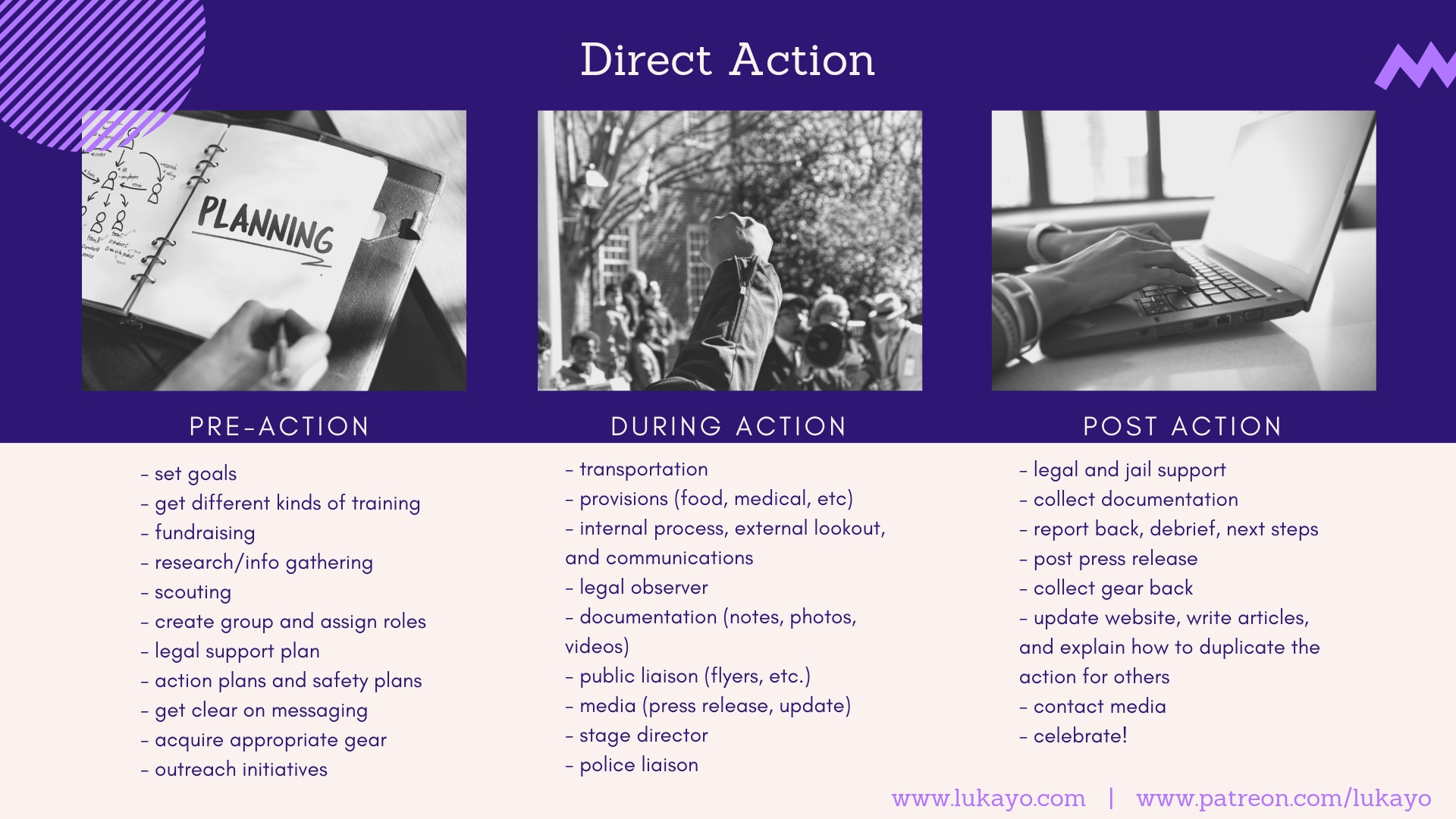
    This is a visual tool that gives the basic outline and/or check-list on putting together a direct action. Though direct actions can be violent (such as sabotage and property destruction) and non-violent (such as strikes, sit-ins, and blockades), the goal is always to stop, change, or reveal an oppressive institutional mechanism.

    This tool is best presented with the tools on Inclusive Policies & Procedures and Inclusive Programming.

    Activity Idea

    Divide the group into three, and assign each group one of each of the following posters:  Dis/Ableism 101, the Pillars of White Supremacy, and The Gender Binary. Each group then has to work as a small collective on planning a direct action against an institutional form of the oppression they were assigned.

    Poster Description

    The top half of the poster is in indigo, and the lower half of the poster is in mauve.

    In the indigo section there are pale purple graphics like a sliced up circle on the left corner and a jagged line on the right. In white there is the title “Direct Action”. Below the title are three black and white photos. The first photo has a notebook open with some drawings of stick figures and the word “PLANNING” written down by a light-skinned hand holding a pen. Underneath that photo is the word “PRE-ACTION”. The second photo has a dark-skinned fist raised in the foreground; the background has people, one holding a megaphone, in front of buildings and trees. Underneath that photo are the words “DURING ACTION”. The third photo has dark-skinned hands typing on a laptop. Underneath the photo are the words “POST ACTION”.

    In the mauve section of the poster are three columns of indigo words, as well as “lukayo.com” and “patreon.com/lukayo” at the bottom right corner of the poster in pale purple.

    The first column under the title “PRE-ACTION” has the following text:

    ” – set goals
    – get different kinds of training
    – fundraising
    – research/info gathering
    – scouting
    – create group and assign roles
    – legal support plan
    – action plans and safety plans
    – get clear on messaging
    – acquire appropriate gear
    – outreach initiatives”

    The second column under the title “DURING ACTION” has the following text:

    “- transportation
    – provisions (food, medical, etc)
    – internal process, external lookout, and communications
    – legal observer
    – documentation (notes, photos, videos)
    – public liaison (flyers, etc.)
    – media (press release, update)
    – stage director
    – police liaison”

    The third column under the title “POST ACTION” has the following text:

    “- legal and jail support
    – collect documentation
    – report back, debrief, next steps
    – post press release
    – collect gear back
    – update website, write articles, and explain how to duplicate the action for others
    – contact media
    – celebrate!”


    Want to have access to the larger full colour updated 2019 poster, the original photograph of the hand-drawn 2016 poster, and other anti-oppression related teaching tools? Click on the link below and subscribe for as little as $3/month. By becoming a patron, you support healing work among my communities, and the indigenous Elders that mentor me.

    https://www.patreon.com/posts/25012822

  • Workshop Wednesday (Pt 2): Inclusive Programming

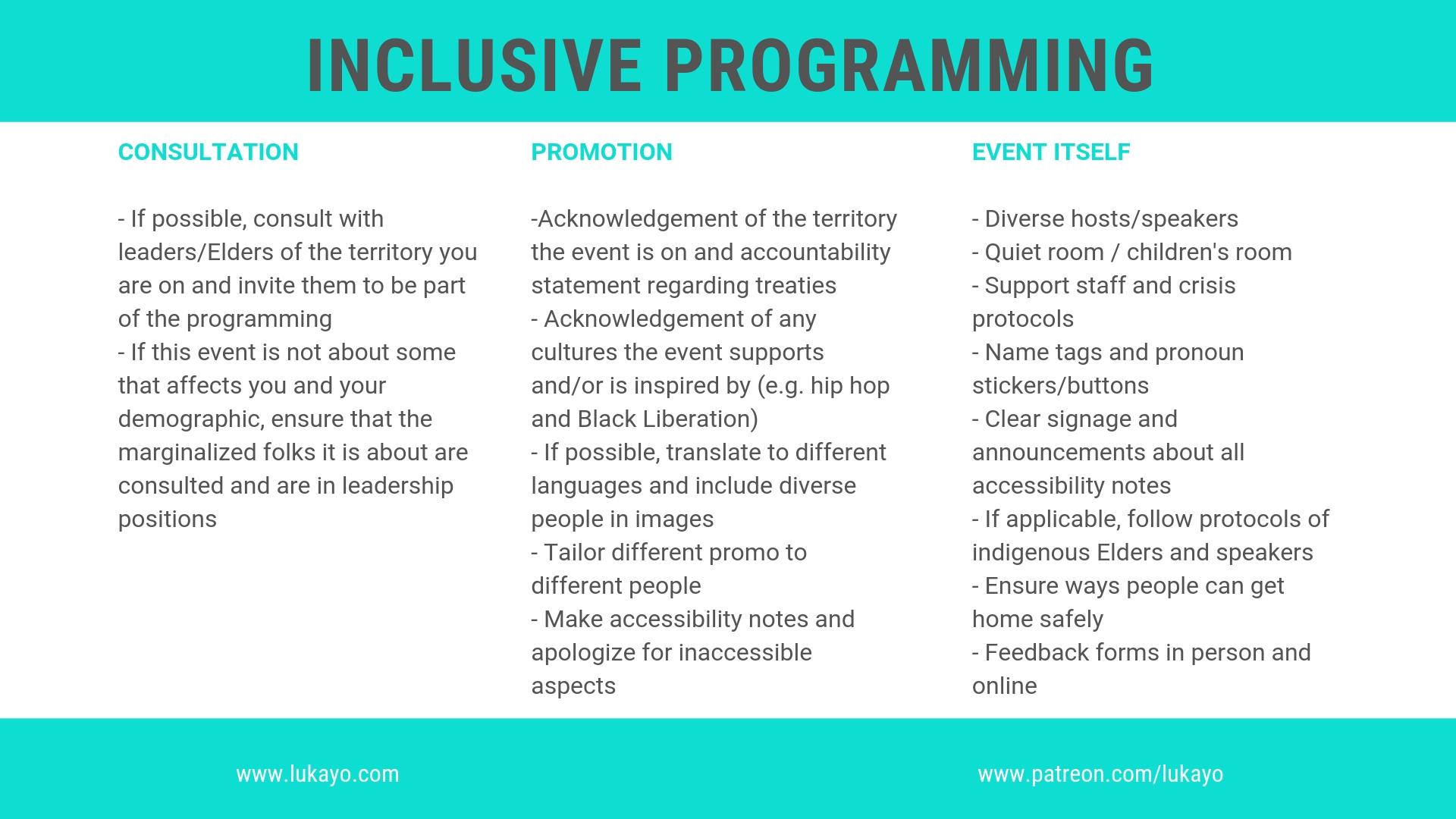
    This is a visual tool that gives the basic outline on how to plan an inclusive program or event. Ideally, events and programming would center those most affected by the issue that the event is about, as well as have them in leadership positions, so they would not have to be considered simply “included”.

    Events, whether they’re knowledge exchanges, presentations, gatherings, or celebrations, are ways that folks can build the communities and anti-oppressive world that we want. That’s why I think it’s so important that our events have to reflect our anti-oppressive theory and prevent the perpetuation of further exclusion and marginalization.

    This tool is best presented with the tools on Inclusive Policies & Procedures and Direct Action.

    Activity Idea

    Divide the group into three, and assign each group one of each of the following posters: Dis/Ableism 101, the Pillars of White Supremacy, and The Gender Binary.  Each group then has to work as a small collective on planning an event centered on or raising awareness about the specific oppression they were assigned.

    Poster Description

    The poster has a turquoise header and footer, with the center having a white background. The header, in dark grey font, has the title “INCLUSIVE PROGRAMMING”. In the footer, in white font, has “lukayo.com” and “patreon.com/lukayo“.

    There are three columns, with a turquoise title and dark grey text.

    The first column has the following text:

    “CONSULTATION
    – If possible, consult with leaders/Elders of the territory you are on and invite them to be part of the programming
    – If this event is not about some that affects you and your demographic, ensure that the marginalized folks it is about are consulted and are in leadership positions”

    The second column has the following text:

    “PROMOTION
    -Acknowledgement of the territory the event is on and accountability statement regarding treaties
    – Acknowledgement of any cultures the event supports and/or is inspired by (e.g. hip hop and Black Liberation)
    – If possible, translate to different languages and include diverse people in images
    – Tailor different promo to different people
    – Make accessibility notes and apologize for inaccessible aspects”

    The third column has the following text:

    “EVENT ITSELF
    – Diverse hosts/speakers
    – Quiet room / children’s room
    – Support staff and crisis protocols
    – Name tags and pronoun stickers/buttons
    – Clear signage and announcements about all accessibility notes
    – If applicable, follow protocols of  indigenous Elders and speakers
    – Ensure ways people can get home safely
    – Feedback forms in person and online”


    Want to have access to the larger full colour updated 2019 poster, the original photograph of the hand-drawn 2016 poster, and other anti-oppression related teaching tools? Click on the link below and subscribe for as little as $3/month. By becoming a patron, you support healing work among my communities, and the indigenous Elders that mentor me.

    https://www.patreon.com/posts/25012437

  • Workshop Wednesday (Pt 1): Inclusive Policies & Procedures

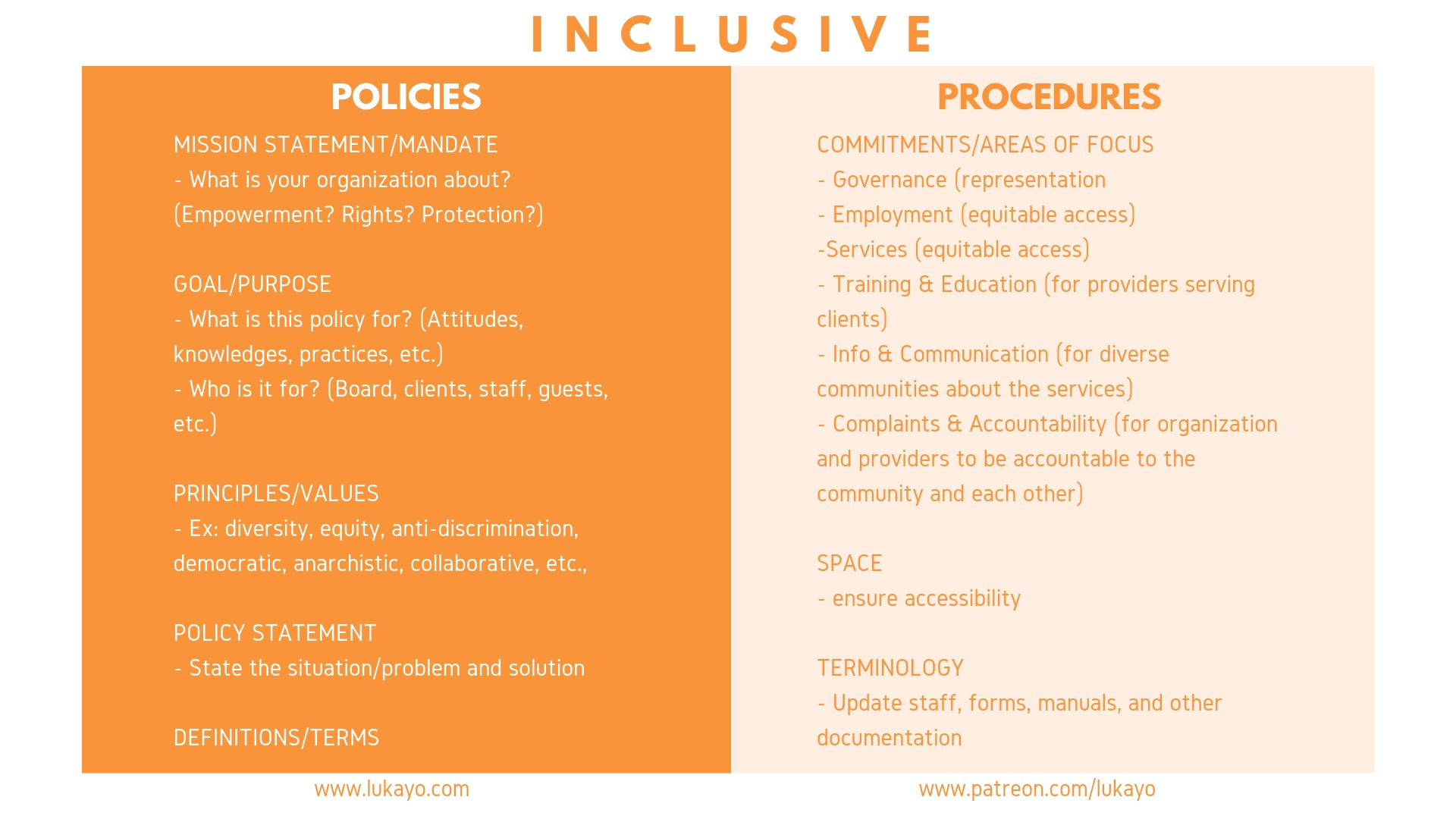
    This is a visual tool that gives a basic outline on how to plan the sections for creating inclusive policies and procedures for your organization, collective, or group. Ideally, these policies and procedures would center those most affected by the mission and ideals of the group, as well as have them in leadership positions, so they would not have to be considered simply “included”.

    Having something written down ensures that even if individual members of the group leaves, these words can continue afterwards as part of the group’s story, a record that helps guide new members to live out the group’s ideals. On top of that, when the group needs to align more with its ideals, the policies can be changed to continue to reflect the growth of the group.

    This tool is best presented with the tools on Inclusive Programming and Direct Action.

    Activity Idea

    Divide the group into three, and assign each group one of each of the following posters: Dis/Ableism 101, the Pillars of White Supremacy, and The Gender Binary. Each group then has to work as a small collective writing policies and procedures to combat the specific oppression they were assigned within their organization.

    Poster Description

    The main colours are white and orange. At the top of the post is the word “INCLUSIVE”. The is a dark orange and light orange box underneath the word.

    In the dark orange box, in white font, is the following text:

    “POLICIES

    MISSION STATEMENT/MANDATE
    – What is your organization about? (Empowerment? Rights? Protection?)

    GOAL/PURPOSE
    – What is this policy for? (Attitudes, knowledges, practices, etc.)
    – Who is it for? (Board, clients, staff, guests, etc.)

    PRINCIPLES/VALUES
    – Ex: diversity, equity, anti-discrimination, democratic, anarchistic, collaborative, etc.,

    POLICY STATEMENT
    – State the situation/problem and solution

    DEFINITIONS/TERMS”

    In the light orange box, in dark orange font, is the following text:

    “PROCEDURES

    COMMITMENTS/AREAS OF FOCUS
    – Governance (representation
    – Employment (equitable access)
    -Services (equitable access)
    – Training & Education (for providers serving clients)
    – Info & Communication (for diverse communities about the services)
    – Complaints & Accountability (for organization and providers to be accountable to the community and each other)

    SPACE
    – ensure accessibility

    TERMINOLOGY
    – Update staff, forms, manuals, and other documentation”

    At the bottom of the poster, in dark orange font, has “lukayo.com” and “patreon.com/lukayo“.


    Want to have access to the larger full colour updated 2019 poster, the original photograph of the hand-drawn 2016 poster, and other anti-oppression related teaching tools? Click on the link below and subscribe for as little as $3/month. By becoming a patron, you support healing work among my communities, and the indigenous Elders that mentor me.

    https://www.patreon.com/posts/25011935

  • Workshop Wednesday: The Gender Binary

    This visual teaching tool is based on the knowledge I received from the work of multiple writers and groups, such as b. binaohan, bell hooks, Janet Mock, Jennifer Coates, Julia Serano, Michael Warner, the Asexual Visibility and Education Network (AVEN), and the Positive Space Initiative (PSI) of the Ontario Council of Agencies Serving Immigrants (OCASI).

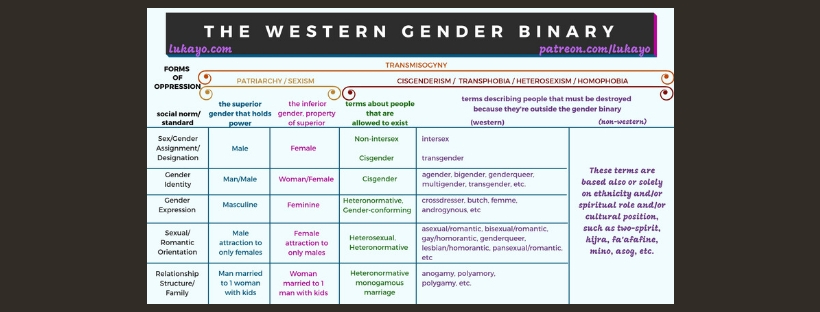
    The Gender Binary tool works best with the Oppression Triangle tool, as well as Dis/Ableism 101 and the Pillars of White Supremacy. The purpose of this poster/handout is to introduce the forms of oppression that the Western Gender Binary perpetuates, how they’re made up of social norms/standards, and the terms that go along with or disrupt the system. It may be a little advanced for folks who are just starting to understand that there are more than just two genders/sexes, but it attempts to sketch a basic outline for those who want to learn how patriarchy, cisgenderism, heterosexism, and transmisogyny are inter-related. This is also a work-in-progress that continues to evolve as our understanding of the Gender Binary and how to dismantle the violence it perpetuates continues to evolve. 

    Note: Transmisogyny refers to a specific oppression that affects folks who were assigned male at birth but identify and/or express themselves as female and/or feminine. This is different than folks who are trans, female assigned at birth, and experience misogyny and transphobia.

    Activity Ideas

    • Draw and write out a large version of the first three columns of the handout, and in chalk, pencil, or eraseable marker, work with the participants on what kind of line would be drawn through these columns based on the terms shown on the rest of the tool. For example, “heterosexual male” would look like a straight line starting from “Male” to “Man married to 1 woman with kids”. Discuss how the Gender Binary creates the threat of violence every time the line deviates from being straight.
    • Divide the participants into 3-4 groups, and have each group focus on one of the following: patriarchy/sexism, transmisogyny, cisgenderism and/or heterosexism. Have them present to each other what they understand these forms of oppression are based on their section of the handout, and how the 5 social norms influences these oppressions.
    • Divide the participants as described above, but instead of just presenting the concepts, have them choose a level of oppression (e.g. individual, cultural, or institutional) to give an example, and a liberation strategy (such as accomplices/allies, direct action, policy, programming, etc) to provide a possible way to respond to the oppressive example.
    • Draw and write out a large version of the poster, but leave most of it blank, except for the forms of oppression, the first column that has all the social norms/standards, and the headers in the first row. Everything else should be on small strips of paper or cards with tape on them that the participants must figure out together where they go on the chart.

    Poster Description

    The background is pale blue, and the title in a black box bordered by blue and pink reads “The Western Gender Binary” with online addresses underneath in purple to “lukayo.com” and “patreon.com/lukayo“. The first column of the chart in black font has seven sections: “forms of oppression”, “social norm / standard”, “Sex/Gender Assignment/Designation”, “Gender Identity”, “Gender Expression”, “Sexual/Romantic Orientation”, and “Relationship Structure/Family”. There are five other columns after this one.

    The first row for “Forms of Oppression” has the word “transmisogyny” in orange on an orange line that encompasses the five other columns, as well as the terms “patriarchy / sexism” and “cisgenderism / transphobia / heterosexism / homophobia”. The words “patriarchy / sexism” in yellow on a yellow line encompasses the first two columns only. The words  “cisgenderism / transphobia / heterosexism / homophobia”  in red on a red line encompasses the last three columns only.

    The second row that has “social norm / standard” in the first column also has the headers for the other columns. The second column is “the superior gender that holds power” in blue. The third column is “the inferior gender, property of superior” in pink. The fourth column is “terms about people that are allowed to exist” in green. The fifth column and sixth column have the same header with a slight difference. The fifth column is “terms describing people that must be destroyed because they’re outside the gender binary (western)” in purple. The sixth column is “terms describing people that must be destroyed because they’re outside the gender binary (non-western)” in purple. The sixth column does not have rows 2-7, because these terms are outside of the social norms and standards that are described in the first column.

    Under the second column called the “superior gender that holds power” in blue, the five ways it manifests with the five social norms and standards in the first column are as follows:  “Sex/Gender Assignment/Designation” : “Male”,  “Gender Identity” : “Man/Male”,  “Gender Expression” : “Masculine”,  “Sexual/Romantic Orientation” : “Male attraction only to females”, and “Relationship Structure/Family” : “Man married to 1 woman with kids”.

    Under the third column called the “inferior gender, property of superior” in pink, the five ways it manifests with the five social norms and standards in the first column are as follows:  “Sex/Gender Assignment/Designation” : “Female”,  “Gender Identity” : “Woman/Female”,  “Gender Expression” : “Feminine”,  “Sexual/Romantic Orientation” : “Female attraction only to males”, and “Relationship Structure/Family” : “Woman married to 1 man with kids”.

    Under the fourth column called the “terms about people that are allowed to exist” in green, the five ways it manifests with the five social norms and standards in the first column are as follows:  “Sex/Gender Assignment/Designation” : “Non-Intersex” and “Cisgender,  “Gender Identity” : “Cisgender”,  “Gender Expression” : “Heteronormative, Gender-conforming”,  “Sexual/Romantic Orientation” : “Heterosexual, Heteronormative”, and “Relationship Structure/Family” : “Heteronormative monogamous marriage”.

    Under the fifth column called the “terms describing people that must be destroyed because they’re outside the gender binary (western)” in purple, the five ways it manifests with the five social norms and standards in the first column are as follows:  “Sex/Gender Assignment/Designation” : “intersex” and “transgender”,  “Gender Identity” : “agender, bigender, genderqueer, multigender, transgender, etc”,  “Gender Expression” : “crossdresser, butch, femme, androgynous, etc”,  “Sexual/Romantic Orientation” : “asexual/romantic, bisexual/romantic, gay/homoromantic, lesbian/homoromantic, pansexual/romantic, etc”, and “Relationship Structure/Family” : “anogamy, polyamory, polygamy, etc”.

    Under the sixth column called “terms describing people that must be destroyed because they’re outside the gender binary (non-western)” in purple, the text reads “These terms are based also or solely on ethnicity and/or spiritual role and/or cultural position, such as two-spirit, hijra, fa’afafine, mino, asog, etc.”


    Want to have access to the larger full colour updated 2018 poster, the original photograph of the hand-drawn 2016 poster, and other anti-oppression related teaching tools? Click on the link below and subscribe for as little as $3/month. By becoming a patron, you support healing work among my communities, and the indigenous Elders that mentor me.

    https://www.patreon.com/posts/23426260

  • Throwback Thursday: Face It (2011)

    Image Description: On a pink wall there is a mirror with a pink frame. In the mirror there are partial reflections of a door way, green plants, and their shadows. The text on top of the image reads: “face it” and “lukayo.com” and “www.patreon.com/lukayo”.

    Content Warning: abuse, substance abuse, self-harm

    it
    is like
    trying to construct my future
    out of the photos of someone else’s past
    fooling me into thinking the pieces fit
    just because they’re in rectangular blocks
    as if I can really build something here
    outside of the playground of
    rusty abandoned expectations
    and the raw failings of the strangers who raised me
    as long as none of the pictures carry
    my
    own
    face

    it
    is like
    staring into a mirror engraved with the lines
    of his left eye, my features distorted by
    the shape of his pupil
    sclera background and iris-bright
    believing that there’s a ghost of me
    living in his head for keepsake
    cuddling his corpus callosum
    and tickling his medulla oblangata
    till all his thoughts are watermarked with
    my
    own
    face

    it
    is like
    screaming
    in an abandoned park mountaintop at midnight
    face-in-pillow empty nest heartbreak
    1st therapy session
    1st rock concert
    1st triple orgasm
    while phantom ex-lovers demand Scott-Pilgrim-like duels
    and current lovers become disruptor shields
    and a makeshift secret treehouse
    build around the weathered bark of
    my
    own
    face

    it
    is like
    her kisses know all the passwords
    her ears trace confessions in my throat-pulsing moans
    her fingers caressing these weary cheekbones
    and button up nose and whip eye lashes
    and cracked slam-spitting lips
    till I grasp after her touch
    by getting reacquainted with
    my
    own
    face

    it
    is like
    the persistent penny in my pocket
    reminding me to save
    my
    own
    face

    it
    is like
    breathing through the
    bruises of disrespect and the
    hollows of self-neglect
    trying to recognize
    my
    own
    face

    it
    is like
    finally feeling safe enough
    to peel off the designer brand new skin,
    armoured make-up, too cool for you look
    and reveal dreams that live on
    my
    own
    face

    it
    on
    my
    own

    face it

    …

    darling

    I am so sorry
    that I left you behind
    that I gave you away
    that I told you to trust them
    and believe them and obey

    I am so sorry
    that I told you love was sacrifice and pain
    that you were worthless if you
    couldn’t make them stay

    I am so sorry
    I starved you of touch, food, and rest
    because I thought you weren’t good enough yet

    I am so sorry
    that when you were crying
    I drowned you with beer and
    other people’s fists to keep you quiet

    I am so sorry
    I only wrote you lines fit
    for a bit part tragic villain

    I am so sorry
    I told you no one would ever be willing
    to love
    that
    kind of
    face

    it was wrong

    face it

    I was wrong

    I couldn’t see what was right in front of
    my
    own
    face

    it

    is the promise

    that from now on

    no more shaming
    no more denying
    no more punishing
    no more lying
    no more running
    from this reflection that cannot be erased

    this is the promise

    to love on my own

    this is the promise

    to love face-to-face


    Wanna hear the rest of the poem? Better yet, want to commission me to write a poem for you? Click on the link to become a patron. For as little as $1/month you can support healing work among my communities, and the indigenous Elders that mentor me.

    https://www.patreon.com/posts/throwback-face-23322261

The site will be down Thursday, July 30th from Noon until 4pm EST for webhost transfer and maintenance.

Close Welcome Bar