Author: Lukayo

  • Homecoming to Leader & Trickster [Patreon Excerpt]

    Introduction

    This article is an elaboration and continuation of Pagliwanag: Homecoming Teachings, and is the last out of three articles which focus on the topic. Each clarification article describes the core of one of the axes in the Homecoming Teachings, then goes into how one can get lost from the Centre, and finally how one can come home to the Centre using Revelation, Embodiment, and Practice. Please read the original article first so as to get the full context of this one.

    These teachings can be learned and practiced by oneself if absolutely necessary, but it’s strongly advised to work them out with another person or a group of people. These teachings can be considered therapeutic, but they are meant to be collective suggestions and guidelines for healing justice, especially around personal and collective soul wounding (trauma) and the transformation of oppression demons (internalized oppression).

    The Axis of Expression

    The axis of the Upperworld & Underworld is about our expression. When I’m writing about expression, I am talking about understanding the needs and boundaries we learned from the Healer and Protector, as well as the knowledge we gained from the Visionary and Seeker, and then acting and communicating all of that to the world around us, to all our relationships within ourselves and among our communities. 

    For example, I have the capacity to express myself verbally using my mouth, in a few different languages. I also can write symbols down to mean words and concepts, some of them representing languages I can speak, some of them representing concepts that are not part of a language. But my clothes are also a form of my expression– what I choose to wear, what they look like, how I wear them, when I wear them. My body gives off a type of language in its gestures, but also in its actions. When I’m picking something up, when I’m pulling or pushing something, when I’m running or walking or crawling or using a mobility aid — these all express something about myself. My face also expresses itself without words, such as the way my mouth quirks, my eyes narrow or widen, my eyebrows lift or come together, my brow furrows, and my nose crinkles. My hands can make movements and also sign a language. Lastly, where and when I put my body, the spaces my body takes up, the times my body exists and what it is doing during those times, these are all expressions.

    How I express myself directly comes from my values and my purpose, which is at the Centre of these teachings. These values and purpose give me a sense of responsibility, which is then expressed through Service, while my purpose also has a wildness to it, which then is expressed in the cycles of Change. I act and speak about my values and purpose, which is shared and recognized by my Community — but they can only share in it and celebrate me if I’ve expressed to them those values and purpose first. This doesn’t just mean that I say the words; this also means that I have acted in ways where the Community has witnessed my values and how I manifest my purpose in the world. Community feedback then informs me on how I can live my values with more integrity, and manifest my purpose with more effectiveness and care. This purpose still is wild, and subject to the cycles of life and death, activity and rest, and the flow of reality. It is a continuing manifestation, a process that unfolds through daily, weekly, monthly expressions from my body-mind-soul.

    Getting Lost

    When individuals and communities are attacked by their personal demons, community demons, and/or oppression demons, the soul wounding (trauma) that occurs pushes people away from the Centre, and they get lost far into the Upperworld or the Underworld. This means their expression is no longer aligned with Service and Change, their purpose and their values, but instead becomes focused on Control and/or Irresponsibility. 

    For example, when I get lost in the Adversary, I become irresponsible, and lack impulse control. I only want to answer to my own feelings, so how I express it is through a series of whims and acts of defiance to anyone I perceive is trying to restrict my expression. I may act in defiance of my own self, expressing a desire and attaining it due to my feelings, even if it will hurt my own body. I don’t care about purpose, or values, or being in a Community. I care about just speaking and acting based on what moves me, and challenging anyone that tries to stop me, even myself. When I’m an Adversarial Destroyer-Martyr, I may pick a fight with any person I regard as trying to exert authority over me or I may express my “truth” regardless of the consequences on myself and other people, because what matters most is what I know and say is right. When I’m an Adversarial Fugitive-Hermit, I may take whatever I want from the world, whether it’s an experience, a substance, a behaviour enacted on someone else’s body, and I may leave anyone or anything that bores me. 

    When I become lost in the Tyrant, I become controlling, and am driven by fear and rage to express myself in ways that will defy the cycles of change. When I’m a Tyrant, I believe that if I can control the people around me, if I can control as many variables in the environment and in my own body, I can stop people from abandoning me, hurting me, leaving me, dying on me. I believe I can stop losing things inside myself and outside of my life. I don’t care about purpose, or values, or being in Community. What matters is imposing order according to what I believe is orderly. When I’m a Tyrannical Destroyer-Martyr, I may manipulate people to get what I want through intimidation or seduction, pity or admiration. The words I say, the actions I take, are all so that people’s behaviour towards me is predictable and controllable. This manipulation also extends to every non-human in the world — I want things to be static, or at least, if something is going to change, it changes when and how I want it to. When I’m a Tyrannical Fugitive-Hermit, I must know as much as possible what’s going to happen, or how things work, with the end goal of being in control of the situation because I “know how it ends”, and I can plan my expression accordingly.

    In the colonial world, the Adversary’s behaviours can be understood as a slew of different kinds of impulse control disorders, or impulsivity and narcissism in general — though the attachment style is decidedly avoidant. The Tyrant’s behaviours in the colonial world can be understood as an anxious attachment style, with a tendency towards obsessive-compulsion. Also, some disorders or syndromes that can look like the poor impulse control of the Adversary, may actually be the manipulation of the Tyrant — such as certain diagnoses of psychopathy, antisocial personality disorder, borderline personality disorder, and narcissistic personality disorder. In many cases, folks can swing back and forth from Tyrant to Adversary, as they respond to their emotions by alternating expressions of impulse chasing or by controlling other people. However, whole communities in the colonial world can get lost in the Adversary or Leader, goaded by community demons and oppression demons. 

    Communities become lost in the Adversary when they revolve around entitlement — they prioritize their own freedoms against other communities and also against other community members. They may also foster a culture where everything is up for debate, including the humanity and dignity of other human beings. Adversarial Communities can be created by oppression demons, but they can also have started as liberation and resistance movements that became so entrenched in being oppositional instead of realigning with purpose and values.

    Communities become lost in the Tyrant when they believe and enforce unjust hierarchies, attempting to create “order” through surveillance, policing, punishment, and reward. These communities have a culture of constant and overt fear, or fear hidden under moral outrage and vengeance-thirsting. Tyrannical Communities tend to be shaped by oppression demons, and even activist and progressive groups can become Tyrannical if they focus on controlling community members instead of celebrating everyone’s unique purpose and making decisions based on collective values.

    Revelation

    The first part of the Homecoming Teachings, to begin a person and their community’s return to Centre, is Revelation — for the Axis of the Upperworld & Underworld, it means creating space and time for authentic expression.

    In the colonial world, if you are a person whose community may also be lost or wounded, so they cannot perform a ritual or ceremony to help bring you back to the Centre, then you can start by connecting your mind to your ancestors and to the land, as well as to non-human guiding spirits that mentor you in your purpose.

    In regards to the ancestors, you may prefer doing a DNA test (though this does not mean you can claim a culture automatically due to DNA), or looking at records and interviewing living family members. Another way to get information, if you already know a bit about your ancestry, is to research what has been written about your ancestral lineages in broad strokes, such as those from the same region or from the same culture or from the same religion. Lastly, as much of the specific history of your deceased family members, and the broader history of generations of your ancestors should be learned, if possible. Remember: this is about learning ancestry and ancestral cultures, but this does not mean you can claim a living culture because different cultures have different protocols and histories of re-adopting or recognizing someone raised outside of the culture.

    In regards to the land, you can start by seeking out and connecting to the sacred spots or power areas of the land by reading articles and books, or attending organized tours and going to museums (note: many museums are historical sites of oppression and colonization demons, so be careful about which exhibition you attend). If you are on stolen land, learn about the indigenous peoples of the land, what they considered sacred, and find out what are the treaties or protocols to build a respectful and reparative relationship, though a an easy start may be to volunteer at and donate to a local Native Friendship Centre or pow wow. 

    In regards to non-human spirits, perhaps there is a pagan pantheon that your ancestors already were connected to, or a religion, or a spiritual practice. Read the histories of the non-human spirits that your ancestors already have a connection to. Perhaps you already have a connection to non-human spirits as well, that were never connected to your ancestors. Regardless, once you can pinpoint some that resonate with you or may mentor you in your purpose, research what was written or talked about in regards to how these spirits viewed family, community, and service. How did they serve humans? How did humans serve them? From what you understand of your own purpose, how can your purpose be of service to humanity based on the traditions you’ve been researching?

    To connect to your heart and spirit, Revelation should also include a journey into the spirit world (if you are trained in spiritwork). If you are not trained in spiritwork, you can try a visualization exercise similar to what I’ve written below.

    [This section was taken out for this excerpt.]

    Remember to set an alarm if you can, so that you can then return through the gate back to your Centre and thank and say goodbye to your new guide, before your next activity for the day. 

    Revelation is a constant unfolding, and you can also move on to Embodiment and Practice while you continue to develop an understanding of these teachings. You can also attend workshops or sessions that I run on these teachings specifically.

    If you feel that you also need to bring your community into this Revelation, you can organize a workshop or skillshare about ancestor work, land reconnection, indigenous solidarity, and/or service that can be facilitated by you (depending on how far you’ve continued in this practice or returned to Centre) or by someone that you know embodies the energies of Leader and Trickster, and has the capacity to relay these Revelations. Having this group gathering, even if it’s not a formal ritual or ceremony, also supports your own Homecoming, in addition to your community’s.

    Embodiment

    The Upperworld & Underworld Axis is connected to the upper and lower halves of our bodies. If the center, our core, is our solar plexus, that includes our major internal organs like our heart and genitalia, then our upper half is our upper chest, upper back, arms, shoulders, neck, and head. Our lower half is our hips, legs, and feet. Our lower half touches the ground more often and connects us to the Underworld. Our upper half is the closest to the sky, and connects us to the Upperworld.

    Here are some embodiment activities that you can choose from based on how your body reacts. This means that your body expands, relaxes, or moves forward when you read or say aloud the activity, as opposed to a negative reaction that can look like your body contracting, stiffening, freezing up, or moving backward. You may also have a pattern that’s different from this that you’ve already observed in your body when it chooses something or refuses it.

    • In a comfortable position (sitting or standing preferred), focus your attention and energy on your feet (or whichever part of your body is closest to the ground), and feel your energy sink into the ground, connecting with the earth and Underworld. Thank the earth and the Underworld as the energy that is now mixed with the land and ancestors begins to travel up your feet, to your knees and hips, up to your genitalia, lower spine and stomach, and crossing over to the upper spine and chest and heart. The energy and attention continues to rise, and if you have arms and the capacity to move them, raise your hands over your head as the energy flows from your shoulders to your neck and elbows, and then to the top of your head and your fingertips. Once you’ve reached the part of you closest to the sky, you push the energy upwards, giving thanks to the sky and Upperworld as that energy flows upwards. Then begin to receive the energy from the Upperworld and sky through your fingertips and the top of your head, and bring the energy back down the way you came, all the way through your feet and into the earth. Give thanks and love to your body as you do this. 
    • If you are familiar with herbalism and crystals, you can ethically harvest or acquire herbs and crystals that focus on self-expression, communication, service, and/or getting in touch with your innate wildness. You can draw a grid that is your body and put the crystals on that grid, making sure you have the same crystals and herbs on the upper half of your body as you do on the lower half. You can make ointments or oils from the herbs and anoint both the lower half and upper half of your bodies. Make sure you give thanks and love to your plant helpers and stone helpers as you do the work.
    • If you are practiced with sigils or drawing symbols, you can draw symbols or sigils of your ancestors, of self-expression and communication, of service, or of wildness on the upper and lower half. For example, if you’re going to draw a specific sigil on your left hand, make sure you draw the identical one on your left foot. 
    • If you are comfortable and have the capacity for dancing, find a clear place where you can stretch out both the lower half and upper half of your body. Then begin to move (with or without music), orienting towards what feels pleasurable for your body, and pay specific attention to how your lower half responds to your upper half, and vice versa, as they dance in tandem or alternately.

    When you are doing Embodiment in a community setting, you or a trusted facilitator can do the above practices together, explaining before you begin that these activities have the intention to connect deeper into our values and expression. At the end of the activity, the group can journal together and have a discussion about what came up for them. Some communities may already have rituals and ceremonies that incorporate Embodiment activities as a way to bring individuals or their whole community back to the Centre.

    Practice

    Traditionally, many communities would have a respected leader or trickster that you could study from or apprentice to so that you could practice the teachings of Trickster and/or Leader. If you don’t have that option, you could watch internet videos or sign up for classes involving leadership skills, giving good service, rewilding, the cycles of life and death, reconnecting to pleasure and play, improvisation, general self-improvement, finding your purpose, connecting to your values, revolution, stand up comedy, and so much more. You can watch documentaries/movies and read articles/books on historical or fictional figures that embody your values as an ideal Trickster and/or an ideal Leader. From these experiences, you can also come up with your own set of practices, and then journal what changes for you as you do the work and your practice transforms into habit.

    Here’s examples of my own Leader practices:

    • When I join any kind of group, whether it’s a team at a paid job, or a household, or a grassroots collective united by a cause, I try to ask folks to think about what our shared values are, write them down, and discuss them. I also ask for everyone to discuss their different personality styles, their conflict styles, their triggers and access needs, and how to build group accountability from all of that.
    • I’m building a habit of checking in with each of my decisions before I make them to understand who else is affected by them, and then trying to check in and get input from everyone who will be affected by my decision.

    Here’s examples of my own Trickster practices:

    • I try to carve out a time every week, every month, or every year where I can relax in my own home or in another area, by not having anything planned or scheduled, and not having immediate and urgent responsibilities. In those moments, whether it’s an hour, a weekend, or a full week, I allow an authentic expression of self, and the throwing off of social norms that I find stifling and controlling (as long as rejecting these social norms during this place and time doesn’t cause harm to myself and others).
    • I have a yearly feast for my ancestors and seek guidance and messages from the dead during the feast. I also have a yearly feast for all my non-human spirit companions, and at least one yearly event I attend or support that nourishes the land and celebrates indigenous people, especially seeking justice against settler colonial states.

    If you’d like your community to enact more Trickster and/or Leader practices, you (or find a trusted teacher/facilitator who) can organize a gathering or ceremony of initiation. Initiation specifically gets folks in touch with ancestral guidance, non-human spirits, and their purpose. Initiations may involve a series of tests or trials, or a journey through unknown areas of the land, all with the intention to remember and realign with your purpose that may have been assigned right before your birth. Initiations may also involve visiting all the important ancestors and spirits that have and are mentoring you, receiving blessings and teachings. For me, as someone who still struggles constantly with getting lost in the Adversary or the Tyrant, it is so crucial for me to be part of initiations with others that balances and brings us all home in the cycles of Change and Service to each other.


    Want to read the full article? Become a patron on Patreon for as little as $1/month to support my Elders and healing work among my communities. $5/month, and you can get an audio recording/podcast of the livestream chat about this article with community members on our free Discord server. (If you want to join the Kinaban Discord server, send me an email!)

    https://www.patreon.com/posts/42573440
  • Homecoming to Seeker & Visionary [Patreon Excerpt]

    Introduction

    This article is an elaboration and continuation of Pagliwanag: Homecoming Teachings, and is the second out of three articles which will have a similar format. Each clarification article will describe the core of one of the axes in the Homecoming Teachings, then go into how one can get lost from the Centre, and finally how one can come home to the Centre using Revelation, Embodiment, and Practice. Please read the original article first so as to get the full context of this one.

    These teachings can be learned and practiced by oneself if absolutely necessary, but it’s strongly advised to work them out with another person or a group of people. These teachings can be considered therapeutic, but they are meant to be collective suggestions and guidelines for healing justice, especially around personal and collective soul wounding (trauma) and the transformation of oppression demons (internalized oppression).

    The Axis of Knowledge

    The axis of the East & West is about our knowledge. When I’m writing about knowledge, I am talking about how we experience the world around us through whatever senses we have available from our bodies and our soul(s), and then how we interpret that with our emotional and mental faculties. These interpretations also are held up against our values and purpose, our community’s knowledge, and the wider knowledge of society. 

    For example, I am sighted, and use my eyes to see shapes and colours. With the use of the nerves in my skin I can feel the texture of what’s near me or on me. I am a hearing person, and with my ears I pick up vibrations that I call sounds. Then my mind begins to discern what all these things are, putting them into categories, interpreting them into larger patterns and making meaning out of them. This is the colour purple. This sweater is soft. The wind is blowing through the trees. But I also have a dream where I experience sensations and images just like when I am awake. I also close my eyes or stare off at a point when I’m awake and still receive visions beyond what my body can sense.

    How I acquire or receive knowledge directly comes from my values and my purpose, which is at the Centre of these teachings. I value all my experiences and knowledge, and I value my ancestors and spirits, so I interpret patterns within both my dreams, visions, and sensations as also containing messages from my ancestors. I also interpret larger patterns. In addition, my knowledge of the world takes into account Service and Change. I am in service to my communities and I interpret patterns in hopes that there will be some gift I can return to my community with. Yet, I also know that the world and my capacity to experience and interpret the world is constantly changing, and to be open to the present as a constant updating of what I know and what I don’t know. Change also represents the cycles of being active in experiencing and knowledge gathering, and spending time to process and rest.

    Getting Lost

    When individuals and communities are attacked by their personal demons, community demons, and/or oppression demons, the soul wounding (trauma) that occurs pushes people away from the Centre, and they get lost far into the East or the West. This means their reception of knowledge is no longer aligned with Service and Change, their purpose and their values, but instead becomes focused on Control and/or Irresponsibility. 

    For example, when I get lost in the Hermit, my desire to control my experiences of the world overrides my responsibility to the community around me. I want to limit my experiences of them– maybe out of fear, maybe out of spite, maybe out of boredom. This can look like literally spending as little time as possible with other living human beings, and not sharing the knowledge I am gaining through my own reflections, introspections, studies, visions, and dreams. Perhaps it can also look like refusing to reflect and introspect, but go through the days in an automatic routine, taking comfort in the control, even if there is no learning or growing, even if it only leads to self-stagnation and self-exile. When I am lost in the Hermit, I am forever in retreat.

    When I become lost in the Fugitive, my desire to control my experiences of the world still overrides my responsibility to the community around me, but in this case, I’m not trying to limit my experiences, I’m trying to gain as much as possible, either in quality or quantity. I may throw myself into a new thrill, a new sensation, a new adventure every day, regardless of my commitments to my communities or to my long-term goals. I may completely focus on a substance or behaviour, and pursue it to the detriment of my body and my communities’ security and stability. Maybe I do this out of fear, or boredom, or restlessness. But no matter where I go, what I do, it’s never enough. When I am lost in the Fugitive, I am forever running away.

    In the colonial world, the Hermit’s behaviours can be understood as dissociation and/or avoidant attachment styles. The Fugitive’s behaviours in the colonial world can be understood as addiction, obsessive-compulsive tendencies, and anxious attachment styles. However, whole communities in the colonial world can get lost in the Hermit or Fugitive, goaded by community demons and oppression demons. 

    Communities become lost in the Hermit when they create an “echo chamber” for themselves, refusing to accept new information outside of their shared world view. They are hostile to who they perceive as “outsiders”, and will exile trusted members of their own community if they try to introduce new experiences, evidence, or knowledge that could challenge or even add to the existing traditions. Part of this can be spurred on by oppression demons of racism and xenophobia, but some communities may have started off using this as a defense against such bigoted influence, and then become lost in the desire to control what people know and experience, instead of realigning with values and accepting that change is a part of growth.

    Communities become lost in the Fugitive when they want to take knowledge from other communities instead of a respectful exchange. Fugitive communities become irresponsible to their own past and traditions, as well as to the boundaries of the communities around them, and instead want to control their knowledge and experience through expansion and conquest of others’ traditions. This can look like cultural (mis)appropriation and toxic tourism culture, but on a larger scale it can look like exploitative, neocolonial practices from corporations and non-profits. A complex web of oppression demons and community demons wounding a community culturally can push whole groups of people into running from their collective past — from the pain as well as the gifts — and into extracting to fill up an emptiness that seems unending.

    Revelation

    The first part of the Homecoming Teachings, to begin a person and their community’s return to Centre, is Revelation — for the Axis of the East & West, it means developing, receiving, and seeking Knowledge.

    In the colonial world, if you are a person whose community may also be lost or wounded, so they cannot perform a ritual or ceremony to help bring you back to the Centre, then you can start by learning about your community’s traditional knowledge and practices, an exercise of the mind. (The next article about Homecoming Teachings for the Underworld & Upperworld will go deeper into Ancestor Work, however you can also start with that work in the Axis of Knowledge.) Finding primary sources may look like information on archaeological digs, dictionaries written by colonizers who made “first contact”, and scholarly articles compiling research on existing literature on the subject. There may be documentaries, social media groups, and conferences where this information can be found. You can also research epistemology (the study of human knowledge itself), if that calls to you, whether it’s the Indian schools of thought on pramana or the Greek writings of Plato and Aristotle, or the European philosophers like Locke and Descartes. I definitely studied different epistemological philosophies, but found the most significant understandings were from my ancestry, in our creation stories and teachings I could find from ancestors and elders studied by European anthropologists. I also strongly encourage receiving a basic understanding on what is and isn’t cultural (mis)appropriation before beginning this search for knowledge, and also to understand knowledge’s ethical boundaries.

    To connect to your heart and spirit, Revelation should also include a journey into the spirit world (if you are trained in spiritwork). If you are not trained in spiritwork, you can try a visualization exercise similar to what I’ve written below.

    [This section was taken out for this excerpt.]

    Remember to set an alarm if you can, so that you can then return through the gate back to your Centre and thank and say goodbye to your new guide, before your next activity for the day. 

    Revelation is a constant unfolding, and you can also move on to Embodiment and Practice while you continue to develop an understanding of these teachings. You can also attend workshops or sessions that I run on these teachings specifically.

    If you feel that you also need to bring your community into this Revelation, you can organize a workshop or skillshare about your community’s traditional stories and practices that can be facilitated by you (depending on how far you’ve continued in this practice or returned to Centre) or by someone that you know embodies the energies of Seeker and Visionary, and has the capacity to relay these Revelations. Having this group gathering, even if it’s not a formal ritual or ceremony, also supports your own Homecoming, in addition to your community’s.

    Embodiment

    The East & West Axis is connected to the front and back of our bodies. The front is the East because that is where the sun rises, and the front is when we face the day. The back is the West because that is where the sun sets, and when we lie down on our backs to rest. If you are nocturnal, perhaps the West represents your front, and the East represents your back. Regardless, the point is to balance the cycles of activity and rest.

    Here are some embodiment activities that you can choose from based on how your body reacts. This means that your body expands, relaxes, or moves forward when you read or say aloud the activity, as opposed to a negative reaction that can look like your body contracting, stiffening, freezing up, or moving backward. You may also have a pattern that’s different from this that you’ve already observed in your body when it chooses something or refuses it.

    • In a comfortable position (sitting, standing, or lying down), focus your attention and energy on the front of your feet (if you have feet and can feel them), and feel your attention and energy gather like a small sun, filled with light and warmth. Let this energy rise — spread from the tops of your feet up the front of your ankles, your shins, knees, thighs, genital area, palms, wrists, stomach, arms, shoulders, throat, face, and then over the top of your head. Now the energy begins to set — travelling down the back of your head and neck, down your spine and the backs of your arms and elbows and hands, traversing your buttocks, the back of your thighs and knees, down your calves and heels, to end at the bottom of your feet. You may also want to start at the top of your head and go down your back, and end with rising from your feet and ending at your head. You may not have or feel your legs and/or your arms, in which case simply focus on the body parts you do have access to. Give thanks and love to your body as you do this. 
    • If you are familiar with herbalism and crystals, you can ethically harvest or acquire herbs  and crystals that connect to knowledge, dreams, and visions. If you want to create a representation of yourself to place herbs or crystals on, make sure that it has a front and back — perhaps a three-dimensional effigy or a doll, or a wood etching that stands upright, with the front and back clearly marked. You can make ointments or oils from the herbs and anoint both the front and back of your body, or take a herbal bath and wash both the front and back. Make sure you give thanks and love to your plant helpers and stone helpers as you do the work, as well as any elements you work with.
    • If you are practiced with sigils or drawing symbols, and have a friend to help you, you can have symbols and sigils of knowledge, vision, dreams, and wisdom drawn on the front and the back of you, for example the front and back of your left hand, or on your chest and upper back. Make sure the symbols are aligned. 
    • If you are comfortable with and have the capacity for dancing and/or exercise, find a clear place with a mat or spongy floor where you can lie on your back and do stretches or move your limbs and hips to the music. Then roll onto your stomach and do stretches and movements that way, which can involve planking or doing push-ups. If water is easier for your body instead of the ground, and you know how to swim and/or float, practice floating and/or swimming on your front and on your back. The goal is to thank your body, the earth and/or the water, and orient to what feels pleasurable in the movement.

    When you are doing Embodiment in a community setting, you or a trusted facilitator can do the above practices together, explaining before you begin that these activities have the intention to connect deeper into our values and knowledge. At the end of the activity, the group can journal together and have a discussion about what came up for them. Some communities may already have rituals and ceremonies that incorporate Embodiment activities as a way to bring individuals or their whole community back to the Centre.

    Practice

    Traditionally, many communities would have a respected person who receives visions and interprets dreams or a person that travels and gathers knowledge ethically that you could study from or apprentice to so that you could practice the teachings of Visionary and/or Seeker. If you don’t have that option, you could watch internet videos or sign up for classes involving lucid dreaming and dream interpretation, oracular divination, trance work, meditation and mindfulness (that honours the Asian lineage that it comes from), the etiquette of travel, traditional guest protocols, how to work with plant medicines, media literacy and critical thinking, and research ethics (“R-Words: Refusing Research” by Tuck and Yang is a great essay to read online). You can watch documentaries/movies and read articles/books on historical or fictional figures that embody your values as an ideal Visionary and/or an ideal Seeker. Lastly, I strongly suggest also keeping a journal or scrapbook to bring all of these practices together in compiling the knowledge you are learning and the wisdom you wish to preserve that aligns with your values and that may be of service to your communities. From these experiences, you can also come up with your own set of practices, and then journal what changes for you as you do the work and your practice transforms into habit.

    Here’s examples of my own Seeker practices:

    • No matter what I am doing, it’s always an opportunity to be meditating and intentionally experiencing the world in the present moment as it is, even while I am conscious of how I am interpreting everything through my thoughts, my memories of the past, and my hopes for the future. This practice assists me in being aware of all the different ways I am taking in experience and knowledge simultaneously while I am awake. It also helps me build a secure attachment with Creation itself, and that I am moving towards Creation and not running from it or myself.
    • Whenever I exit my house, I am now a guest somewhere else, and try to act with courtesy and gentleness to the environment around me, even as I also take safety precautions based on my understanding of the area. When I am in a human-made area, I try to understand what the rules are (where to walk, what is for cars, which buildings can I enter, do I need money or ID, etc.). When I am in places that may not necessarily be human-made, like a forest, I try to give an offering or libation, or at least say “tabi-tabi po”, which in one of my native languages is just saying “excuse me, I’m passing through” to the spirits of that place.
    • When I encounter new information and knowledge, I reflect on it critically, try to find other sources that can verify it, see if I can verify it myself through first hand experience, and then find community members I can share it with to determine if it is valuable and important to the thriving and growth of my communities.
    • When I have a new experience, I immediately try to process it with a community member to see if it is something they’ve gone through before. This helps me and my communities understand how to make sense of the experience and to see if it is valuable and important to our thriving and growth.  

    Here’s examples of my own Visionary practices:

    • I have a journal where I record all of my dreams, divinations, and visions. I study it from time to time, reflecting on the messages and wisdom that’s being shared, and checking in with my communities around their importance and value.
    • I try to go on a monthly retreat, which can look like being in my own home or another location, fasting or on a special diet, having no contact with information technology or social media for at least 24 hours, being on a vow of silence, and spending the time meditating, praying, journaling, reflecting, doing spiritwork, creating something, and resting. I share what I’ve learned during retreat with community members during an appropriate time. 

    If you’d like your community to enact more Visionary and/or Seeker practices, you can (or find a trusted teacher/facilitator who can) organize a gathering or ceremony of group dream journeying and/or knowledge sharing. This could also look like a skillshare against oppression demons done as a seeker’s ritual, and a collective visioning done as a dreaming ritual or group retreat. I still struggle with getting lost in the Hermit and Fugitive all the time (though these days with the pace of capitalism demons and the internalized ableism possessions, I get more lost in the Fugitive), and it is so crucial for me to be in group retreats that help me realign with the values of my community, to understand the cycles of rest and activity and change, that I have made it my life’s work to organize retreats in service to my communities, so that we can all come home to the Centre together.


    Want to read the full article? Become a patron on Patreon for as little as $1/month to support my Elders and healing work among my communities. $5/month, and you can get an audio recording/podcast of the livestream chat about this article with community members on our free Discord server. (If you want to join the Kinaban Discord server, send me an email!)

    https://www.patreon.com/posts/41869534

  • Homecoming to Healer & Protector [Patreon Excerpt]

    Introduction

    This article is an elaboration and continuation of Pagliwanag: Homecoming Teachings, and is the first out of three forthcoming articles which will have a similar format. Each clarification article will describe the core of one of the axes in the Homecoming Teachings, then go into how one can get lost from the Centre, and finally how one can come home to the Centre using Revelation, Embodiment, and Practice. Please read the original article first so as to get the full context of this one.

    These teachings can be learned and practiced by oneself if absolutely necessary, but it’s strongly advised to work them out with another person or a group of people. These teachings can be considered therapeutic, but they are meant to be collective suggestions and guidelines for healing justice, especially around personal and collective soul wounding (trauma) and the transformation of oppression demons (internalized oppression).

    The Axis of Needs

    The axis of the North & South is about our needs. When I’m writing about needs, I am talking about something that, when taken from you or is not fulfilled, immediately diminishes or endangers your quality of life. I separate this from “wants”, which, when added, can increase your quality of life, but will not endanger or diminish it if you don’t have it. Boundaries are also a form of needs, specifically, they are what should not happen, otherwise it would diminish or endanger your quality of life.

    For example, I have a need for breathable water, drinkable air, and food with nutrients. I also have a need for loving touch and emotional support. When I don’t have these needs, my life is in danger, or severely diminished. Things I want: someone to play horror videogames with, fantasy books involving Tagalog mythological creatures having polyamorous relationships, and a service robot. If I didn’t get any of these things, I’m going to be okay, but if I did get them, I’d have a lot more fun. My boundaries, on the other hand, include not being physically attacked, not being verbally abused through name-calling and condescension, and not being lied to within intimate relationships in regards to significant decision-making matters. If my boundaries are violated, I am hurt and need to say something or adjust my behaviour for my protection.

    My needs and boundaries are directly coming from my values and my purpose, which is at the Centre of these teachings. I value life and thus attempt to protect it physically and nourish it with water and food. I value honesty, so I request not to be lied to. I value relationships and community, and so I cultivate touch and emotional connection, and I request not being verbally attacked. In addition, my needs and boundaries take into account Service and Change — that I also am in service to the needs and boundaries of my communities, and that I can advocate for needs and boundaries, but sometimes things will happen outside of my control and to make peace with the cycles of change, such as how death is a part of life.

    Getting Lost

    When individuals and communities are attacked by their personal demons, community demons, and/or oppression demons, the soul wounding (trauma) that occurs pushes people away from the Centre, and they get lost far into the North or the South. This means their needs and boundaries are no longer aligned with Service and Change, their purpose and their values, but instead becomes focused on Control and/or Irresponsibility.

    For example, when I get lost in the Destroyer, my desire to control what is happening moves beyond protecting myself and my community, into destroying the other. I cannot grasp my responsibility to all life, only to my own, or to the ones I consider “mine”. To control the other person, I become irresponsible with my own words and actions. My feelings are the most important, specifically my anger, which when balanced is just informational energy in my body that tells me to protect my needs. However, when the feeling is not understood as a signal, it becomes an energy that can reopen my soul wounds, which causes a lot of pain. That pain, especially with the intrusive thoughts of personal/community/oppression demons, goad me to see attacks and enemies even when there are none, through tones, gestures, words, accidental touch, etc. I then lash out against the other person or people.

    On the other hand, I can also be lost in the Destroyer by turning on my own self in a form of self-destructive critical perfectionism. This is slightly different from being lost in the Martyr, where the Martyr’s actions are to sacrifice themself for other people, the Destroyer turns on themself because they see themself as the enemy of their own self or their community, and the only answer is destruction. This can look like avoiding others out of self-hatred and shame, as well as enacting self-injurious and suicidal behaviours.

    When I become lost in the Martyr, my desire to control what is happening moves beyond the balance and responsibility that life requires, such as my own, and completely wants to care for the other at the expense of the self. This isn’t true caring, as the Healer understands the interconnection of people in a relationship, and so when one person harms themself by ignoring their needs or boundaries, the other person is also being harmed. The Martyr’s feelings of fear are consuming, and like the Destroyer’s anger, the Martyr forgets that fear is informational energy that requires a strengthening and preparation of boundaries for a threat, and instead the fear rips open soul wounds, causing pain that is manipulated by the intrusive thoughts of personal/community/oppression demons. I am then goaded into constantly allowing behaviour that harms me, saying yes to tasks or actions when I don’t have the capacity to do them, and hiding my own feelings/thoughts/needs so I can never be abandoned and/or to prove that I am worthy to someone or a group of people.

    In the colonial world, the Destroyer’s behaviours can be understood as narcissism and/or borderline personality disorder, or as avoidant attachment styles. The Martyr’s behaviours in the colonial world can be understood as codependence and anxious attachment styles. However, whole communities in the colonial world can get lost in the Destroyer or Martyr, goaded by community demons and oppression demons.

    Communities become lost in the Destroyer when they attack others based on characteristics outside of their control, even others that would usually be considered part of the community. This is due to community/oppression demons like racism, (hetero)sexism, cisgenderism, and general xenophobia. There are also community demons that can encourage behaviour like the most extreme forms of cancel culture and disposability politics that replicate police and prison institutions– where once these behaviours may have started as protective measures against oppression demons and those in power who perpetuate them, they are then used against other community members without an attempt at recognizing their humanity and potential for change and service.

    Communities become lost in the Martyr when they welcome and defend unjust authorities and hierarchies, refusing to stick up for fellow community members who are being harmed by community/oppression demons, and actually justifying or rationalizing that harm. These behaviours can look like assimilationist moves and respectability culture, which may have begun as protective or compassionate measures towards colonial/imperial institutions, and then became twisted by the fear of losing what little resources have been left to communities devastated by oppression demons. They sacrifice their other community members for even a promise of more stability and security, a promise that may never be fulfilled.

    Revelation

    The first part of the Homecoming Teachings, to begin a person and their community’s return to Centre, is Revelation — for the Axis of the North & South, it means developing an understanding of Service, Change, Needs, Boundaries, and Feelings.

    In the colonial world, if you are a person whose community may also be lost or wounded, so they cannot perform a ritual or ceremony to help bring you back to the Centre, then you can start by reading books from the library and articles on the internet. I recommend Anne Katherine’s books on boundaries. I myself went to pay-what-you-can workshops about emotions, needs, and self-esteem in my area. As you learn with your mind, start to make notes and/or create art in a notebook or scrapbook. Then you can also set up a permanent or temporary altar, gathering objects that symbolize what you’ve been discovering about your needs, boundaries, and feelings. This work will also, hopefully, begin to lead you into understanding your values or more of your values, which should be recorded in your journal.

    To connect to your heart and spirit, Revelation should also include a journey into the spirit world (if you are trained in spiritwork). If you are not trained in spiritwork, you can try a visualization exercise similar to what I’ve written below.

    [This section was taken out for this excerpt.]

    Remember to set an alarm if you can, so that you can then return through the gate back to your Centre and thank and say goodbye to your new guide, before your next activity for the day.

    Revelation is a constant unfolding, and you can also move on to Embodiment and Practice while you continue to develop an understanding of these teachings. You can also attend workshops or sessions that I run on these teachings specifically.

    If you feel that you also need to bring your community into this Revelation, you can organize a workshop or skillshare about boundaries, needs, and feelings that can be facilitated by you (depending on how far you’ve continued in this practice or returned to Centre) or by someone that you know embodies the energies of Protector and Healer, and has the capacity to relay these Revelations. Having this group gathering, even if it’s not a formal ritual or ceremony, also supports your own Homecoming, in addition to your community’s.

    Embodiment

    The North & South Axis is connected to the right and left side of our bodies — some of us will associate North with right, while others may associate North with left. Regardless, the focus is on coordinating the right and left sides.

    Here are some embodiment activities that you can choose from based on how your body reacts. This means that your body expands, relaxes, or moves forward when you read or say aloud the activity, as opposed to a negative reaction that can look like your body contracting, stiffening, freezing up, or moving backward. You may also have a pattern that’s different from this that you’ve already observed in your body when it chooses something or refuses it.

    • In a comfortable position (sitting, standing, or lying down), focus your attention on your right hand. You can do this with eyes closed or eyes open. Feel the energy gather in your hand with your attention, feel what it’s like on the inside of your hand and on its surface. When you feel ready, move the energy from your hand up to your elbow, to your shoulder, across your chest, to your other shoulder, down the elbow, and into your left hand. Move the energy back and forth from your left hand back to your right. Do the same from your right foot, up to your hips, across your genitals, to your left foot, and then back to the right. You can even practice moving the energy from your right foot and right hand to your left foot and left hand simultaneously. Give thanks and love to your body as you do this. If you only feel or have legs, or only feel or have arms, you can focus on whichever limbs you have or can feel, or you can focus on your torso or head instead.
    • If you are familiar with herbalism and crystals, you can ethically harvest or acquire herbs that are balancing for your emotions, and crystals that strengthen your boundaries and get in touch with your needs. You can draw a grid that is your body and put the crystals on that grid, making sure the left and right are balanced. You can make ointments or oils from the herbs and anoint both the left and right sides of your body. Make sure you give thanks and love to your plant helpers and stone helpers as you do the work.
    • If you are practiced with sigils or drawing symbols, and are somewhat ambidextrous, you can draw symbols or sigils of balancing emotions, of respecting needs and boundaries, on the left side of your body and on your right, making sure the symbols are drawn on both sides.
    • If you are comfortable and have the capacity with dancing, find a clear place where you can stretch both the left and right sides of your body, and then began to move (with or without music, your choice), orienting towards what feels pleasurable for your body as you move and dance, and paying attention to how your right side responds to your left, and vice versa.

    When you are doing Embodiment in a community setting, you or a trusted facilitator can do the above practices together, explaining before you begin that these activities are about how the intention is to connect deeper into our values, needs, feelings, and boundaries. At the end of the activity, the group can journal together and have a discussion about what came up for them. Some communities may already have rituals and ceremonies that incorporate Embodiment activities as a way to bring individuals or their whole community back to the Centre.

    Practice

    Traditionally, many communities would have a respected warrior or healer that you could study from or apprentice to so that you could practice the teachings of Protector and/or Healer. If you don’t have that option, you could watch internet videos or sign up for classes involving self-defense and healing modalities connected to your ancestry and/or community. You can watch documentaries/movies and read articles/books on historical or fictional figures that embody your values as an ideal Protector and/or an ideal Healer. Lastly, I strongly suggest also learning self-accountability skills, either from groups like 12 Step or similar programs, or to set up an accountability pod. From these experiences, you can also come up with your own set of practices, and then journal what changes for you as you do the work and your practice transforms into habit.

    Here’s examples of my own Healer practices:

    • Instead of getting angry and saying hateful things at my body when I am sick, or angry at the environment around me and saying hateful things when a situation doesn’t go my way, I try to pause and meditate on the situation, focusing on what the purpose and function of my body and its different organs are, or on what are the different purposes and functions of the technology, nature, and other parts of the environment. I then meditate on how I can further align my inner parts and the external environment towards their purpose and function, as opposed to what I want them to do.
    • When I’m in conflict with another person and they are not giving me what I want or need, or has violated a boundary and I have already established new boundaries and consequences, I also meditate on how I can be gentle and compassionate towards myself and this person in the conflict, holding space for how we can both realign towards our purpose.

    Here’s examples of my own Protector practices:

    • Every time I feel anger within myself and for my community, I meditate on the message of the anger — the what and the how. What are my values that are asking to be protected? What are the values of my community that are asking to be protected? After I understand what those values are, I meditate on how I can protect those values, while still honouring the purpose and value of all life as much as possible. Perhaps the protection doesn’t require confronting who or what did the harm or is making the threat. Perhaps protection involves building up defenses and resilience, and forming a communal strategy to get more information on the nature of the threat.
    • When I’m in conflict with another person, and I’m terrified of them, I meditate on what it is I fear I will lose, and consider how my community can make up for that loss. I meditate on how it’s more important to me to live by my principles and values than the fear of loss. I focus on explaining the harm that was done to me, the request for changed behaviour, and the consequences for the harm done and for any continued harm. I feel and visualize my ancestors and guardian spirits arrayed around me as protection as I vocalize or write out my own boundary to the other person.

    If you’d like your community to enact more Protector and/or Healer practices, you can (or find a trusted teacher/facilitator who can) organize a gathering or ceremony of group protection and/or group healing. This could also look like a protest/rally against oppression demons as a protection ritual, and a vigil or rally where the speakers offer blessings to the people as a healing ritual. Community accountability rituals can also be done to combine both Protector and Healer energy, a form of transformative justice that includes the ancestors and spirit world. However, I strongly advise that for community accountability to work, everyone involved already is practiced around self-accountability skills, and has begun work around balancing and embracing both their Protector and their Healer, and is not lost in the Destroyer or the Martyr. I still struggle with getting lost in Destroyer and Martyr all the time, and it’s been so crucial that there are other people who also have self-accountability skills to be in community with and hold me accountable, while still honouring my humanity, and supporting me coming home to the Centre.


    Want to read the full article? Become a patron on Patreon for as little as $1/month to support my Elders and healing work among my communities. $5/month, and you can get an audio recording/podcast of the livestream chat about this article with community members on our free Discord server. (If you want to join the Kinaban Discord server, send me an email!)

    https://www.patreon.com/posts/41538847

  • Pagliwanag: Homecoming Teachings

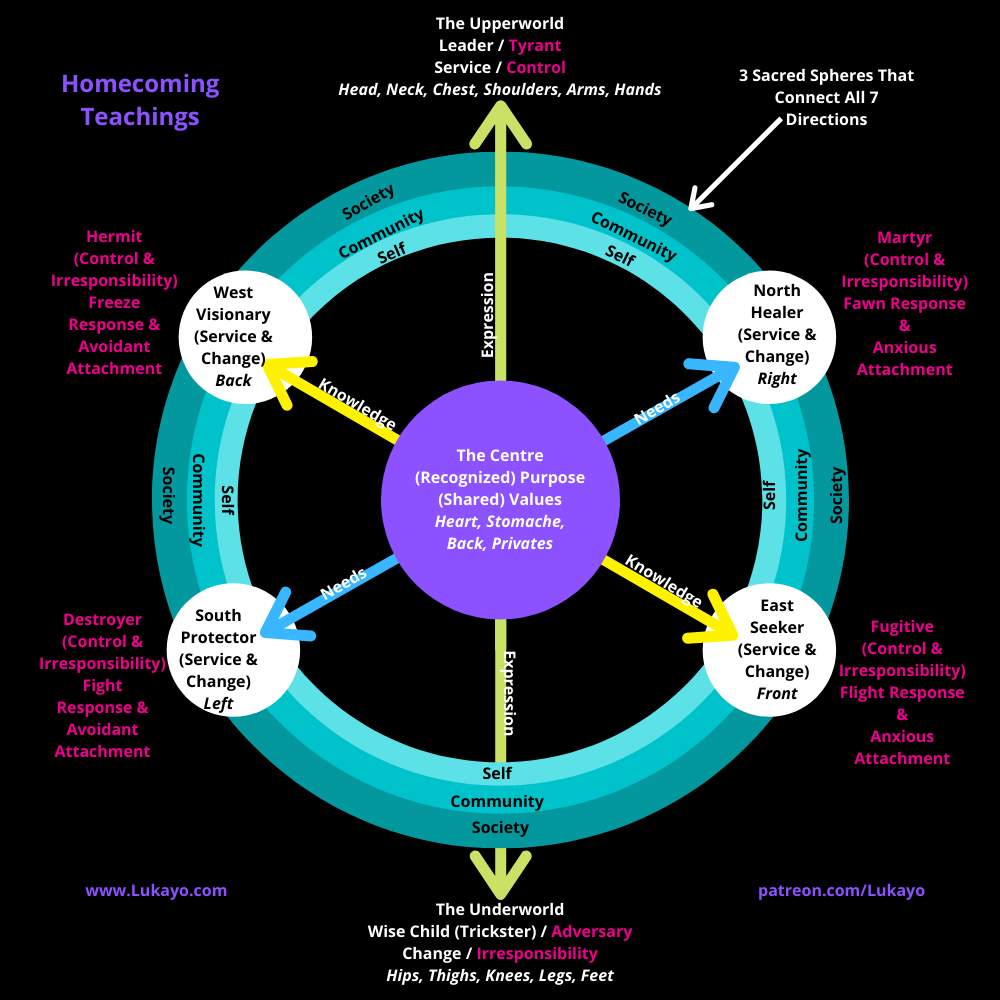
    This introductory article is divided into the following sections:

    • Background
    • 3 Sacred Spheres & 7 Directions
    • The Centre & The Spheres
    • North & South / Healer & Protector / Martyr & Destroyer
    • East & West / Seeker & Visionary / Fugitive & Hermit
    • Upperworld & Underworld / Leader & Wise Child (Trickster) / Tyrant & Adversary
    • Homecoming
    • Image Description

    Background

    These teachings came to me in a vision this summer while currently in the middle of attending online training at the Hilot Academy of Binabaylan founded by Apu Adman Aghama (Reverend Rolando G. Comon) and also currently in the middle of attending the online Play & Pray course facilitated by Larissa Kaul (of Liberatory Animist Healing) and Dare Sohei (of the Body Altar and the Ritual as Justice School for Cultural Somatics co-founded with Tada Hozumi at the Selfish Activist). My background in Somatic Experiencing, the classes I’ve taken in Generative Somatics, the brilliant infographical creations of Kai Cheng Thom, and the astrological bodywork of Luka Roderique also have deeply influenced my understanding of Pagliwanag. These teachings are made up of my life experiences and healing journey to date, but they also manifested at a particular time in my life and in these historic moments for the communities I serve, and so it’s important for me to acknowledge the context and influences of those teachers and healers near and dear to me.

    I consider these teachings a healing justice sacred tool that guides me in my own healing journey, and in the journeys of community members who come to me for guidance. My intention in sharing them is for the benefit of folks who would like to know some of my framework but may not have the time, resources, or alignment with me to do this work with me, but they can do it within their own communities when everyone is ready. I also wanted to provide another commentary and entry point to working with soul wounds and/or trauma that acknowledged Western trauma and attachment theory without using academic and technical jargon that can be alienating to some (though, of course, the spiritualist language I use can also be alienating for a different audience). I am writing for the social justice witches, and the trauma-informed sorcerers. I am writing for oppression exorcists and transformative justice healers. I’m writing for you, if this resonates within your body-mind-soul.

    Pagliwanag, or Homecoming Teachings, is meant to be understood and practiced within the context of community ritual and spiritual transformation. I would encourage you to read my articles on “Soul Wounds & Personal Demons”, “Community Demons”, and “Oppression Demons” so that you can have the larger context of how these teachings can work with your Healing Altar and communal activities. This article is also an introduction– there will be at least three more articles fleshing out what Homecoming Ceremonies can look like.

    A note on “Pagliwanag”: There is a version of this infographic that only uses Bikol and Tagalog words and concepts, that I intend to share mostly with those who have ancestry in the islands colonially known as the Philippines. However, I still wanted to emphasize how much of my understanding of these teachings are influenced by my Bikol diasporic spirit, and so I shared the alternate title in this article. In Google Translate’s version of a Filipino language, “pagliwanag” is translated into English as “enlightenment”, but in the Bikol dictionary, the English meaning is defined as “directions” and “instructions”, while the root word “liwanag” is defined as “light” and “clarity”.

    3 Sacred Spheres & 7 Directions

    The 10 components to Pagliwanag or Homecoming Teachings are the Sphere of Self, the Sphere of Community, the Sphere of Society, Centre, North, South, East, West, Above (Upperworld), and Below (Underworld).

    The Spheres are not just nested within each other, but also merged with each other, like parallel planes of existence that are happening together simultaneously. The Directions are specific experiences of moving through those three Spheres either away from or towards the Centre as part of our body-mind-soul’s process of exploring and responding to the world around us. Imagine that the Spheres are like the elements and sensations of air, earth/water, and light/heat around us while the Directions are specific paths that have landmarks made up of those elements. When we explore how to journey on these paths and not get lost, we’re always mindful of the context of the Spheres.

    The Centre & The Spheres

    The Centre is, ideally, where we start from, and where we return– the “home” in the homecoming teachings. It holds our purpose and values; a purpose that is recognized by and values that are shared by our community and at least parts of our society. This is because the Centre is also the 4th Sphere, and can only be understood as intertwined with the Self, with Community, and with Society.

    The Self, in regards to the Centre, is not just the mind-soul of a person that thinks about and holds the purpose and values of an individual being, but it also includes the body. The Centre in the body is represented as the torso, specifically the region that holds the heart, the stomach and the back of the stomach, and the nether regions that have the processes of reproduction and waste removal. The body is part of our home, but also part of how we navigate the world, and is as central to these teachings as the mind and soul.

    In this teaching, I define Community as a group of beings that recognize each other’s purpose and move together based on their shared values. I define Society as a collection of Communities that have at least some common values together so that they can work together and acknowledge each other’s purposes. This, of course, is based on my own individual values that everything has a purpose and inherent value, so my community shares in those values, and I see the world through that lens.

    Non-human and/or non-living beings are also very important to this teaching, as they all have a purpose and can recognize an individual living human’s purpose, and have the possibility of sharing the same values with living humans. These beings can make up part of one’s Self (as in spirit companions that are with a soul all the time), one’s Community (such as the land, the building in which one resides, and one’s Ancestors), and one’s Society (for example, another people’s Ancestors who preside over closed traditions or lineages but share similar values to one’s Ancestors).

    Another way to understand the Centre would be to look at the writings of Grace Nono and Elder Malidoma Somé. In the stories of the different spiritualists from the Philippines that Grace Nono compiled in “Song of the Babaylan”, the spiritualists each grow up with their community’s values and share in them even as they come into contact with other communities, and their understanding of their purpose both comes from an inner knowing as well as external events that are validated by their community– i.e. dreams from the Ancestors, spirit possession, acknowledgement from Elders. In Elder Malidoma Somé’s writings, especially in his memoirs “Of Water and Spirit”, he ran away from the residential school he had been kidnapped to, his inner knowing realizing that he didn’t share in the values of that place and that the purpose they had for him was not right. Through the guidance of the Ancestors and spirits, he managed to return to his village, and underwent an initiation with a group of younger boys, where he re-learned his values from teachings by living human beings and non-human ones, as well as re-connected with the spiritual and ancestral realms to remember and retrieve his purpose, which involves serving his community by being an ambassador to other communities in the larger society of the world. My own life parallels some of these stories, for I grew up in Canada with the inner knowing that my purpose wasn’t recognized and my values weren’t fully shared. As I grew older, I began to interact with different communities who shared my values, until I found the community that recognized my purpose, and thus, I was able to reach the Centre. The above examples, to me, illustrate how the Centre holds the crucial interplay of Self, Community, and Society in regards to purpose and values.

    North & South / Healer & Protector / Martyr & Destroyer

    This is the axis, or line, of Needs, which also encompass boundaries and feelings. When we move from the Centre along this line with an acceptance of the cycles of change that is part of reality, as well as in service to our community, we value a good life and a good death. Our boundaries explain ways that our needs can be met and respected or protected, moving us towards a good life and a good death. Our feelings are the energy and information that flows between our mind-body-soul to signal to us when our needs are being met, harmed, or neglected.

    When we move North towards the role of the Healer, we recognize the purpose and value of the system of living parts that make up the body, i.e. what the body needs. This same approach happens in the other Spheres as well; we seek to understand communal and societal needs by recognizing the purpose and value of the beings that make up our community and our society. As the Healer, we learn to keep these different parts of our Self, Community, and Society in balance with each other and in alignment with their purpose so as to create the state we call wellness or health. Healers support the movement of parts and beings to what they need.

    When we move South towards the role of the Protector, we protect needs, purpose, and values through the creation and activity of boundaries. Protection in general is also a form of showing that something has value. Protection in the form of preventive care, or setting boundaries and making protocols, conveys the need ahead of time, and how to respond to the need appropriately. Protection in the form of interventive care, or enacting boundaries, are the consequences when other beings do not respond to a need appropriately by respecting boundaries and protocol. Protectors, because they are in tune with their Self, Community, and Society, work to ensure that the protocols and boundaries created are in service to shared values and recognized purposes, while the consequences for disrespect still honour both a good life and a good death.

    The North and South, or Healer and Protector, are represented by the right and left side of the body. Though I have the North as Right and the South as Left in my infographic, for those who want to follow these teachings, it’s not necessary to strictly follow that correspondence. Perhaps the Right side of your body is more active in protection while the Left side of your body is more about alignment and repair. In this specific teaching around needs and the body, the point is the balance between having needs met and protecting those needs in a constant shifting or simultaneous coordination of your left and right sides.

    When we get lost in the North or in the South, we run the risk of becoming a Martyr or a Destroyer. What that means in relation to these teachings is that we lose sight of the cycles of change and are obsessed with controlling everything around us, or we lose sight of service to our community and become irresponsible towards our relationships, or both.

    The Martyr, intentionally or involuntarily, ends up controlling others through sacrificing their Self, and their purpose and contribution to their Community is lost. The Martyr may believe they are being very responsible towards their relationships, but they have become over-responsible for some of the needs and purposes of Community while being irresponsible to their Self. The Martyr can be understood in Western theories of trauma and attachment, via the stuck fawn response or anxious attachment styles.

    The Destroyer, intentionally or involuntarily, ends up controlling others through fear– other people are afraid that they will be destroyed by the Destroyer. This is also irresponsible to other people’s purpose, and their right to a good life and a good death, but Destroyers are consumed by their feelings and want to punish people for disrespecting boundaries instead of offering consequences that will re-align the Community to purpose and values. The Destroyer can be understood in Western theories of trauma and attachment, via the stuck fight response or a specific kind of avoidant style, or anxious-avoidance styles.

    East & West / Seeker & Visionary / Fugitive & Hermit

    This is the axis, or line, of Knowledge, which encompasses our experiences of the world through our body-mind-soul, our inner knowing, intuition, and our wisdom. When we move from the Centre along this line with an acceptance of the cycles of change that is part of reality, as well as in service to our community, we value and participate in the cycles of activity and rest. Beyond just being awake and being asleep, activity and rest is how we transmute our experiences into knowledge and wisdom. At every moment of our living existence, we are experiencing something, whether actively or receptively. Active experience can be understood as dialogue, creating something, or reacting to stimulation. Receptive experience can be receiving dreams, allowing thoughts to arise in the mind, or meditating so that we become one with our own consciousness and present in the moment.

    When we move East towards the role of the Seeker, we seek out experience, and we actively participate in the world around us as our Self with our Community, or as part of our Community within Society, or as a part of Society in relation to our Self. This is the Direction of the rising sun, and so Seekers look for something new on the horizon, either that is based on purpose or values, or that can be brought back and tested against the purpose and values of their Self and Community. Seekers understand that in the cycles of change, activity is essential for growth in the Self, Community, and Society.

    When we move West towards the role of the Visionary, we receive and/or process experience from our Self, Community, and Society. This is the Direction of the setting sun, and so Visionaries are often in retreat as they process or integrate their experiences based on purpose and values. A retreat doesn’t just mean something like a meditation retreat; it can look like receiving messages from our Ancestors in dreams, or spending time ruminating on an important change that has happened in our life, or lying down and visiting the spirit world. Visionaries understand that in the cycles of change, rest is essential for integration within the Self, Community, and Society, for when experience is integrated, it can be transmuted into wisdom, which can lead to a death or transformation of how things used to be. Through death and transformation, another cycle of activity and growth can begin, in deeper alignment with purpose and values.

    The East and West, or Seeker and Visionary, are represented by the front and back of the body. For many of us, it is our front that faces the new day, like the rising sun, while we lie down on our backs to rest as the sun sets. If you are nocturnal, perhaps it will be the reverse for you. Regardless, this teaching is pointing out that we need to care for the front and back of our body, ensuring we spend a balanced amount of time engaging in both as we actively participate in life and rest from it.

    When we get lost in the East or in the West, we run the risk of becoming a Fugitive or a Hermit. What that means in relation to these teachings is that we lose sight of the cycles of change and are obsessed with controlling everything around us, or we lose sight of service to our community and become irresponsible towards our relationships, or both.

    The Fugitive, intentionally or involuntarily, seeks to control their experience of the world by constantly searching for a specific, new (often euphoric) experience or some kind of knowledge that will finally feel safe enough for them. Fugitives have forgotten about the Centre and are in an endless flight because nowhere feels safe, and thus the ways they take knowledge or pursue experience can be irresponsible to their Self, to their Community, or to other Communities in Society. The Fugitive can be understood in Western theories of trauma and attachment, via the stuck flight response or anxious attachment styles, or anxious-avoidant styles.

    The Hermit, intentionally or involuntarily, seeks to control their experience of the world by being in retreat from it as much as possible. The Hermit, even if they receive the most amazing insights or have a vivid imagination that can be inspiring, cannot or will not share it with their Self or with Community and Society, and so that knowledge becomes lost. The Hermit is irresponsible to their relationships because they refuse to acknowledge the potential that being vulnerable through sharing can also bring joy and beauty, and not just possible rejection or loss that is part of the cycles of change. The Hermit does not align their behaviour in regards to purpose or values, and instead to feeling in control. The Hermit can be understood in Western theories of trauma and attachment, via the stuck freeze response or avoidant attachment styles.

    Upperworld & Underworld / Leader & Wise Child (Trickster) / Tyrant & Adversary

    This is the axis, or line, of Expression, which encompasses and connects the lines of Needs and Knowledge, either towards being in Service or towards the wildness of the cycles of Change. When we move from the Centre along this line, we are balancing the work of the Healer, Protector, Seeker, and Visionary. The expression of who we are as individual Selves, or as a part of a Community or Society, will involve some form of all four roles, even if one or two are stronger than the rest.

    When we journey to the Upperworld towards the role of the Leader, we understand the responsibility of being connected, through purpose, with Self, Community, and Society. Our responsibility manifests as Service. When we practice alignment/healing, protection, rest/contemplation, and activity/adventure, we are in service to communal/societal purpose and shared values. Leaders continuously check-in with their own personal purpose and values as well as their Community’s and Society’s, to ensure that their expression is responsible.

    When we journey to the Underworld towards the role of the Wise Child or Trickster, we become wild; we understand the cycles of Change, of life and death, of activity and rest. The Wise Child understands that change cannot be controlled, and instead, must be integrated as part of the flow of reality. Wise Children flow through the alignment and protection of a good life and a good death, as well as the experiences of activity and rest, without trying to completely control the process. They also understand that there is a purpose to all life and all death, that there is a purpose to Self, Community, and Society, and that all are connected together in the flow of change.

    Above and Below, or the Leader and Wise Child (Trickster), are represented by the upper half and lower half of our bodies. Our upper half, from our chest and hands to our head, is the part of our body that can express our Service to Community and Society. Our lower half, from our hips to our feet, is the part of our body that connects to the Earth, to our wildness, and the cycles of life and death. Even if someone did not have hips, or legs, or feet, they can still connect by the part of their body closest to the ground, or their own inner connection to the Earth.

    When we get lost in the Upperworld or in the Underworld, we run the risk of becoming a Tyrant or an Adversary. What that means in relation to these teachings is that we lose sight of the cycles of change and are obsessed with controlling everything around us, or we lose sight of service to our community and become irresponsible towards our relationships, or both. The Tyrant is particularly focused on controlling others and our own experiences in our refusal to yield to the cycles of change, while the Adversary is focused on answering only to our impulses or feelings, without regard or responsibility to the Service Community gives to us or that we can give to Community.

    In addition, Tyrants and Adversaries also can be a combination or a mix of the Martyr, Destroyer, Hermit, and Fugitive. As a Tyrant or an Adversary, we may have a specific pattern where we swing towards Martyr until triggered into Destroyer, or Hermit and Fugitive. If we feel dismembered downwards in all four directions, we may be the type of Adversary that is unable to respond to our needs or our experiences in a consistent way, just lashing out or withdrawing, consumed by a project or drug or relationship because it feels less bad in the moment. If we are dismembered upwards, every tactic we employ as a Tyrant is meant to ensure we seem powerful and everyone else is beneath us. The Adversary or Tyrant can be understood in Western theories of trauma and attachment, via any of the stuck fight/flight/freeze/fawn responses or anxious-avoidant attachment styles.

    Homecoming

    For me, the main usefulness of these teachings is in the Homecoming– how the Self and Community can return to the Centre if we get lost in one or more Directions. If we get lost in one Direction, for example, then the Service & Change teachings of the opposite Direction can generate enough pull to create a Homecoming. So the Martyr can learn to be a Protector so that they can transform into a Healer, and a Destroyer can learn to be a Healer so that they can transform into a Protector. If we swing to extremes, such as escaping into an activity or substance as a Fugitive while also withdrawing from Community like a Hermit, then we would need to learn the teachings of both the Visionary and the Seeker, as well as the Leader if our actions tend towards irresponsibility, or the Trickster if we tend towards control (even both if we swing between those two as well).

    Homecoming can be divided into three sections: Revelation, Embodiment, and Practice. Depending on which Direction we’re lost in, Revelation consists of developing an understanding of Service, Change, Needs, Knowledge, and/or Expression. This understanding isn’t just about reading about these concepts or learning from a teacher, but also can consist of going into trance or a spirit journey, journaling, creating an altar, or creating visual art, song, or dance. Embodiment is the use of awareness, touch, dance, and/or play to attune to the body — whether it’s the front, back, left, right, upper half, or lower half, before rooting deeper into the torso or core. Embodiment activities can involve guided meditation, energy work, prayer, plant and mineral medicines, drawing games, and orienting to pleasure. Lastly, the Practice part of Homecoming involves the activities of whichever Directional role is needed to balance out and guide us back to Centre. These activities can be taught to us by mentors and teachers recognized by Community who embody the role of Healer, Protector, Visionary, and Seeker, but they can also be taught to us by the Community’s stories of these roles, embodying our shared values.

    I’ll be writing the following articles to elaborate more on what these activities are in relation to Self, Community, and Society:

    Image Description

    The background is black. In purple text, the infographic is titled “Homecoming Teachings” and there are the links to “www.Lukayo.com” and “patreon.com/Lukayo”.

    A purple circle in the centre has white text inside, which reads: “The Centre. (Recognized) Purpose. (Shared) Values. Heart, Stomache, Back, Privates.”

    There are six arrows pointing out from the centre purple circle. The blue arrows opposite each other are labeled “Needs”. The yellow arrows opposite each other are labeled “Knowledge”. The green arrows opposite to each other are labeled “Expression.”

    The blue and yellow arrows point to white circles that have black text inside them and hot pink text outside them. The green arrows point to white and pink text.

    One blue arrow points to a white circle with the following text: “North. Healer. (Service & Change). Right.” The pink text outside it reads: “Martyr. (Control & Irresponsibility). Fawn Response & Anxious Attachment.” The opposite blue arrow points to a white circle with the following text: “South. Protector. (Service & Change). Left.” The pink text outside it reads: “Destroyer. Control & Irresponsibility. Fight Response & Avoidant Attachment.”

    One yellow arrow points to a white circle with the following text: “East. Seeker. (Service & Change). Front.” The pink text outside it reads: “Fugitive. (Control & Irresponsibility). Flight Response & Anxious Attachment.” The opposite yellow arrow points to a white circle with the following text: “West. Visionary. (Service & Change). Back.” The pink text outside it reads: “Hermit. Control & Irresponsibility. Freeze Response & Avoidant Attachment.”

    One green arrow points to white and pink text that reads: “The Upperworld. Leader / Tyrant. Service / Control. Head, Neck, Chest, Shoulders, Arms, Hands.” The opposite green arrow points to white and pink text that reads: “The Underworld. Wise Child (Tricksters) / Adversary. Change / Irresponsibility. Hips, Thighs, Knees, Legs, Feet.”

    The arrows are intertwined with three circles. The light teal inner circle reads: “Self”. The medium teal middle circle reads: “Community.” The dark teal outer circle reads: “Society.” A white arrow points to the circle, and the white text at the beginning of it reads: “3 Sacred Spheres That Connect All 7 Directions.”

    [hr]

    Want to get a better version of the infographic? Become a patron on Patreon for as little as $1/month to support my Elders and healing work among my communities. $5/month, and you can get an audio recording/podcast of the livestream chat about this article with community members on our free Discord server. (If you want to join the Kinaban Discord server, send me an email!)

    https://www.patreon.com/posts/39741639

  • Oppression Demons [Patreon Post Excerpt]

    CW/TW: oppression

    This article is divided into the following sections:

    • Background
    • Oppression Demons & Their Patterns
    • Rituals to Transform Oppression Demons

    Background

    I’ve been receiving visions and dreams on Oppression Demons for as long as I can remember. Starhawk’s book Truth or Dare was also very helpful in understanding how they work. Though this article completes the set of writings on demons (see “Soul Wounds & Personal Demons” and “Community Demons”), the main catalyst was community members and loved ones (including myself) who began to realize they needed communal support around healing from sexual trauma and assault.

    Much of the knowledge of the behaviours and patterns of oppression demons have been done by the scholarship and teachings of many before me, especially Black writers/teachers like Eddie Ndopu, Franz Fanon, Audre Lorde, Angela Davis, bell hooks, Kimberle Crenshawe, Barnor Hesse, Alishia McCullough, Rhizome Syndigrast Coelacanth Flourishing, and Luka Roderique. Other writers that have been deeply influential are Edward Said, Jose Rizal, Dylan Rodriguez, Leny Strobel, Grace Nono, E.J.R. David, Kay Ulanday Barrett, Leah Lakshmi Piepzna-Samarasinha, Mia Mingus, AJ Withers, Harsha Walia, Eve Tuck, Lynn Gehl, Leanne Betasamosake Simpson, Robin Wall Kimmerer, Patty Berne, Eli Clare, and Andrea Smith. Zainab Amadahy’s Ways of Wielding the Force is particularly influential in regards to communal ritual. I’ve also recently come across the work of Tada Hozumi and dare sohei, who are adding a somatic and important depth to my understanding, and of which my understanding on oppression demons may radically change the more I become students of their work. There are so many others that I do not have time to name, but all the credit goes to my Elders and teachers. I ask for your forgiveness if I have forgotten to name you.

    [This section was taken out for this excerpt.]

    Oppression Demons & Their Patterns

    To review, I wrote in the “Community Demons” article that oppression demons try to infiltrate different communities (groups of people that share similar values, beliefs, and customs) and imprint a specific pattern of violence through the deception that the oppression demons’ hierarchies are “natural”. Each demon has its own pattern of violence, but it relentlessly tries to force folks in communities to do it, regardless of the community.

    An oppression demon’s pattern of violence attempts to target one group or community, while convincing another group or community that this scapegoating is deserved or will benefit the rest. Those who are most likely to discover the pattern of violence that an oppression demon tries to bring about, are the survivors of this violence (what we would call the “oppressed” or “marginalized”). Those who are least likely to discover or even believe that an oppression demon is working through them or is in the community are those who are “unaffected” or benefit from this violence (what we could call the “privileged”). I used quotation marks for “unaffected” because there is still a way that an oppression demon affects everyone in the community, even if a person isn’t a specific target for the pattern of violence.

    Usually, the oppression demon also tries to convince the targets of violence that they deserve being treated this way too, and that setting up a “system” that perpetuates this violence is “natural”. When targets of violence from an oppression demon hurt each other because they are consciously or unconsciously convinced by the oppression demon’s violent agenda, this is usually called “lateral violence”.

    When folks, both the oppressed and the privileged, are possessed by these demons, there is the argument that “this is just how it is”, that they “deserve” to be treated this way, or that the targets of violence “deserve” their treatment. This type of violent hierarchical thinking is what “affects” those that are privileged, and it disconnects them from community and each other. With a group that can be scapegoated, then that means that the privileged are “worthy” and “deserving”, and most of their identity becomes built on being at the “the top”. Thus going against the influence of oppression demons can also cause psychological suffering as they realize they are not as “worthy” or “deserving”, that the system was set up to harm others deliberately, and that they have been unknowingly complicit or deliberately responsible for violence.

    Oppression demons have an added layer of complexity where some people can be privileged by one and oppressed by another. Those who are being oppressed by one or more demons tend to have trouble recognizing when and how they are privileged by another. Those who are being oppressed by multiple demons, the patterns of violence become merged most times, and are not separable– they interweave with each other. This is one of the main patterns that all oppression demons have: through setting up violent hierarchies they seek to constantly hide their existence while dividing communities from each other and feeding off the suffering of everyone involved, but especially those that are the target of violence.

    For examples of specific demons, I refer you to some of the teaching tools I created:

    So, yes, there is a white supremacy archdemon that is composed of the anti-Blackness demon, the settler colonialism demon, the Orientalism demon, and the anti-migrant demon. There is an ageism archdemon that can be split into anti-youth and anti-elder demons. There is the gender binary archdemon that gives birth to the patriarchy demon of rape culture. I didn’t want to start off with these “isms” and these types of names because they are academic and sometimes unwieldy, and sometimes using such terms is another way to hide the demons’ existence from us.

    It’s also important to understand that oppression demons don’t just possess humans individually or intergenerationally in their words and deeds, but they also possess the sacred tools and technology of humans such as how we build our dwellings, our cities, our policies, our weapons, etc., etc. This means that there are specific buildings or tools or forms of technology that are “infected” by the oppression demon so that they are deliberately created to violently target a group or community while privileging another.

    An oppression demon’s reach is huge, and its form vast. I’ve found that if I’m doing work to heal from and transform a personal demon or a community demon, and it keeps coming back even when I thought the process was complete, most likely it is because it’s part of a larger oppression demon, and the oppression demon will just keep sending more and more of itself disguised as personal or community demons. So how do we stop the harm of the oppression demons?

    Rituals to Transform Oppression Demons

    The key that I’ve witnessed is the power of communal ritual– the bigger the oppression demon, the more people are required for the ceremony. This is to counter a lot of the oppression demons’ powers. For example, instead of being convinced that the demon doesn’t exist and that there is no harm, we are deliberately calling the demon out in ceremony and naming the harms. Instead of dividing us and obeying a violent hierarchy or supremacy, we are coming together in ceremony as equals to envision together a different world. Lastly, instead of being consumed by the fear and hatred that spurs all oppression demons, we offer them love and peace, until they too become transformed.

    Another important reason, which was covered somewhat in the “Community Demons” article, is that it’s easier to not get “possessed” by a demon when in a group. For example, when in circle with community members and I hear an oppression demon begin to possess them as they start to shake and say things over and over again like they “deserved” their oppression, I can hold space for their feelings and also counter the narrative the oppression demon is implanting– even if I’ve said those things to myself. I know that same person would do the exact same thing for me, even if they just went through it yesterday. Sometimes it’s a lot easier to fight for and come to the defense of your community members than yourself, but that’s why they also come to your defense and support.

    Common types of communal anti-oppression rituals are protests/direct actions, vigils, and celebrations.

    Protests and direct actions channel the rage of multiple communities, and this potent energy of protection and defense can be used to dismantle or undo an oppression demon’s influence in physical areas (like taking back land, pushing downs statues, repurposing factories and police stations, etc.) or in the realm of decision-making (convincing politicians to change legislation, or CEOs to change policies).

    Vigils, especially with the use of storytelling of the past and present, are an outlet of grief for multiple communities. Not only does it help to turn the restless dead into honoured ancestors, but it provides a healing space for folks to begin to come to terms with the ongoing reality of losses, of what oppression demons cost our peoples, so that folks can be moved to action. On the other hand, vigils can also be a post-protest ceremony, for coming to terms with all the grief after the angry defense work, so that more room can be made for hope and rebuilding.

    Celebrations, especially paired with storytelling/visioning of the future, are not just an outlet for communities’ joys together, but also by anchoring a reality outside of the oppression demons’ narratives and violent hierarchies. Celebrations can contain the reality that our communities can be one of peace and love, and that we can relate to other groups and communities without violently placing each other in hierarchies. Celebrations can channel creation energy to (re)build the present and future through drawing, painting, sculpture, singing, dancing, chanting, playing musical instruments, and re-teaching technology spirits like buildings and tools that they can be re-oriented away from oppression and towards the ways of spiritual connection and community.


    Want to read the full article? Become a patron on Patreon for as little as $1/month to support my Elders and healing work among my communities. $5/month, and you can get an audio recording/podcast of the livestream chat about this article with community members on our free Discord server. (If you want to join the Kinaban Discord server, send me an email!)

    https://www.patreon.com/posts/38813600

  • Community Demons [Patreon Post Excerpt]

    CW/TW: aswang, community demons, trauma, abuse, oppression

    (If you have questions about this article, join me during my livestream chat in the Kinaban Discord Server on Saturday, May 30th, 1pm EST.)

    This article is divided into the following sections:

    • Background
    • What are the demons of community, and how are they different from the demons of oppression and colonization?
    • What do community demons tell us about what we value in our communities?
    • How do community demons manifest and interact with activist communities who are focused on fighting the demons of oppression and colonization?
    • What are some rituals and suggestions for transforming and healing a community’s demons?

    Background

    This article is based on an online teaching I gave for the Center for Babaylan Studies’ Ginhawa: Elements of Care series, specifically, on the aswang, as well as an online conversation in a Facebook group where I was asked about social justice communities and their own “demons”, similar to the aswang. I had been having dreams of and divination instructions for writing this article, and then when I was asked to do the workshop and asked the question on Facebook, it all began to connect for me.

    Note on the word “demon”: I’m using the word here as an extension of my use of it in the article on “personal demons”. I am not referring to the inspiration Greek spirit daimon, but a type of antagonistic spirit that wants to harm human beings, either by preying on someone’s personal memories of trauma or their soul wounds (like personal demons), preying on a whole community of people with shared values and practices (like community demons), or preying on whole groups of communities and trying to assimilate them into a way of life that inherently makes them inferior or disadvantaged (like oppression demons). I characterize these patterns as “spirits” or “beings” because the pattern they have in common, besides harm done to human beings, is that they “fight back” in some kind of sentient way for their survival to their food source (human energy, especially human suffering), and they can “possess” a human into believing their way of doing things is the “right way” or that the human came up with it themselves (even when it’s a clear pattern they’ve witnessed in others).

    To get deeper into understanding what community demons are, I’ll need to explain a bit what the aswang is, in a very quick, abridged way. I’ll be using the aswang as the main example of an ancient community demon, and contrast it with some new forms of community demons.

    The word “aswang” is used among many of the islands known as the Philippines that describes a spirit (or person possessed by a spirit) that usually seems like a regular community member but secretly wants to eat human flesh and drain life force, particularly fetuses, children, and corpses. They have one or more of the following powers: shapeshifting (usually into animals), flight, illusion, separating the upper half of their body from their lower half without being harmed, and having a tongue like a proboscis or thread that can stretch long distances and pierce skin.

    An aswang is created if there is an ever-hungry “creature” put inside a human, usually seen as a baby chicken that can be kept unnaturally alive inside a human body. The creature can be put inside a human using the following ways: willingly, through force from an aswang, tricked by an aswang into eating human flesh (the creature then grows or appears inside them), or inherited from parents or family members.

    Humans are attacked by aswang through the specialized tongue, or using their shapeshifting powers. Usually aswang will try to pierce the womb of a pregnant person to eat the fetus, or pierce the skin of a fresh corpse and suck out its blood and insides. Sometimes, they will steal sleeping people or corpses to chop them up and eat them, or they can curse with a look or touch so that a person will sicken and die, and then they’ll collect the corpse later. Not all attacks are making humans into meals– sometimes an aswang will want to make more aswang, and so they’ll try to trick a human into eating other humans through illusion (e.g. magically making human fingers look like fish in a stew).

    Aswang is part of a class of spirits or “demons” found all over the world, even if there are specific regional differences and names. This group is what I call “community demons”, and they all have different names and characteristics because their attributes are specifically tailored to or evolved from the communities they target.

    What are the demons of community, and how are they different from the demons of oppression and colonization?

    Demons of community are spirits that specifically show what a community is not about, while also embodying its fears of infiltration and co-optation. Community demons are not quite like the type of monsters or aliens that represent xenophobia and our fear of obvious difference from ourselves. Instead, community demons bring up the danger of when someone that was part of our community at some point, or from the beginning, actually was only there to hurt others and not about sustaining the community and helping it thrive. The community, instead of their home and sanctuary, is just their feeding ground.

    Community demons are also not like demons of oppression and colonization, though they definitely are related. Oppression demons and community demons are both about using communities as feeding grounds through acts of violence, and turning community members against each other so that it’s easier for the demons to gain power and control over humans. But oppression demons try to turn every community they infiltrate into a specific pattern of violence, so once people recognize the pattern, it’s a lot easier to undo the work of internalized oppression or oppression demons from one community to another (more on these demons in a later article). Community demons are more insidious– they know how to look like they’re part of the community, and only those in the community who really work to embody the community’s values and understand its ancient connections can find the pattern of a community demon and the way to protect others from it.

    What do community demons tell us about what we value in our communities?

    Let’s return to the example of the aswang, and how some of its characteristics, and the ways community members can protect themselves from or heal the aswang, are all indicators of general Filipino community values, what I like to call “kapwa”. By using “kapwa”, I am also referencing the use of this Tagalog word in Virgilio Enriquez’s theories on the personality of Filipinos, called Sikolohiyang Pilipino (Filipino Psychology). Enriquez cited that Spanish dictionaries recorded the term as meaning “one and the other” and “both”, an inclusive other. Katrin de Guia, author of Kapwa: The Self In The Other, wrote in Babaylan: Filipinos and the Call of the Indigenous, that kapwa “is widely used when addressing another with the intention of establishing a connection”, and is also translated as “fellow being”. My understanding of community, even with people I have not met yet and non-human beings, aligns with how this Tagalog word is used and understood.

    So, If kapwa is about having a solid connection to our own identity/personhood so that we can connect to others, then the aswang do not have that, as they are ruled by the creature inside of them, and shapeshift, and/or are literally severed in half, unable to have a solid or stable sense of identity and personhood.

    If kapwa is about respect and connection to community members, especially through rituals of birth and death, then the aswang disrespect that by devouring humans, especially fetuses and corpses. Further to that, the reflection of others in an aswang’s eyes are upside down or inverted, because an aswang cannot see humans as part of their community, as people. Aswang do not respect the hospitality values of kapwa in offering shelter and food, help and comfort, to community members. Instead, the aswang only offers shelter and food so they can make the human into a meal, or turn them into another aswang through trickery. The aswang rarely offers help and comfort, as they can cause sickness by looking and touching. The creature inside of an aswang is also an inversion of a traditional offering of a chicken to the spirits– it is alive when it should be dead, and a chick when it should be fully grown. The creature is a mockery of the gratitude and spiritual practices of kapwa.

    Furthermore, kapwa involves connection to mineral, plant, and animal spirits and medicines, so that is why ways to ward off or reveal the true nature of an aswang involves using salt, kalamansi/lemon, garlic, coconut, or stingrays (powerful salty water beings). Kapwa also involves human tools and activities, symbols of communal protection and care, which then also become more items of protection against aswang, like the bolo/machete, the walis ting-ting/broom, ash from a fire, or fire itself.

    The rituals for transforming aswang back to humans also reveal more about kapwa. These rituals involve a human willing to support the process, symbolizing the human relationships that are part of kapwa. These rituals also involve the non-human relations that are very important to kapwa, such as kalamansi/lemon or the smoke of coconut husk. Sometimes the ritual involves a “beating” that signifies the remorse/guilt and empathy the kapwa connection gives when you harm another community member. Lastly, the ritual ends and the aswang is transformed back into a human when the hungry creature leaves the body, and is returned to the cycles of life and death, usually by being destroyed.

    What I’m trying to get at with this example, is that even if a community demon still looks and acts like community members, there are tell-tale signs that they are a community demon or a person who is being possessed by a community demon and needs support and transformation. These signs are rooted in community values that have always led to the community’s sustainability and thriving. Community demons, as much as they can cleverly look like they’re being part of a community, have difficulty in supporting a community’s growth because of their patterns of destruction or targeting community members, and are eventually found out by those that embody the community’s values.

    [This section was taken out for this excerpt.]

    What are some rituals and suggestions for transforming and healing a community’s demons?

    Before I begin outlining some ritual steps, I want to note that folks who are suffering from soul wounds and personal demons are also more likely to be influenced and possessed by community demons– or targeted by them! Please check out my article Soul Wounds & Personal Demons for some spiritual healing practices regarding that.

    The following guidelines are for working with what you suspect may be a community demon growing inside of you, especially if you are exhibiting behaviour where you are harming community members for your own power and gain. I write it this way because it’s important to understand that a community can’t “make” an individual community member be accountable– it requires a level of self-awareness from the individual’s part, and a voluntary, active, readiness to transform. Otherwise, what needs to occur is communal boundary-setting, where the aim is to prevent more harm to the community, not to completely destroy and give up on the person who is possessed by the community demon.

    1. Gather the human, spirit, and non-human community to you. In a circle, have representations of Creator and Creation, trusted and loving human community members, mineral/plant/animal medicines, and healed ancestors with you, to show yourself and the community demon about the power of the community. Never do this ritual by yourself, as that is exactly what the community demon wants, to make you feel isolated.
    2. Out loud, call out the community demon, and say that you know they are there.
    3. Describe the harm that the community demon has been doing, and the effects it is having on the community. Use the medicines while this is done. If this was an aswang transformation ritual, then this part is the equivalent of the “beating”, the pain of empathy. Allow yourself to feel that remorse. If you can feel remorse, it also means that you can still feel empathy and connection. Remorse is the emotion and signal that you want to repair a connection that has been harmed. In the circle, there may be others who have been harmed by you that also want to describe the harm that you have done.
    4. The community demon may flee at this point, or it may be transformed. You’ll know it has left because there is no longer hunger to hurt yourself or others. If there is a transformation, then the hungry creature is exposed, which may be a physical object that you vomit out or it may look like a spiritual confession of a wound that led to this desire to do harm. If the community demon wasn’t transformed and only fled, it may come back and you may need to do this ritual again until it is transformed.
    5. If a transformation took place, the hunger that has been exposed needs to be dissolved into the cycle of life and death. This can look like destroying the object through water or fire. It may look or sound like forgiveness. It may also look like community members asking for amends to repair the harm that was done, so that the transformation occurs in the whole community, and not just within you. Sometimes, there is also a discussion between yourself and the community members about what the repercussions and boundaries are if the community demon returns and harms others again, and how to keep community members safe.
    6. End the ceremony by thanking all the beings that were invited to help with the protection and transformation, and, if appropriate, have a feast. The feast should have a spirit plate set aside for the non-humans, and the food should be prayed over and thanked for its gifts.

    Like I wrote in the previous section, these are all guidelines and suggestions from many other practices and rituals that have worked to various degrees. Ultimately, however, my lone voice is not the be-all-end-all of this discussion, and it should never, ever be. I have my own biases, my privileges, my soul wounds, my susceptibility to community demons as well, and it’s only through an intergenerational community discussion within the communities I serve (including activist communities), that solid ceremonial healing and transformational practices can be implemented.


    Want to read the full article? Become a patron on Patreon for as little as $1/month to support my Elders and healing work among my communities. $5/month, and you can chat with me about this article during my livestream chat on Saturday, May 30th, 1pm EST in the Kinaban Discord Server.

    https://www.patreon.com/posts/37497317

  • Spiritwork & Justice: Maintaining the Balance [Patreon Post Excerpt]

    CW/TW: sickness, wrongdoing/transgression, colonialism, ableism/saneism, disability

    [Portions of this article was previously posted on Facebook May 31, 2018]

    Debt has so many connotations in North America/the West, as so much of our modern capitalist society runs on debt, on money that is owed, instead of money that is already generated. For many, including myself, it conjures up images of years, if not decades, of attempting to pay off student loans or this “mortgage” I and other younger millennials keep hearing about. There have been some periods in my life I’ve lived hand-to-mouth on welfare checks, and couldn’t possibly conceive an end to debt.

    There is, however, another understanding of debt, a spiritual understanding– though I’m now loath to use that word in description of this concept that is difficult to translate into English. Perhaps better ways of describing it are “maintaining balance”, “honouring connection”, “honouring Creation”, “right relations”, “interdependence”, and “reciprocity”.

    Firstly, this is an underlying principle in the way I do spiritwork, informed by a very specific worldview that I’ve experienced as a Bikol person and spiritworker, but was articulated in Fenella Cannell’s dissertation Catholicism, Spirit Mediums and the Ideal of  Beauty in a Bicolano Community as well as John P. McAndrew’s book People of Power: A Philippine Worldview of Spirit Encounters (entirely about Visayan practices, a culture closely linked to Bikol). This underlying principle is also somewhat captured in the Tagalog phrase “utang ng loob”, and is roughly translated into English as a “debt of spirit/gratitude”. In Bikol, it’s captured in the words “bawi” and “parabawi”, which means “debt” and “exorcist” in the rough English translation, but, of course, it’s so much more complicated than that. I’ve also witnessed with Indigenous folks to Turtle Island that I’ve been in community with, that they have expressed similar principles in the term “All My Relations” (specifically from the Lakȟóta and/or the Anishinaabe, but other nations have also expressed this). I’ve also read something similar in the work of Malidoma Somé (a Dagara spiritworker from Burkina Faso), when he writes about how sickness is a sign from the spirits, a form of communication, as much as success and health is a sign of their joy.

    Put simply, in this worldview, we are all connected through space, time, energy, spirit, and blood. Offerings build relationships through “debts of gratitude”, and transgressions create debts of retribution. To restore balance, we must turn debts of retribution into debts of gratitude through offerings– not just in way of apology of transgressions, but to rebuild connections.

    A relationship necessitates that everyone is in a debt of gratitude towards each other. For example, I’m in a debt of gratitude to the Sun for the light and life it gives me, and I try to honour that debt through offerings to the Bikol sun spirit Aldao. In turn, Aldao may bestow on me further gifts, which create more debt of gratitude, which I respond with more offerings, and a basic relationship is maintained in that matter. Much of my prayers, rituals, and offerings, are about acknowledging and honouring debts of gratitude– whether it’s to the plants I’ve consumed, the technology that assists me, the ancestors that lived and died for me, or a pet cat that cuddles me while I sleep.

    A transgression is harm with or without intent– something that I find fascinating because in my anti-oppression workshops I talk about how impact matters more than intent. This is certainly true among anito/spirits within the indebted worldview. Anito don’t care if you didn’t intend to destroy their home or break your promise to them, all they care about is the impact, which harms and dishonours them. This creates a debt of retribution which they then “honour” or repay usually with what mortals experience as a sickness of some kind in the mind, body, or both. To the anito, it’s simply restoring balance to the situation. We can continue a retributive interaction by creating further harm to the spirits, of which they create further harm towards us, or we can change it back to relationships of gratitude through offerings– basically reparations.

    [Several paragraphs were taken out for this excerpt.]

    I think my main concern from a social justice point of view is that folks will interpret the viewpoint as insinuating that the sickness is inherently the fault of the one who is sick, a kind of ableist/saneist victim-blaming. I don’t want that to come across– the worldview is more about the function of sickness and the far-reaching impact of our actions because of how we’re all connected to everything else. For example, in the 1920s, when American women painting watch dials with self-luminous paint began suffering from anemia, bone fractures, and necrosis of the jaw, the accountability lay at the feet of the corporations who insisted that the radium in their paint did not cause radiation sickness, deliberately continuing to endanger people’s lives despite a group of women’s attempts to get studies done and legal action against the companies that were lying about radium.

    There is a definite danger here in how structures of power use disability and sickness, or what they define as “sick”, to oppress groups of people– homosexuality and transsexuality were “sicknesses” and running from a slave master was a “sickness”. However, such a worldview is not predicated on the connection to Creation and reciprocity, even if proponents of such things back then and now will insist it is. Oppression is based on hierarchies that need to be enforced by violence. This is starkly opposed to a lateral connection to all things that needs to be maintained through gratitude and care and the prevention of violence and the reparation of harm, otherwise those relationships sicken and fade. 

    Additionally, individual disabled people and chronically ill people cannot be used as “posters” for anyone else’s theories or worldviews. My spiritual experience and understanding of my illnesses is specific to me. If someone comes to me wanting to know why they are sick in a specific way that Western doctors cannot understand or can no longer provide anymore care for, I am very careful to understand what worldview they are coming from. I may refer them to Gabor Maté’s book “When The Body Says No”, if that’s something that may be helpful, in explaining the science of the stress-disease connection (one of my doctors had referred that book to me early in my diagnoses). Each person gets to decide their individual relationship with what is happening with them. Whether they call it illness or disability or dis-ease or a message or a curse or a neurodivergence or a diverse ability or a mutant power, they get to decide what it says about their relations and communities– that is the gift and burden of the world we live in, the balance between our individual free will and the love or hate from our communities and societies. 

    For me, my understanding of Disability Justice is founded on “interdependence” (informed by the work of Mia Mingus, Patty Berne, Leah Lakshmi Piepzna-Samarasinha, and Sins Invalid). Even though there are individual and personal understandings of what is going on for each of us that are labeled as “disabled”, there is a communal movement to be in it together, to build futures of care and gratitude together. 

    In a world continually devastated by capitalism and colonialism, my form of spiritwork has to be founded on justice. Being a modern parabawi, especially in the fraught context of the diaspora, as a guest/settler more aligned with indigenous sovereignty than the settler colonial state, requires teachings, training, and thorough understanding of gratitude, harm, and the reparation of harm– in all its historical and political contexts, for those contexts are inextricably intertwined with the spirits, such as the spirits of the Land and the Ancestors. If one does not understand historical, political, and spiritual harm, how can they maintain the balance between the spirits, animals, plants, ancestors, and the human world? This tradition of spiritwork, translated into the modern day, must be predicated on the collective liberation of all Creation from oppression.


    Want to read the full article and chat with me about this article during my livestream chat on Wednesday, April 29th, 4pm EST? Become a patron on Patreon for as little as $1/month to support my Elders and healing work among my communities. 

    https://www.patreon.com/posts/36455735

  • Soul Wounds & Personal Demons [Patreon Post Excerpt]

    CW/TW: discussions around trauma, soul wounds, intrusive thoughts, personal demons, mental illness, healing journeys

    I remember when a lilt in someone’s tone, a certain phrase, a touch on the “wrong” part of my skin would feel like the sky crashing down. Sometimes I would be hurtled backwards through time, images and sounds booming through my mind. Other times an agony would spread all across my body, causing me to shake or clench my fists, a howl trapped in my chest that would bring me to my knees. Then the voices would come: “You failure”, “You monster”, “You deserved it”, “You’re worthless”, “No! Make them suffer!”, “You’re in danger, get away from them!” And on and on it went, a tumult that would send me far away from the present moment, my limbs reacting, my speech responding, in ways that people could not understand, or frightened them.

    Things changed for me, slowly. It took a lot of work, multiple types of work simultaneously and oftentimes rigorously, but it happened. In this article, I’d like to share some of the work with you, specifically the spiritual and non-Western forms of healing in regards to trauma and the cognitive distortions that come with complex and chronic trauma. During these times of collective pain and grief and fear, when a virus ravaging the land may itself be causing new wounds in our soul, new traumas to heal from, perhaps we can take this time to add more tools into our medicine cabinet. Or just rest, my dear ones. I’ve been doing plenty of that, and that also is a large portion of healing work.

    For those curious and as rested as you’ll ever be, read on. I’ll briefly be describing some Western theories of trauma and non-Western understandings (indigenous and Tibetan Buddhist, mostly). I’ll go into descriptions of personal rituals that worked for me, though I highly encourage at least one witness to follow you on this journey, even if they’re just listening on the phone or through video chat.

    I also want to name some of the teachers whose words directly influenced my understanding– to offer my gratitude and also in case you would like to do some reading or training as well. In regards to indigenous understandings, I owe my life to the works of Eduardo Duran (Healing the Soul Wound), Renee Linklater (Decolonizing Trauma Work), Francesca Mason Boring (Connecting to Our Ancestral Past), Malidoma Patrice Somé (Ritual: Power, Healing, and Community; Of Water and Spirit; The Healing Wisdom of Africa), Grace Nono (Song of the Babaylan), and being in the presence of communities of healing guided by Elder Harry Snowboy, Elder Juliana Snowboy, and Elder Blu Waters. My understanding of trauma from a Tibetan Buddhist perspective (Kagyu, Nyingma, and Shambhala lineages) is from the works of Machig Labdrön, Chögyam Trungpa Rinpoche, and Lama Tsultrim Allione. In regards to Western theories of trauma, I learned from Staci Haines (The Politics of Trauma), Pete Walker (Complex PTSD: From Surviving to Thriving), Judith Lewis Herman (Trauma and Recovery), the Somatics Experiencing Trauma Institute, and peer support training with the Psychiatric Survivors of Ottawa.

    [The section on Western Views of Trauma was taken out for this excerpt.]

    Non-Western Views of Trauma

    Indigenous worldviews also talk about an external force. It’s not so much an event, as it is a spirit or force that severs your connection with your Self, your communities, and Creation. This severing is done in such a way that your attempts to heal yourself only keep hurting you, since you’ve lost the larger perspective that your communities, Ancestors, and memories would have given you to heal fully.

    Soul wounds are not about biological vulnerability— it’s about how each person is unique and each wounding is unique based on how and what happened to them and their communities. The focus is also more on who and what has done the wounding, how they (whether it is the spirit of institutional oppression or racist strangers) can be stopped and healed. Some of the external forces also have a spiritual aspect that becomes internalized– these become personal demons that, when a soul wound is reopened, feed on the emotional energy coming out of that wound by ripping it further open through interpreting the original event as the person’s fault, and that they should harm themselves and others around them.

    Healing the soul wound requires a journey of reconnection— to the love of and offered by Creation, to one’s safe and trusting communities (which also includes Ancestors, plants, animals, minerals, technology, etc), and to one’s Self (which includes the different parts of memories that have been severed— sensation, images, behaviours, emotions, and meaning). If there are personal demons feeding on the soul wounds, sometimes healing the soul wound also requires a journey of transformative/restorative justice and accountability for the ones who have done the wounding, as well as confronting the personal demons and transforming them. This healing journey is most effective in ritual or ceremony with trusted community members and healers.

    In the Tibetan Buddhist views that I’m familiar with, trauma is part of the suffering of life due to a human being’s attachment that breeds false hope and constant fear, as well as the forgetfulness of remembering that we are all one existence– all part of Creation. The external forces that sever us from Creation can also be understood as manifestations of our own internal forces that can be met with compassion and love, as well as using skilful, realistic, practical action in our day-to-day lives.

    For healing, meditation is the prime vehicle to work on staying present, while tantric practices like transmuting emotions into energy and Chöd (“cutting through the ego”) face the effects of the severing or confront the spiritual aspects of the external forces that caused the severing itself.

    Spiritual Healing Practices for Soul Wounds & Personal Demons

    I’m going to briefly present some spiritual healing practices that folks can do on their own or with a group of trusted people during an online gathering, over the phone, or in person. These are what I named some of the healing practices I want to share: 1) The Healing Altar, 2) Body Temple Work, and 3) Naming Soul Wounds and Naming Personal Demons.

    The Healing Altar

    • On a piece of paper, write your name in the middle and draw a circle around it.
    • Then draw a larger circle. On the outside of the large circle, write or draw your concept of a loving power.
    • Inside the large circle, draw/write your safe and trusting connections.
    • Try to draw or write things that you could also get as a physical object to hold or wear.
    • You can keep this paper and use it as part of your healing process.
    • You can also use it as a rough draft and make a collage or more artistic version.
    • You can also use it as a template and set up an altar in your room with all the objects. All you need is a shelf or table. Remember not to put anything else on that shelf or table except your healing objects, unless they’re also healing too! So no car keys, or mittens, or pictures of your ex.
    • The purpose of the Healing Altar is to create intentions for your healing work, and also to visually/physically represent your sources of strength, your support network, and also how you are rooted in Creation even when you feel severed from it. You are loved. You are held.

    Body Temple Work

    • Try and draw out your own body on a piece of paper. It doesn’t have to be elaborate, and you use a metaphor, like a tree, or a house, or a spaceship. What are the limbs? What is the torso? What is the head? What are the insides?
    • If you feel comfortable with being inside your body, I encourage you to quietly do a body scan. Bring your attention from your feet to the top of your head. Start with your front, then your back, and then your insides.
    • Now I want you to think about plants. Plants take in our carbon dioxide and they breathe out oxygen for us. Our connection to them is mutually beneficial and helpful.
    • It’s the same with how our energy flows back and forth with our connections. Our anger, our grief, our terror– they can also be taken and we receive something back that can be peace and joy. Trees I find especially caring like this.
    • For your Body Temple, I invite you to imagine how energy flows in and out of it.
    • If it’s a house, do you sweep out the energy you don’t need, and open your windows to the energy you do need? If you are a tree, do you let the toxins out through your roots and draw up energy from the sun?
    • If you did not draw anything but did a body scan, use your in-breath as drawing in peaceful energy and your out-breath as exhaling out energy you don’t need.
    • For those of you who drew a picture, draw how you would protect your body temple. Is there a force field around your star ship? Is there a fence or alarm system on your house? Is there a fence and/or animals that guard your tree?
    • What do you want to keep out of your body and what do you want in?
    • How would you program the protectors to know what to let into your body and what to keep out?
    • For those who did not draw anything, visualize a force field around your body, that you can change the way you change your clothes. Maybe choose a colour or texture, such as “red” or “metal” for wanting to block out people’s unjustified anger towards you, or “yellow” or “wood” for blocking out fear. Make sure that you still tell yourself you want to be open to other energies, just not the specific ones you shield against.
    • How does this exercise translate to the kinds of people we want in our life? The kinds of social interactions? How do we verbally communicate and physically move to protect ourselves?
    • How does this exercise translate to the kinds of food we eat, the clothes we wear, the medicines and products we use in and on our bodies?

    Naming Soul Wounds & Personal Demons

    • Once you’ve created a Healing Altar for yourself and practiced Body Temple Work, you can sit down with a trusted person or with your Healing Altar, and begin to reflect on the patterns of your triggers.
    • Sometimes it helps to start a journal, or ask people what they’ve noticed in regards to when you become triggered– i.e. the moment you begin reacting to a situation where you’re responding to a threat that isn’t there.
    • Here’s how this process might look like, or how it looked like for me: First, I started to notice that I felt pain, like I was about to die, when I received any kind of criticism from a loved one or made a mistake with a loved one. After some careful work with journaling, counselors, and memory retrieving rituals, I found specific memories of chronic child abuse that wounded my soul around believing I should have been born and that I was inherently bad. I called this wound “the Monster”. I also noticed that I would have a “fight response”, or feel angry and do controlling, harmful behaviours towards loved ones when they couldn’t “be there” for me, even when it was reasonable boundaries they were setting. I went through the same process of journaling/counseling/ritual, and found other memories of child abuse and intimate partner violence that wounded my soul into believing that I always had to be the one taking care of others and then being abandoned, and that I was “entitled” to unconditional constant care. I called this wound “the Orphan”.
    • Naming your personal demons is a similar process, but they are looking at the behaviours that you do from the wounds. For example, when something triggered the Monster wound for me, I had a behaviour where I immediately wanted to hide away from everyone and stop talking. I soon realized that was my personal demon of self-isolation. I had another behaviour where I would take lots of drugs, alcohol, or binge eat certain types of food. I named that personal demon addiction. When something triggered my Orphan wound, I had a behaviour where I would try to punish the person I perceived was abandoning me, a personal demon that I described as “make them suffer the way you suffered”.
    • Naming our soul wounds and personal demons can be a slow, painful, vulnerable process, but it lays the groundwork for healing your wounds closed and transforming those demons into allies.
    • When you start recognizing the wound, you can begin the process of noticing when it’s being ripped open by accident or on purpose. Then you can also start recognizing which personal demons flock to you when your wound is reopened. Through this naming process, you can be more clear about your boundaries and needs around your healing work while also taking responsibility for the impact you have on others when you are reacting to your personal demons.

    What happens next after these three practices? Well, there are many more types of practices one can learn. Meditation is an amazing practice and skill, first to learn to notice and observe what’s going on inside your body, your emotions, how to react, and then for staying present in a situation instead of immediately reacting to a soul wound or listening to a personal demon. There are rituals you can do with healers where they can retrieve the piece of your soul that went missing, go back to the original memories with you, and “complete” or restore the soul piece, find the resolution that had been needed, help you create a lesson from it that doesn’t make you into the Monster or the Orphan. There are ceremonies you can do in regards to facing your personal demons, realizing what they really need to be fed, and feeding them so that they have the chance to transform into allies. There are ceremonies around accountability and forgiveness.

    This process is lifelong, especially when there are continuous ways our soul gets wounded from the ongoing larger spirit of oppression that makes our personal demons look like dollhouses compared to the monolithic haunted house of, say, colonization. That’s why I really encourage collective healing and communal ceremony paired with direct action in conjunction with these healing practices (inspiration for the next article, perhaps?). We are all part of Creation– when Creation is wounded, so are we; when we are wounded, so i s Creation. Liberation and transformation happens together.


    Want to read the full article and chat with me about this article during my livestream chat tomorrow, Tuesday March 31st, 5pm EST? Become a patron on Patreon for as little as $1/month to support my Elders and healing work among my communities. 

    https://www.patreon.com/posts/35432964

  • Poem: Lessons in Unprofitability

    This is what I learned

    you start off full of excitement and hope
    finally! something that you believe in!
    finally! something that can help people!
    finally! something… just

    but underneath it all is weeping relief that says
    “finally, I’m gonna be saved”

    This is what I learned

    next, you think it’s about your resume
    not enough volunteer experience?
    not the right kind of schooling?
    is your lived experience enough?
    are you enough?

    but it was never about you
    it was about what they could become
    if they swallowed you whole

    This is what I learned

    you begin to believe, then
    that it must be about family
    it’s not like working corporate
    it’s not like working government
    it’s not at all for profit so
    they want to take care of you
    they want you to belong

    but no matter how much they say
    they can be the kind of family you never had
    the kind of family that you deserve
    they end up being exactly the kind of family
    you ran away from, the kind that threatened you
    with raised voice, burning gaze, clenched first,
    behind-the-back whispers

    This is what I learned

    you begin to lose sense of what’s right
    are you not righteous enough?
    are you not left enough?
    what is your rightful place?
    are you being left behind?

    but it was never about you knowing
    they never told you your rights from the beginning
    what you should be paid or owed or worth to them
    what they’re not allowed to do to you
    that they’re not supposed to make you into part
    of a fresh crop of martyrs for a movement
    they believe they own

    This is what I learned

    after the first time they lie to you, hurt you
    you must save every email,
    screenshot every text exchange,
    record every meeting

    This is what I learned

    build a support network outside of the org
    so if HR does nothing –if there’s no HR at all–
    your support can start planning an exit for you

    This is what I learned

    keep insisting that you only check emails
    and messages during work hours–
    do. not. pick. up.
    don’t let their ghost follow you home

    This is what I learned

    grieve. rage. grieve.
    you loved them.
    you trusted them.

    This is what I learned

    you go back to school,
    or corporate, or government,
    but the heartbreak follows

    This is what I learned

    even if you win the lawsuit,
    the human rights claim,
    the social media campaign–
    you still feel loss

    This is what I learned

    even if you never work again,
    even if you work for yourself,
    even if you go back or try another one,
    you are never the same again

    This is what I learned

    just because it’s called “non-profit”
    doesn’t mean they won’t put the money
    above your life

    This is what I learned

    just because it’s an “industrial complex”
    doesn’t mean it’s not also a simple scam

    This is what I learned

    just because they’re a “charity”
    doesn’t mean they’re your salvation

    —

    Note: My microphone is not working right now, so I’ll be releasing a better audio version in about a month. But I thought it would be nice to offer a poem up in the middle of Patron-only articles.

  • Creation & Prophecy: The Seed and Fruit of My Healing Justice Work [Patreon Post Excerpt]

    Much of the work I do is rooted in my understanding of Creation, which grows and flowers into Prophecy. I do believe all Creation stories have the seed of Prophecy, and all Prophecies beget new Creation stories.

    Cryptic, I know. Let me try to explain further, for my politics and my spirituality are the same to me.

    For folks who grew up in the West, and specifically like me in the settler colonial state of Canada, we are steeped in the narrative of European-based North American superiority in knowledge, beauty standards, and values. What those in academia would call “cultural imperialism”. I began to try to understand myself outside of this when I was doing my Bachelor in Humanities in university. By third year, professors and other racialized students taught me about colonization and colonialism. That all the self-hatred and shame I carried was something I could let go of, that the rage I had turned inward on myself could be crafted into determination, into community organizing. This sparked a renewed interest in understanding my ancestry, and a long journey of aligning myself with Indigenous struggle and decolonization on Turtle Island, as well as the broader global indigenous struggle and indigenization movements.

    Part of this process is tearing myself away from the “cultural imperialist” view of things, and understanding myself and my communities from other points of view. Though I acknowledge being raised in the West has influenced me, and continues to influence me and my understanding of Creation stories in general, it is the Creation stories specific to my ethnicity/people/region (primarily Bikol, but also with the neighbouring Tagalog and Bisayan influences) that helped root myself in a new world view. This world view didn’t find me inherently inferior and deserving of violence, shame, erasure/destruction, and exploitation/fetishization. This world view helped me to understand my gifts, my own personal narratives, and what I had already observed and felt about the world around me.

    ***

    I am rooted in the past as I dream of a wondrous future. This keeps me grounded in the present, in my purpose, in what I have to do.

    I hope we all can connect to a Creation story and a Prophecy of our people, the one that teaches us to be connected and good to each other, to heal and be whole, instead of to divide and punish. As we grow into protectors, healers, storytellers, visionaries, leaders, caregivers, workers– all of us need to again respect the sovereignty of the land itself, and the sovereignty and self-determination of the stewards of those lands, the original peoples, who are now called the indigenous peoples, while also honouring and respecting those who have been stolen, who are now called Black peoples. This is more important than ever, right now, as I, a non-Black settler, write during Black History Month, while Black people are still being discriminated against in settler colonial Canada, while the Wet’suwet’en are persecuted for protecting the land and their people, while the Anishinaabe on whose territory I reside continue to have their land and sacred waterfalls stolen by settlers and the Crown.

    If we can fulfill this Prophecy of protecting and healing the land, the spirits, the ancestors, and ourselves, through accompliceship and reparation, then we can again begin something new. Another Creation story awaits us.

    ***

    Want to read the whole article? Click on the link below and subscribe for as little as $1/month. By becoming a patron, you support healing work among my communities, and the indigenous Elders that mentor me.

The site will be down Thursday, July 30th from Noon until 4pm EST for webhost transfer and maintenance.

Close Welcome Bar