Author: Lukayo

  • Update: Our First Retreat!

    Hey folks!
    So sorry for the lack of recent updates, I just helped co-organize our first retreat almost two weeks ago!
    Reflections about the retreat are upcoming as I go through the logistical and administrative process of wrapping up finances for our first event, but I want every patron to know that your support is what helped make this happen!
  • Musings Monday: On Healing Justice & Sacred Activism (Part 5 of 5)

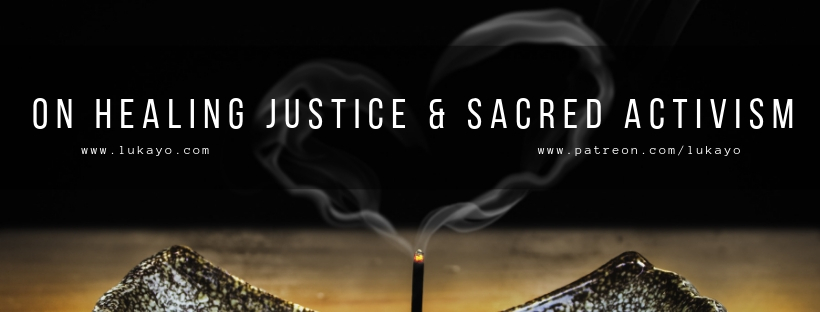
    Image Description: A stick of upright incense in a bowl on a wooden table. The smoke curls in the shape of a heart against a black background. The title on the image reads: “On Healing Justice & Sacred Activism” with the URLs “lukayo.com” and “patreon.com/lukayo“.

    (This article is one of a 5-part series written in the spring of 2017 for a spirituality and social work class.)

    As I struggle to keep my daily practice alive without regular classes to keep me accountable, I diversify how it is done. I am centering on the bus. I meditate on the train. I wander my neighbourhood and speak to the buildings and plants around me. I trance in the heart of Toronto, the downtown streets steaming with unsavory odours while their oracles stamp themselves into my mind through spraypainted graffiti on innocuous brick. I peer into campfires and sacred fires all night long in the woods at Henvey Inlet First Nations by the rez, grounding myself into firekeeping and lodge-building and ceremony with Cree, Anishinaabe, Haudenosaunee, Metis, and others. I spend hours divining meaning in the tumble of stones, the patterns of shells, and the spread of cards. I make food for my Ancestors. I pray. I seek Spirit in my activism.

    When one of my oldest friends, a gay Indigenous man, defends police involvement in Toronto Pride, repeatedly bringing up this sore point between us, I try to open myself to be mindful, to deep listening. “Deep listening requires us to clear space in ourselves first, so we can offer that space to those around us” (Gomez, 2015, “Listening is Sacred Activism, para. 12). I take a deep breath, I try to clear myself of all the pain and baggage I have around the police. I try to be present in the holistic and total nature of my friend that exists beyond this moment, and expand myself outside the incredulity that a gay and Indigenous man would defend the institution of policing. Instead I let myself be curious. I open up a space. I try to “come from a place of understanding and compassion” (Gomez, 2015, “Sacred Activism”, para. 8). From this place, I confront him gently, lovingly, by speaking my own truth without attacking his and by exploring this love or passion he has to defend police.

    I wonder if this is what it means to use bawi as part of interpersonal conflict? What Butot (2004) calls “spirituality”, i.e. “a recognition of the intrinsic interconnection of all beings and a recognition of, and respect and reverence for one’s own and others’ intrinsic wholeness, sacredness, and value as an expression of the diversity of this interconnection” (as cited in Butot, 2007, p. 149), is foundational to bawi. There is no native Bicol word for “spirituality” among my people because it is a part of our culture. What Butot’s definition stops short of, is the responsibility inherent in that connection. The gratitude that is expressed and the amends made because of it. I see this more reflected in Sheridan’s (2012) work concerning the connection of social justice and spirituality through seven key themes: “(a) spiritual motivation for justice work; (b) recognition of interdependence; (c) the means matter; (d) acceptance of not-knowing; (e) openness to suffering; (f) outer change requires inner work; and (g) commitment to spiritual practices” (p. 195). Specifically themes (a), (c), and (f) speak to this, though I could go on about each of these themes and how important they are to my own life, and find myself surprised that I wholeheartedly agree with every single one of them.

    I think what I find most interesting is that these themes need to be written about and gathered as “evidence” to practice spirituality with social work, when from my background, I don’t understand how to practice social work without spirituality– it would feel false and colonial and oppressive. It would neither be true to my values, nor my communities. In these readings, I scanned for what I understood about my spirituality– which is a connection to Spirit, and to the spirit worlds. None of that was mentioned. Instead, all of this seems like practical and obvious behaviours and protocols of a spiritual nature, but still without the admission of connecting to actual spirits.

    My sacred activism is all about healing, navigation, mediation, and advocacy– between people and institutions, the living and the dead, and humans and spirits. They’re all transferable skills, though the techniques are different due to technological advancement, and how culture grows, is colonized, decolonized, and resurges. However, though the course readings did not touch so much on my own ways of “spirituality”, it did clarify to me how social work and spirit work can be similar, and how my life path unfolds with the two intertwined or merged into a single movement, a flow of sacred activism.

    Works Cited

    Butot, M. (2007). Reframing spirituality, re-conceptualizing change: Possibilities for critical social work. In J. R. Graham, J. Coates, B. Swartzentruber, and B. Ouellette (Eds.), Spirituality and social work: Select Canadian readings (pp. 143-159). Toronto: Canadian Scholars’ Press.

    Gomez, M. B. (2015, September 10). Sacred activism: Mindfulness and racial justice. The Huffington Post. Retrieved from http://www.huffingtonpost.com/marisela-b-gomez/sacred-activism-mindfulne_b_8080444.html

    Gomez, M. B. (2015, November 11). Listening is sacred activism. The Huffington Post. Retrieved from http://www.huffingtonpost.com/marisela-b-gomez/listening-is-sacred-activ_b_8485818.html

    Sheridan, M. J. (2012). Spiritual activism: Grounding ourselves in the spirit. Journal of Religion & Spirituality in Social Work: Social Thought, 31(1-2), 193-208.


    If you like what you’ve read and want to support healing work among my Elders, teachers, and communities, please subscribe to my Patreon. Link to the original article here: https://www.patreon.com/posts/26449495

  • Workshop Wednesday: Pickup Planets

    Image Description: The title in white reads: “Pickup Planets”. The sub-title in pale grey reads: “A Game of Privilege and Oppression”. The backdrop is outer space, with stylized white stars and one shooting star on a black background. There are five planets– a small red one, a giant yellow one, a medium-sized blue one, a giant purple one with a thin ring on a vertical axis, and a medium-sized green one with a thick ring on a horizontal axis. The URLs in white read “patreon.com/lukayo” and “lukayo.com“.

    What’s The Source?

    The Pickup Planets Game was first taught to me at a LGBTQ+ youth leadership retreat called Project Acorn in 2010. The facilitators learned it a few years prior from Karen B.K. Chan (http://www.fluidexchange.org/), who had facilitated the creation of the earliest version of the game with youth of colour in Toronto.

    What’s The Point?

    This game shows the ways people come from different social locations and deal with systemic pressures. It illustrates basic understandings of racial and class privilege and oppression.

    Who’s It For?

    This game is best for ages 12 and up.

    What You Need

    • Pickup Planet Activity Cards
    • Red buttons/stickers/ribbons/etc. equal to the amount of Red Pickup Planet Cards you have
    • 10-40 players/participants

    What You Do

    1. You hand out Pickup Planet Activity Cards to all participants.
    2. Make sure all Red Cards come with a button/sticker/ribbon/etc. for the participant to wear.
    3. Make sure there’s at least two of every card given out (Red, Blue, Yellow, Green, and Purple).
    4. First, tell the participants that they can read their cards but can’t show their cards to anyone.
    5. Secondly, tell the participants that they have to act out whatever the card tells them to (but keep your hands to yourself!).
    6. Lastly, tell the participants that the point of the game is to “pick up” as many friends as possible, and they have 5-10 minutes to do so.
    7. After 5-10 minutes, ask the participants to sit down in a circle together and start a discussion.

    What You Talk About

    1) [Do this for every card: Red, Blue, Yellow, Green, Purple] Who was from the [insert colour] Planet? Can one of you read your card out loud? What did it feel like to be from the [insert colour] Planet? What did everyone else feel and think about the [insert colour] Planet?

    2) What kind of real life examples do these cards talk about? Examples:

    • Green Planet is an example of newcomers who are still learning the dominant language.
    • Purple Planet is an example of newcomers and peoples who have different cultural values and behaviours.
    • Red Planet is an example of privileged and supremacist-thinking folks.
    • Yellow Planet is an example of folks whose people have been demonized and oppressed for generations.
    • Blue Planet is an example of folks who have been colonized and/or oppressed for generations and are pro-assimilation.

    3) Explain that this game is a great example of privilege. You, as the game facilitator, are the system of privilege that sets up everything up. No one earned or were chosen to be from Red Planet, and no one earned or were chosen to be from Yellow Planet—it was randomly chosen. Privilege is that unearned advantage, and oppression is that unearned disadvantage. It doesn’t mean the system is right, and it can be undone.

    4) Imagine if the goal of the game wasn’t to get as much friends as possible, but also to get jobs, land, resources, opportunities, and livelihoods. How can we work together to make sure people feel less alienated and oppressed? Examples:

    • Cultural exchanges where we try to learn each other’s cultures and languages.
    • Individual interactions where we think about why we react a certain way and work to understand where the other person is coming from, without jumping to assumptions and stereotypes.
    • Going through anti-oppression and decolonization training.

    Want to have access to the Activity Cards of this game, and other anti-oppression related teaching games and tools? Click on the link below and subscribe for as little as $4/month. By becoming a patron, you support healing work among my communities, and the indigenous Elders that mentor me.

    https://www.patreon.com/posts/27040291

  • Troubleshoot Tuesday: The Place of Rage Pt 3

    Image Description: The background is hot pink. There is a gradient pink and yellow circle with a giant yellow “angry” emoji/emoticon in it. The title text is yellow and reads “The Place of Rage Part 3”. The links in black are “lukayo.com” and “patreon.com/lukayo“. The other title pages are yellow circles or gradient yellow-pink circles on a hot pink background with a yellow border. 

    Content warning: trauma, police, prisons.

    Transcript:

    Mabuhay! If you haven’t already checked out part one and two, I suggest you listen to them first. The links are in the video transcript, along with links to writers that informed this series.

    This week we’re focusing on the question of “what happens when expressions of anger have harmed someone in a space?” Especially if it’s a space that you’re facilitating or leading for skill-sharing and educational purposes? My approach tries to take into consideration two core concepts: trauma and ethics.

    Before we get into it, I just want to put a content warning up, since we’ll be talking about trauma, prison, and police systems.

    So why are we talking about trauma? First of all, my understanding of trauma was covered in a previous Troubleshoot Tuesday article, which I’ve also linked in the transcript. To sum it up in a really basic way, trauma is a reaction to being or witnessing wounding and harm, and it messes up your threat response. The idea is that we have the capacity to choose our threat response when we are threatened or harmed (like fight, flight, freeze, appease/fawn, etc.) but when we are traumatized, a threat response gets “stuck” and starts automatically before we can even think about it. This is what being “triggered” means in trauma theory. So for me it’s important to introduce concepts like triggers and trauma into my workshop early on, like in the Community Agreements, and discuss how to hold space for those stuck threat responses. That way when anyone does get triggered, whether they know if they have trauma or not, other people in the workshop are prepared and there’s some guidelines in place on how to support everyone.

    But how about when folks can choose their behaviour when they feel threatened or when they witness or experience harm? That’s ethics. There’s so many concepts out there about what folks think are moral, i.e. “good and bad”, so I’m just gonna cover some of my own ethics and how that’s informed my responses in my workshops. I’m hoping that this sharing will help you figure out or rethink your own courses of action in your teaching spaces.

    In my previous video on The Place of Rage, I talked about considering power dynamics in the space, which I think is foundational to intersectional anti-oppressive ethics. My ethics is also relationship-based, and is part of a decolonial and disability justice framework. Lastly, I believe in transformative justice (TJ), and I think that TJ makes sense as a form of ethics that also comes out of, if not the same as, intersectional anti-oppression, decolonization, and disability justice.

    My understanding of TJ is informed by workshops run by the Just Practice Collaborative in Chicago, writings by the Bay Area Transformative Justice Collective in Oakland, California, and the zine and book The Revolution Starts At Home (all of these linked in the video transcript below). As well, transformative and restorative practices are deeply embedded in the practices of many Indigenous peoples to Turtle Island, and their teachings in informal and formal gatherings, in social media and over messenger, and the hard and necessary work that is done alongside the settler colonial Canadian prison industrial complex with Gladue sentencing, also has informed my understanding, and I owe a debt to them as do many settlers and non-Indigenous to Turtle Island folks when trying to practice transformative justice. Though I will not cover it in this series, my understanding of transformative justice is deeply informed by ceremony with my own people and indigenous peoples in Turtle Island and in the Philippines.

    The first thing I try to do when responding to harm in a workshop space I am facilitating, a harm traced directly from someone’s expression of anger, is that I try to slow down or redirect any responses I have that come from my own trauma, and focus on consequences and the impact of the harm on everyone involved, and perhaps communities that aren’t even in the space right now but are connected in some way.

    Thinking and feeling about consequences is important, and I try to go there instead of immediately wanting to punish, exile, and control. My understanding of the settler colonial and racist prison and police systems that I’ve grown up in is that they operate on systems to control that are enforced through punishment and exile– “I’m going to make this person hurt, I’m going to make this person lose, I’m going to make this person feel worthless and take away as much of their humanity as possible because they are bad and wrong”. These systems got into my head, mixed up with my trauma, when I was growing up, and it takes a lot of practice and conscious effort every day not to fall back on them. I don’t want to make people disposable because this is against my values of intersectional and decolonial anti-oppression and disability justice. I don’t want the prison and police in my head to win, because I believe there is another way to go about things.


    Want to listen to/read the rest of the video? Please subscribe for $10 per month to gain access to weekly interactive posts where you can ask questions about the creative process and troubleshoot your anti-oppressive workshops. Supporters will also receive a mailed package with print-outs of anti-oppression activities and posters. All funds raised go to healing work among my communities. 


    Links:

  • Musings Monday: On Healing Justice & Sacred Activism (Part 4 of 5)

    Image Description: A stick of upright incense in a bowl on a wooden table. The smoke curls in the shape of a heart against a black background. The title on the image reads: “On Healing Justice & Sacred Activism” with the URLs “lukayo.com” and “patreon.com/lukayo“.

    (This article is one of a 5-part series written in the spring of 2017 for a spirituality and social work class.)

    Back against the wall, smoke unfurling up and across my body, wreathing my head and sliding into my nostrils. I remember the smell of coconut husk shavings and fire, soothing me as my energy fell into the ground and spiralled upwards. My grounding exercises are tinged with guilt and responsibility, since I had stopped the practice quite frequently in the last two weeks before. I’ve built a new sleep routine, with the exercise, and flossing, and grounding exercise. Issues that have been bothering me throughout the day begin to resolve themselves during the grounding period– not even actively. I watch the thoughts come and go like the flickering images on a screen, moving from confusion that a situation is happening, and then blooming, unexpectedly into a sense of understanding as to the motivation and what it means to me. It also gives me time to pay attention to my aching and ill body.

    As I write this reflection, so late that it’s almost morning, I think of Hanh’s (2007) admonishment: “If you don’t know how to take care of your body, how to release the tension in your body and give it permission to rest, you don’t love your body” (Hanh, 2007, p. 48). I grow sad about the revelation that I don’t love my body, because I definitely want to. The truth of the matter, though, is that my actions do not align with my desires, with my wants. This is something that I desperately want to make right. I wonder if I can incorporate it into my grounding exercises, lengthen them from 10 minutes to 20 minutes, by embracing mindfulness through a self-healing. “When you come to an organ or a part of your body that is ailing, you can stay with it longer, using the energy of mindfulness to embrace it and smile to it. This will speed the healing” (Hanh, 2007, p. 49).

    I think about the microcosm of my body being a type of balance that needs to be restored, and all the things that need to be transformed for that to happen, within myself, outside myself, and all the social and spiritual communities and environments I inhabit. Similarly, the macrocosm of cultural community, and of society in general, replicating the harm being done to the body by the harm we inflict on all Creation. Baskin (2011) believes “the balance needs  to be restored by making the one who caused harm accountable, providing compensation to the person who had been harmed, and conducting healing ceremonies” (p. 153).

    These healing ceremonies are what fascinate me, what drives me to my inevitable life’s work, and to the group “Healing Justice Network Toronto” on Facebook. How do we bring the community together so we just don’t restore lives to a broken system, but transform those lives and transform the broken system together? And not just fancy spas and luxurious “spiritual” retreats only accessible to the privileged and rich. These ceremonies and circles should be open to any who want to transform their communities and support the reparation of relationships from harm, for “the true measure of our character is how we treat the poor, the disfavored, the accused, the incarcerated, and the condemned” (Stevenson, 2015, p. 18). I would even go further– it’s not just how we “treat” them, it’s how we centre them, it’s how we empower them to lead their own movements while we work alongside them.

    This subject has been on my mind even more so than usual because I will be on a panel on June 26th called “Alternatives to the Criminal Justice System” from racialized LGBTQ perspectives. My contribution to the panel can be summed up in Stevenson’s (2015) emphatic belief that “each of us is more than the worst thing we’ve ever done” (pp. 17-18). Last summer I was on a similar panel, and I spoke of what it means to rehabilitate oneself, to restore the balance, and work towards transformative and healing justice when you are a person who has done harm. I talked about self-accountability skills and how crucial that is in being accountable to your community. I talked about ways to offer compensation, and ways to make amends. But I did not speak of healing ceremonies. On this new upcoming panel, I think that’s definitely what I want to discuss more of. I want to explore with my fellow panelists and also those who’ve come, the nuances of a survivor-centric politics while trying to practice transformative justice, and what that means for communities that do not have shared accountability lore and traditional customs. I feel like when the queer and trans community tries to implement such processes, that they inevitably fall apart because there isn’t that foundation of trust in a tradition with recognized Elders that can bear the process and have the confidence of the community. That for these processes to be more effective, grounding it in ceremony, in a community-wide consensus on what our values are and who we are asking to embody them, need to be the next steps.

    Works Cited

    Baskin, C. (2011). Chapter 9: Healing Justice. Strong Helpers’ Teachings: The Value of Indigenous Knowledges in the Helping Professions. Toronto: Canadian Scholars’ Press.

    Hanh, T. N. (2007). The art of power. New York, NY: HarperOne.

    Stevenson, B. (2015). Just mercy: A story of justice and redemption. New York: Spiegel & Grau.


    If you like what you’ve read and want to support healing work among my Elders, teachers, and communities, please subscribe to my Patreon. Link to the original article here: https://www.patreon.com/posts/26449384

  • Workshop Wednesday: So It Begins!

    [Image Description: A black and white photo with a light bulb, two pencils, and an eraser on top of a blank piece of paper. The photo is part of a cover page that is in turquoise, light grey, and dark grey. There are also pyramid shapes in monochrome. The title is “So It Begins!” and the URLs are lukayo.com and patreon.com/lukayo.]
     
    Transcript:
     
    Mabuhay to Lukayo’s Workshop Wednesday Video Series! For our first episode, I’m going to offer some suggestions about how to begin your workshop, specifically a workshop grounded in anti-oppression.
     
    We’re going to look at the following 5 different parts: introducing yourself, land accountability and gratitude, community agreements, checking in with the participants, and icebreakers.
     
    Introducing Yourself
     
    Basic components involve your name and your pronouns. You can even talk a little bit about yourself, like if you represent an organization, or come from a certain school, or why you wanted to do this workshop.
     
    I like to introduce myself in my native language. “Mabuhay! Lukayo ako. Taga-saan Bikol ako.” Welcome, my name is Lukayo, and I am of the Bikol people. My pronouns are “they/them/their”.
     
    This is important to me because I want to honour my ancestors and people, as well as show that I don’t completely follow the Westernized way of sharing knowledge.
     
    Sometimes, if I know the language of the land, I may say hello in that language to honour the people of that land. For example, if I’m in Anishinaabe territory, I may say hello in Anishinaabemowin.
     
    Land Accountability & Gratitude
     
    At this point, I like to give thanks in gratitude to the people of the land, and also mention the treaties that that specific area is under. If possible, if I’m presenting on land that I’m not indigenous to, I also try to explain what happened to the treaties and what the responsibilities are that settlers have to indigenous folks. I consider that my responsibility as a settler, especially one sharing knowledge in a gathering.
     
    So how do I find out about all of this info? I attend indigenous education trainings from the people of the land I’m currently residing on, put together by Native Friendship Centres or grassroots indigenous collectives. I also check out websites like DecolonialAtlas.wordpress.com and Native-Land.ca.
     
    Lastly, I talk about how settler responsibilities have expanded beyond just respecting treaties, especially in areas where the treaties have been broken, or land was outright stolen and no treaties were made. I talk about reparations as a form of accountability, and current ways I am offering reparations in accordance with what has been asked by local Indigenous collectives and grassroots organizations, as well as further ideas for reparations for anyone attending, such as supporting local Indigenous grassroots initiatives in regards to reclaiming sacred areas and land, justice for missing and murdered Indigenous Two spirit peoples, women, and men, and healing initiatives led by Indigenous peoples for Indigenous peoples.

    Want to listen to/read the rest of the video? Please subscribe to my Patreon for $5 per month to gain access to anti-oppression workshop tutorials and videos. All funds raised go to healing work among my communities. Original article here: https://www.patreon.com/posts/26879671

    Links:
  • Troubleshoot Tuesday: The Place of Rage Pt 2

    Image Description: A cellphone with a giant angry emoji/emoticon on the screen, lying on top of a wooden surface.

    Transcript:

    Mabuhay! If you haven’t already checked out part one, I suggest you give that a listen first, before jumping in. I’m going to build on what I talked about last week, which was in favour of emotions and anger, by discussing this idea of “too much”, which leads into concepts of conflict, abuse, bullying, and oppression (so content warning for all those things).

    Here’s the core question for me: When is the expression of emotions and anger considered “too much” in a given context, especially a workshop setting, without perpetuating oppression by policing, silencing, and invalidating people’s trauma and pain? How do we figure that line out? And, if we have that line figured out, what do we do when it’s crossed?

    I wonder if this is more a question of ethics than it is anti-oppression– but to me anti-oppression and decolonial thinking is a form of ethics. I just find the ways that this ethics is interpreted or practiced on the daily is so different from one person to the next, from one social group to the next. This gets into complicated territory of “are we gaslighting survivors?” and “are we believing survivors?”, as well as “are we apologizing for abusers?” and “are we scapegoating other survivors as abusers when we don’t ask for evidence or their side of the story?”

    Now, before I get deeper into how I would attempt to figure this line out, let me state briefly that, speaking for myself –while encouraging other people, groups, and collectives too– the attempt must be made, because the consequences are dire. I have witnessed harm occur when anger is expressed violently and abusively, and I have witnessed harm occur when anger is expressed and it was arguably not violent or abusive but the backlash towards the expression was violent and abusive. I have witnessed harm occur when people have done nothing and when people have intervened. The stakes are high, and I want to grow and move forward– I want our movements and our campaigns to grow and move forward too.


    Want to listen to/read the rest of the video? Please subscribe to my Patreon for $10 per month to gain access to weekly interactive posts where you can ask questions about the creative process and troubleshoot your anti-oppressive workshops. Supporters will also receive a mailed package with print-outs of anti-oppression activities and posters. All funds raised go to healing work among my communities. Original article here: https://www.patreon.com/posts/26851147


    Links:

  • Musings Monday: On Healing Justice & Sacred Activism (Part 3 of 5)

    Image Description: A stick of upright incense in a bowl on a wooden table. The smoke curls in the shape of a heart against a black background. The title on the image reads: “On Healing Justice & Sacred Activism” with the URLs “lukayo.com” and “patreon.com/lukayo“.

    (This article is one of a 5-part series written in the spring of 2017 for a spirituality and social work class.)

    As my illness waxes and wanes, the crumbling of my body, the fog that smothers my intellect, and the surging tide of despair and rage that leaves puddles of hopelessness in its wake– all become factors and bitter seeds to chew upon as I reflect on how I fell out of my daily centering exercises. There are ways I tried to make up for it– I tried to exercise more every day. I tried to center myself on the subway– though inevitably I fall unconscious. I try, so hard, not to shame myself about it. And yet, shame I feel all the same. Did it begin with the physical examination? The doctor’s appointment that demanded that despite the levels of chronic pain I am in, exercising will help? I downloaded an app to monitor my sleep, food intake, and exercise quantity. Then there was the dentist appointment. She asked me to floss every night. I noted it and tied it to a before bed practice. The app could not add my daily centering practice. The app began to regulate my life, and the centering faded from my memory– as if I can only hold one daily routine at a time, as if the flossing, though not electronically monitored, replaced it within my mind.

    I seek to return to the centering practice this week. I seek to absorb the lesson here. I have tried, throughout the decades to make lists on my walls, on my phone, on my computer, of routines I “should” do daily. Inevitably they are forgotten in a few weeks’ time if I don’t have a form of accountability attached to an external source. Often I shame myself that this is a personal failing. Now I contemplate that this, in fact, is a symptom of a gift that I have, of connection to others, of the sort of deep empathy I can cultivate because of my ability to attune to other people’s needs and align with a group’s values. I am driven into being useful to those around me– if a daily practice does not seem immediately useful in a way that can be externally and readily validated, it fades from my habits. Just like the flossing did years ago until I had a check-up. My thoughts are spinning on how to organize weekly meetings (online and offline) with a spiritual care group (of self- and community-care) where we write each other journal entries on our daily practices.

    I also know of the dangers that my connection to others, what is sometimes called “reward-dependent” behaviour or codependent tendencies, can wreak. As Hanh (2005) points out, “We busy ourselves doing as many things as possible, taking refuge in doing more and more, faster and faster. The more we do, the greater the suffering becomes” (p. 13). It is easy for me to escape into the tempting lull of “busy”ness, away from my feelings and the hard work I must do in solitude or in difficult dialogue. In this, there is a revelation as I read Hanh’s piece on “Uprooting Terrorism”– there is a difference when I am compassionately there, as a counselor, a social worker, a being of connection love; and when I am a rescuer, a workaholic, a being that needs to keep busy and be rewarded for it. I cannot truly be there for others’ suffering when I cannot be there for my own suffering. I cannot truly be present and attentive when I am busy rescuing.

    Such interpersonal lessons, of the terror and pain in our own hearts, and the terror-filled actions that I have done and received from individuals, also translates into social groups, and institutional terror wielded by the state. So often I see “allyship” and “solidarity” as words flung about in moments of self-identification, when in fact they should be used to describe a relationship. I cannot declare myself someone’s spouse having never met them, and yet people call themselves “ally” when they have not tried to contact the group of which they claim to ally themselves with. Walia (2014) talks about moving “beyond a politics of solidarity”, specifically in regards to Indigenous issues, by

    taking initiative for self-education about specific histories of the land we reside upon, organizing support with the clear consent and guidance of an Indigenous community or group, building long-term relationships of accountability, and never assuming or taking for granted the personal and political trust that non-natives earn from Indigenous peoples over time (p.46).

    This paragraph can be broken down into four different essays in themselves, about what self-education looks like, how to build accountability relationships, etc. However, it inspires me to see it all written out like that, and validates my approach to stop being a “rescuer” in all ways in my life, from my activism to my romance, and instead work together with people to liberate ourselves from terror and trauma so that we may achieve joy and peace.

    But what would it look like to listen to my own suffering on a macro-scale? To understand the plight of my communities, of Pilipinx and QTBIPOC peoples? King’s (1963) “four basic steps” to a nonviolent campaign offer insight: “collection of the facts to determine whether injustices exist; negotiation; self purification; and direct action”. Though I am well aware and even proficient in fact-collecting, negotiating, and direct action, it is the third step that strikes me. Self-purification. King describes his process for the Birmingham direct action program as “self-purification” when his group put on “a series of workshops on nonviolence” where they asked themselves soul-searching questions like to what extent of violence they would be able to receive and how they would respond nonviolently.

    Here I believe is a service I both want to learn more of and organize and offer more of– the process of self-purification in our communities before we head towards direct action. Rituals of preparation, grief, rage, and contemplation as to our purpose and the desire for transformation and justice at our core.

    Works Cited

    Hanh, T. N. (2005). Calming the Fearful Mind: A Zen Response to Terrorism. Parallax Press.

    King Jr, M. L. (1963). Letter from Birmingham city jail.

    Walia, H. (2014). Decolonizing together: Moving beyond a politics of solidarity toward a practice of decolonization. In T. Kappo and H. King (Eds), The winter we danced: Voices from the past, the future, and the Idle No More movement, 44-50.


    If you like what you’ve read and want to support healing work among my Elders, teachers, and communities, please subscribe to my Patreon. Link to the original article here: https://www.patreon.com/posts/26449099

  • Throwback Thursday: Charity (2011)

    https://youtu.be/sMyBEQNyVCY

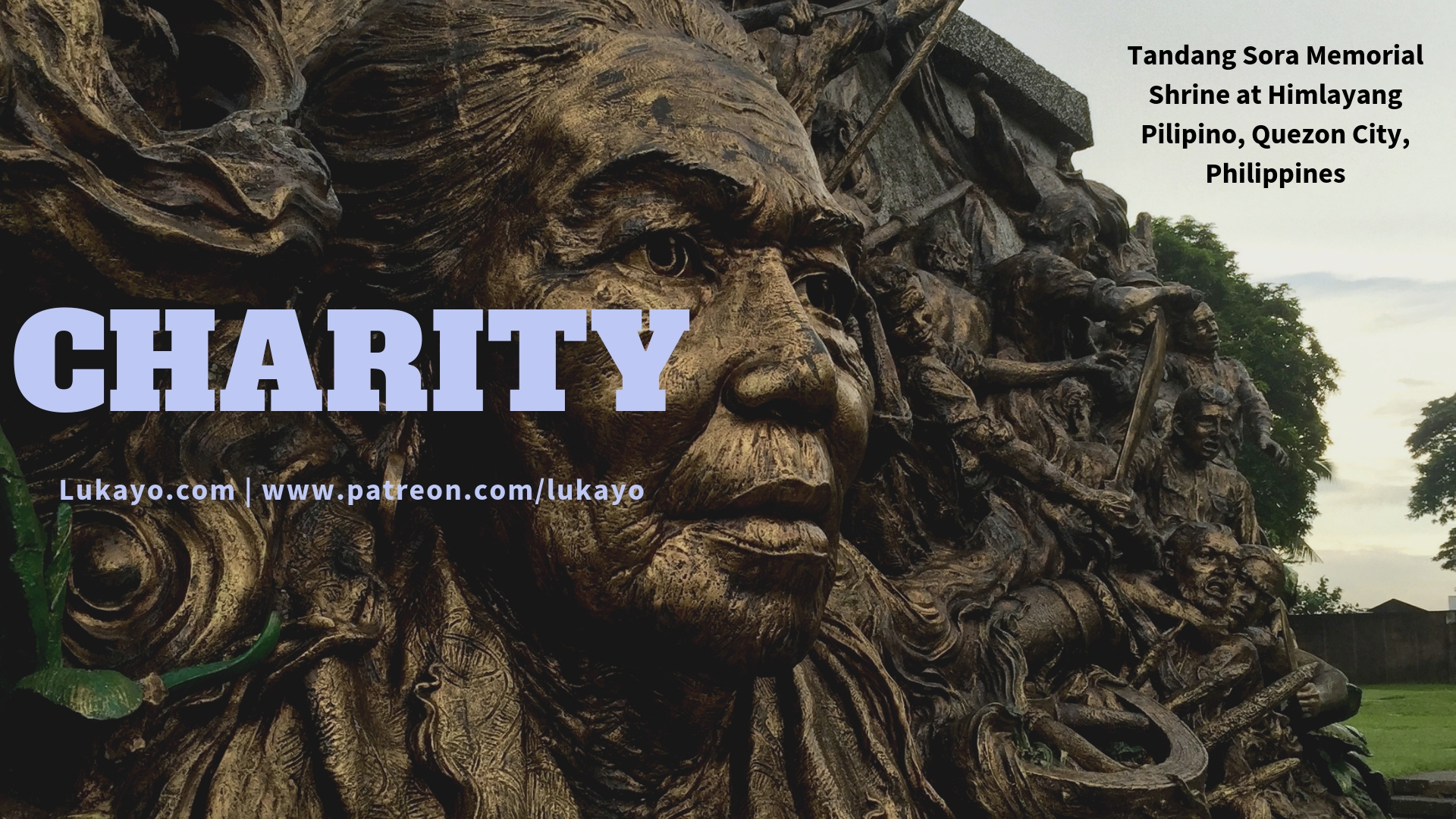
    Image Description: A photo of the a bronze statue of a Filipina woman, the bust of her head larger than the background depicting the Philippine Revolution. The words at the top read: “Tandang Sora Memorial Shrine at Himlayang Pilipino, Quezon City, Philippines”. The title reads “Charity”. The website addresses are “Lukayo.com” and “www.patreon.com/lukayo”.

    Content Warning: About the prison and military industrial complex, mentions torture, and alludes to sexual assault.

    Dedicated to my she-roes: b. binaohan, Beatriz Colmo, Charity, Dino, Sass Rogando Sasot, and all transpinay and pinay writers and organizers for justice and freedom. This poem is for you.

    The heat clings to me as if I had just wooed it with
    Well-placed words and its favourite drink
    Making it hard to think, it’s so hot that the sweat on my thighs
    Evaporates faster than the breaths in my sighs
    But I’m not thinking about that because I’m here
    Looking into her eyes

    Ignoring her ragged clothes scrubbed clean with diligence
    And the men outside with their guns and vigilance
    The dirt floor and grey cracked walls,
    The people pressed up like animals in concrete stalls
    The strip searches and razor-wire fear
    But I’m not thinking about that because I’m here

    Looking into her eyes
    And listening to every word that drops from her lips
    Because this is the least that’s owed to her
    Because this is the least that I can give

    And when she’s finished speaking
    My silence hangs like a stone around my neck
    Heavy with all the things that you wouldn’t expect
    Like my aunt’s medical career
    My grandfather’s typing skills
    My parents taking me and my brother away from these coconut tree covered hills
    From these smoking volcanoes and smoky-mirrored unlicensed vans
    From these ocean-drenched beaches and smog-stained cities I call my homeland
    Growing up in a country where we can talk trash about our politicians on Twitter
    Form unions, have anarchist book fairs, and march in the streets when we feel bitter
    Have lengthy discussions about the state of the world in air-conditioned classrooms
    Not worry about the tab when doctors finally see us about a mild cold or grave wound
    My silence is filled with every decision that lead me here

    Where I’m looking into her eyes
    Where I’m the visitor and she’s the inmate
    And my presence is just a mere consolation prize
    For what we both really want:
    Her freedom

    Before this moment, I thought I knew what a hero was supposed to be
    Some nerdy white guy with another personality and random luck
    That made him big and green or spider-keen, or faster than a flying machine
    They were the ones that kept the world clean from tyranny and villainy
    Taking all the bad guys away from civilized society
    And putting them here
    And I’m looking into her eyes
    And I’m listening to the words that drop from her lips
    Like her name: Charity
    Charity Dino.

    Charity Dino was a schoolteacher who loved to read
    But when she saw corporations displacing families, she saw the need
    To gather up the people, form a union, start a protest
    Isn’t that what they do in democracies? Isn’t that what they do in the West?
    And on a stretch of road one November morning came rolling
    An unmarked van that grabbed her off her feet
    Shoved a bag over her head and tied her up like a piece of meat
    Brought her to a cell that would be her home for two weeks
    They used her body and her sex, threatened her family and friends
    To get her to confess to something she didn’t even comprehend
    “You’re a communist! A terrorist! Sign the paper, and we’ll stop.”
    How can you confess to something you were not?
    So they threw her in prison charged with carrying explosives
    Though she never held a weapon, never hurt a person, and they know this
    What they didn’t know was that Charity had with her community and truth
    Not just Sonny and Billy, her colleagues who were tortured too
    But dozens of activists who made the call throughout the world
    That here in this island country, let these voices be heard
    And then came visitors, letters, food rations and supplies
    Charity wrote and read every day, she began to organize from the inside

    And the higher-ups grew nervous, posted military around this little jail
    Threatened to kill her with a hired gun, but all to no avail
    So a man in a uniform with metals on his chest
    Came down to see her and said “We can erase this entire mess.
    Die in prison a monster, or join the army a hero– this is your choice.”
    But Charity wasn’t listening to his words, it was his voice
    “You’re the one who kidnapped and tortured me,” she said with recognition.
    And he shrugged his shoulders, “So? What’s your decision?”
    “I’m not thinking about that because I’m here,” she said.
    “Looking into your eyes.
    And this is what I realize.
    I’d rather die in prison serving the people
    Then join and serve the likes of you.
    Now get out. I’ve got some organizing to do.”

    So what’s a hero? What’s a terrorist?
    What exactly are prisons for?
    Are the villains in these holding cells
    Or in offices behind closed doors?
    How many more like Charity, and the Talisay 3,
    From Burma to Cuba, from Egypt to Haiti
    From China to the United States, from Zimbabwe to Iran
    From Venezuela to Cambodia to Azerbaijan
    Must be kidnapped and killed, or tortured and imprisoned
    Until the rest of us finally make our own decision?
    But I’m not thinking about that because I’m here.

    Looking into her eyes.
    And she doesn’t ask me to speak, doesn’t ask me to decide.
    But I choose to offer her my privilege, my poetry, my potential to do more
    Because this is the least that is owed to her.
    Because that’s what heroes are for.

    Note: Arrested, tortured, and incarcerated in November 2009, Charity Dino, Billy Batrina and Sony Rolegio spent more than 3 years as political prisoners in my homeland, the Philippines, all because they wanted to start a peasant union. Over that period many activists came to visit them, fundraise for legal aid, and spread the word. One of those activists was me, who wrote this small poem and used it to fundraise money in the Filipino community in Ottawa, as well as to raise awareness and put pressure on the government by petitions written by Canadian labour unions and churches. On the morning of December 26, 2013, all charges were dismissed because of lack of evidence, and Billy, Sony, and Charity were finally free to go home. Never stop writing and organizing– we can become accomplices in each other’s struggle and make a difference.


    If you liked this content, please become a patron, where all funds raised goes directly to healing work in my communities. Link to original article here: https://www.patreon.com/posts/26731218

  • Troubleshoot Tuesday: The Place of Rage

    Image Description: A cellphone with a giant angry emoji/emoticon on the screen, lying on top of a wooden surface.

    Transcript: 

    Mabuhay! This Troubleshoot Tuesday, I’m going to briefly talk about what Katherine Cross writes as “call-out culture, purity politics, and the veneration of rage in activist circles” (the link to her article in Feministing is in the transcript to this video). This is a multi-part series because of how huge this topic is.

    I am not going to talk about social media scapegoating because these tutorial videos are about supporting folks facilitating workshops and running programming in their schools, communities, and workplaces. I think that the dynamic and nuanced discussion on social media scapegoating and shunning culture is super important, and I’ve offered links below to folks who have a lot to say about it.

    In the next few videos I’m going to talk about different strategies to handle rage in participants (and yourself) during a workshop. In this particular video I want to argue in favour of emotions, and in favour of anger, and how to make space for it.

    I’ve noticed historically and currently how “being emotional” is equated with “being less than” in regards to feminized people and racialized people, and that anger is only permitted for the masculinized– and white. It’s a tactic of silencing, where a person or people’s pain is minimized or erased by the underlying message that they have no right to be angry at all. Giving space for emotions and anger in our workshops for folks who have been told they are “too angry” and “too emotional” is about validating the pain and trauma that folks have endured under oppressive circumstances.

    So how do we make space for these feelings? You can say it openly, right at the beginning of the workshop or discussion. That it’s okay to cry, to get angry, to need to walk out, to ask for space, or a hug, or to shake with fear and anxiety. Talk about your own feelings, how they affect you, how they may express themselves during the workshop. I talk about how sometimes I sing when I’m nervous, and I cry suddenly, and that’s okay to let me cry. That when I get angry, I clench my fists, and I scream into pillows but my voice doesn’t rise.

    I think it’s also important to bring this up during the Community Agreements part of your workshop (a video on that coming up soon). I don’t think it’s responsible to hold space for emotions without checking in with everyone about any trauma they’re willing to disclose regarding triggers, as well as agreements made on how to manage conflict and feedback between participants, and if there are support people to check in on folks who step out in the midst of great distress.

    Anyway, that’s it for today! Don’t forget to comment on this post with your own concerns and questions, and I’ll be happy to answer and troubleshoot with you any situations that have come up for you in your own work and discussions. Tune in next week for more on The Place of Rage!

    Links:


    If you liked this video, please become a patron, where all funds raised goes directly to healing work in my communities. Link to original article here: https://www.patreon.com/posts/26681270


The site will be down Thursday, July 30th from Noon until 4pm EST for webhost transfer and maintenance.

Close Welcome Bar