Author: Lukayo

  • News: Schedule Update, Upcoming Show & More!

    Thank you all for your patience as I mourned and worked through grief, theft, and injury in the last month or so. In the meantime, I’ve also been doing a lot more healing work with clients / community members, and I’m part of a spiritual art show!

    This means that I will no longer have a regular schedule for my Patreon and instead will try to update whenever I can, with at least doing a post per week (2 patron-only posts and 2 public posts per month).

    As for the art show, here are the details:
    187 Proudly Presents: 13 OFFERINGS
    OPENING NIGHT
    WHEN: November 23, 2018
    WHERE: 187 Augusta Ave, Tkaronto/Toronto
    TIME: 6 – 10 pm
    FEE: PWYC / suggested $10
    A co-creative project conjured by 13 healers, lightworkers, brujas and artists. Photography, poetry, music, altars, and art. Along with 12 other healers, I will have an altar and photographs set up to express my practice and identity as an artist-healer. There will also be some presentations of my poetry and music.
    Facebook Event Page: https://www.facebook.com/events/253115705556588/

    Stay tuned, as I’ll be starting up a workshop series in December on undoing anti-Blackness and settler colonialism in Filipino/Pilipinx communities, self-accountability, and spiritual trauma work! Below are some of the titles for the spiritual mental health series (feel free to suggest more if you feel inspired):

    *The Soul Wound: Decolonizing Trauma*
    Based on works by Grace Nono, Eduardo Duran, and Renee Linklater, this workshop will explore both Western and non-Western approaches to healing trauma, or “soul wounds”/ “wounds of the spirit”. Lukayo will also be drawing upon their background in peer support, co-counseling, and somatic experiencing trauma counseling, as well as traditional healing practices of Bikol and general Filipino peoples. The goal of this workshop is to explain non-Western approaches to trauma while not discounting the available Western avenues of healing. The first hour will be a go around and check in with all participants, creating group guidelines together on healing and sharing space. The second hour will be a discussion and sharing with each other on soul/spirit wounds, where they come from and how colonization/racism/heterosexism/cisgenderism creates and perpetuates them, their effects on our lives, and Western and non-Western approaches to healing. The third hour will introduce some techniques folks can practice on their own.

    *Protect Your Spirit: The Daily Effects of Capitalism and Colonialism*
    This workshop is very similar to The Soul Wound workshop, with the first hour for check-in and guidelines, and the last hour for techniques. However, in the second hour we delve into the concept that Capitalism and Colonialism are personal and systemic demons that are haunting us. What kind of things do they whisper to us, causing pain and uneasiness? How do they force us to compromise our own values and needs? What are the ways we can build resistance to them and peace for ourselves and loved ones even as they seem to be in every aspect of our lives? The goal of this workshop is to focus on somatic, psychological, and/or spiritual techniques and sources of strength and resilience against the daily effects of Colonialism and Capitalism, while shielding ourselves with knowledge and self-forgiveness.

    *Grounding: Managing Anxious Energy*
    This workshop is very similar to The Soul Wound workshop, with the first hour for check-in and guidelines, and the last hour for techniques. However, in the second hour we delve into the concept that “anxiety” is a form of energy that gets trapped inside us, thus causing harm to our body and spirit. What are the ways this energy enters or grows inside of us? How does this energy get trapped? How do we release it without causing further harm and distress to ourselves and others? The goal of this workshop is to focus on somatic, psychological, and/or spiritual techniques and strategies of grounding and mindfulness that builds on folks’ already existing strengths and practices.
  • Indefinite Hiatus on New Posts

    Hey folks, though I’ve healed from my injury, two recent deaths last week in the QTBIPOC communities I’m a part of requires me to have time away from posting. I also took down the Musings Monday on transmisogyny in nonbinary communities I posted earlier because it still needs a lot of revisions. If you were one of the folks interested in giving me feedback, just message me and I’ll email it to you.

    I hope to be back next week or the start of November at the latest. I’m so grateful for the new patrons that have signed up recently!

    Diyos Mabalos for your patience and understanding.

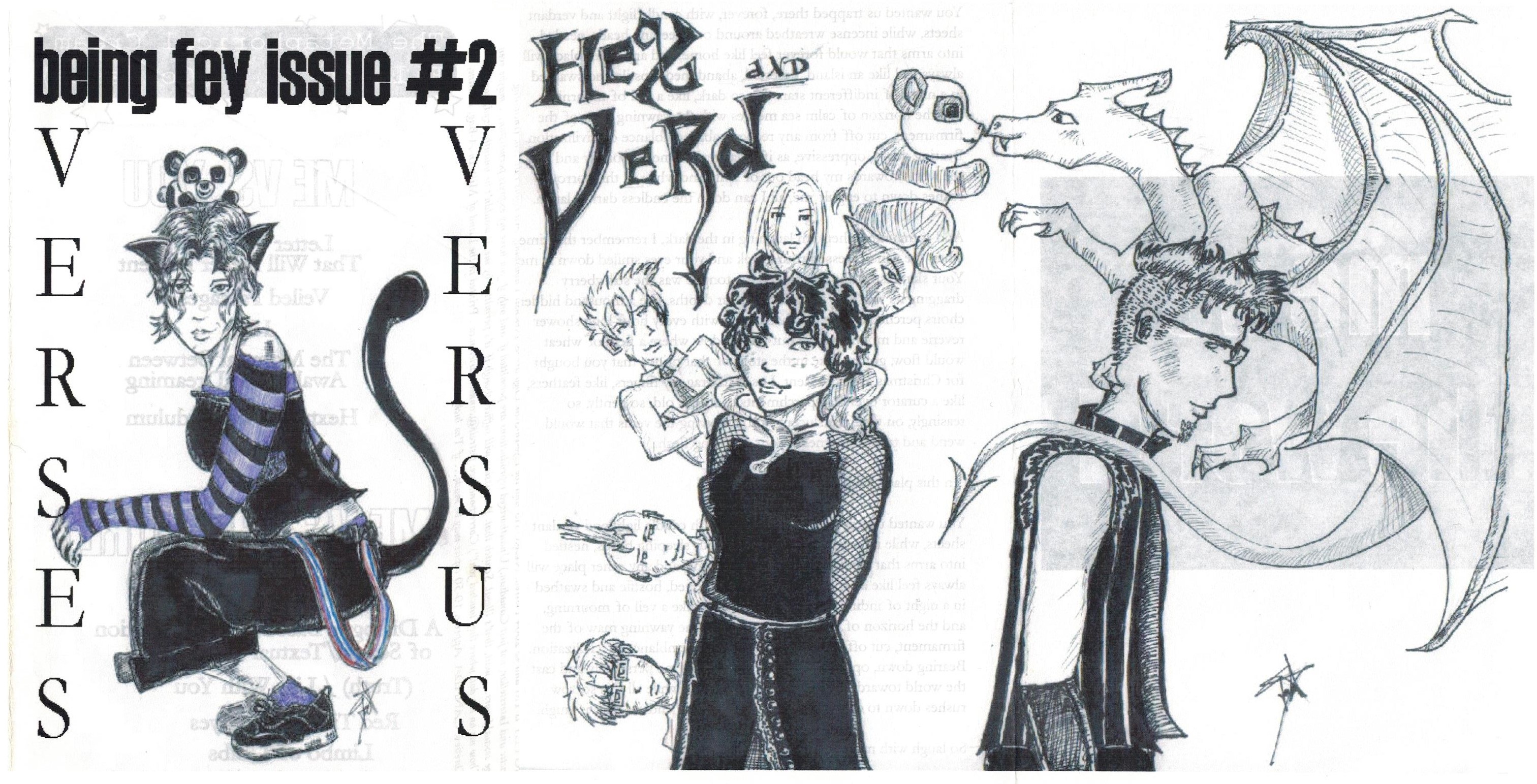
  • Throwback Thursday: Being Fey #2 (2004)

    Image Description:

    The cover of the zine is a picture of a person with cat ears and tail, curly black hair, purple and black arm warmers, black jeans, striped suspenders, black sneakers, purple socks, with a tiny panda on the person’s head. The title is “being fey #2” and “VERSES / VERSUS”.

    The second picture has many beings– a curly-haired Asian person wearing fishnets and a skirt, with several spirits (a short-haired face with glasses, a partially-shaved face, a person with a tie, a person with long hair, a black cat, and a panda). They are facing away from a white person who has glasses and wearing a black vest, with a dragon spirit on their shoulders. The dragon and the panda are reaching for each other. The title of the picture is “Hex and Verd”.


    Wanna see the rest of the artwork and the full pages from this zine? Better yet, want to commission me to draw something for you? Click on the link to become a patron. For as little as $1/month you can support healing work among my communities, and the indigenous Elders that mentor me.

    https://www.patreon.com/posts/22142796

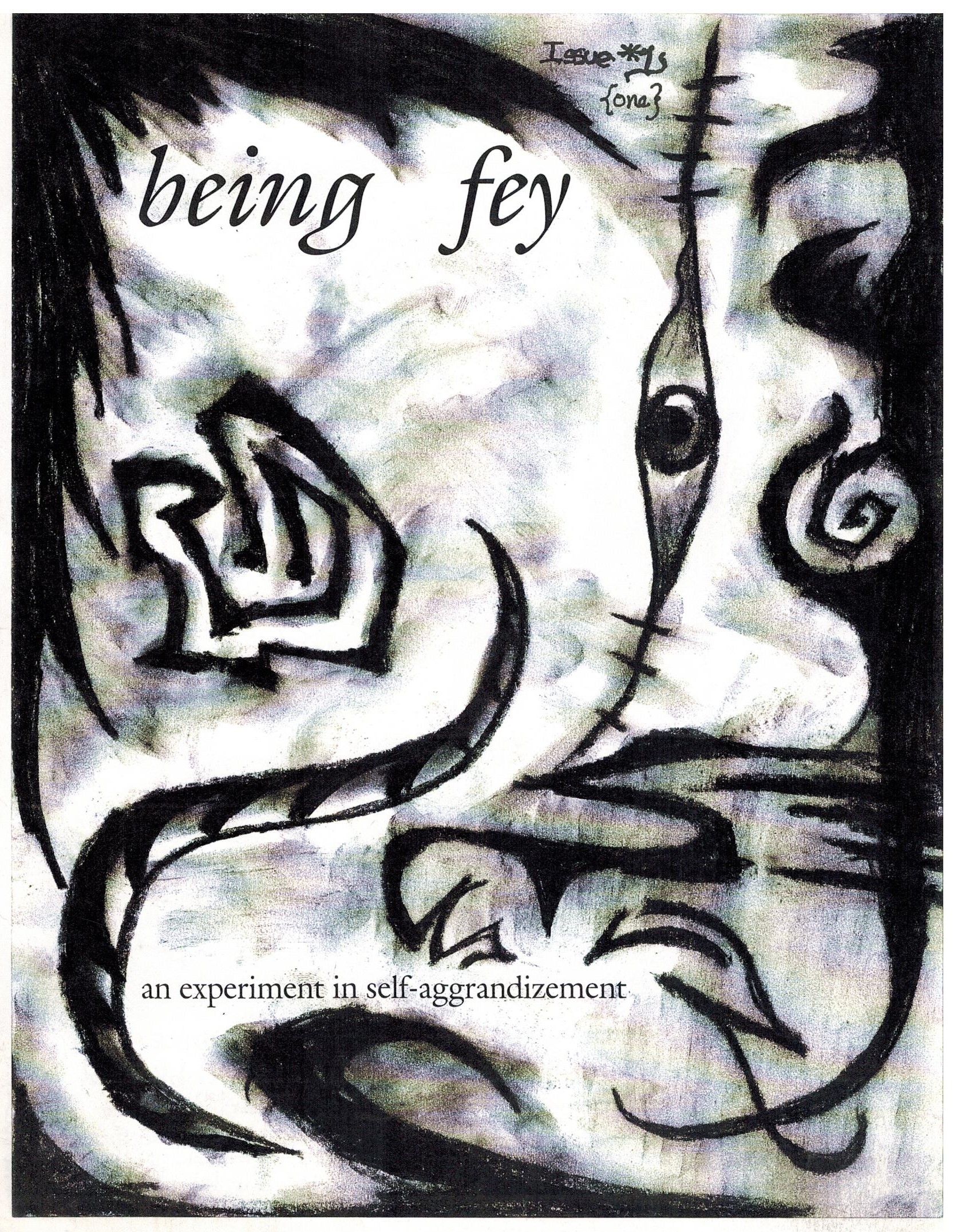
  • Throwback Thursday: Being Fey #1 (2003)

    Content Warning/Trigger Warning: questioning reality/schizophrenia mention/casual saneism

    Image Descriptions:

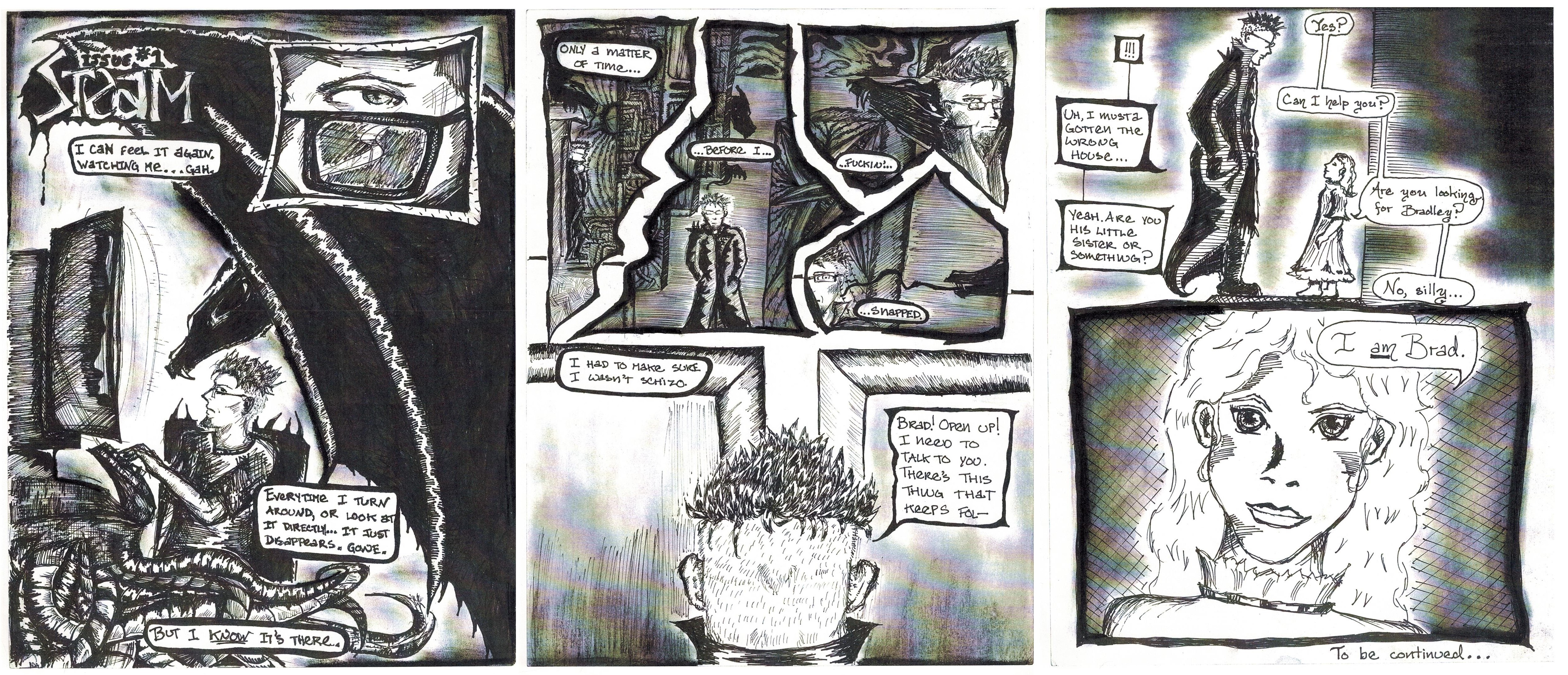
    The cover of the zine is an abstract art piece done in charcoal with shapes that look like claws, spirals, eyes, stitches, tails, wings, etc. The text reads “being fey Issue *1 {one}” and “an experiment in self-aggrandizement”.

    Title page of a comic done in black ink and charcoal. The main picture is a bespectacled pale-skinned figure with a goatee and short spiky dark hair sitting at a computer on top of a next of tentacle wires, with a shadowed winged reptilian silhouette looming behind them. There is a small panel close-up of the person’s eye glancing to the side over one of the lenses of their glasses. The title is “Issue #1: Steam”. The thought bubbles read: “I can feel it again, watching me… gah. Everytime I turn around, or look at it directly… it just disappears. Gone. But I KNOW it’s there.”

    Four panels. The person is leaving their apartment while the shadowy figure hovers above them, follows closely behind, and at one point is snaking a tongue into their ear. The person ends up facing a closed door, with a shot of their undercut/partially shaved head. The thought bubbles read: “Only a matter of time… before. I… fuckin’… snapped. I had to make sure I wasn’t schizo.” In a speech bubble, the person is saying: “Brad! Open up! I need to talk to you. There’s this thing that keeps fol–“

    Two panels. In the first panel, the tall bespectacled person in a black trenchcoat is staring down a second, smaller person with long pale/white hair, pale skin, bare foot and in a frilly dress. They are having a conversation on the second person’s doorstep. The conversation is as follows:

    • “Yes?”
    • “!!!”
    • “Can I help you?”
    • “Uh, I musta gotten the wrong house…”
    • “Are you looking for Bradley?”
    • “Yeah, are you his little sister or something?”
    • “No silly…”

    The last panel is a close-up of the second person’s face as they say: “I AM Brad.”

    Below the panel is the words “To be continued…”


    Wanna see the rest of the artwork and the full pages from this zine? Better yet, want to commission me to draw something for you? Click on the link to become a patron. For as little as $1/month you can support healing work among my communities, and the indigenous Elders that mentor me.

    https://www.patreon.com/posts/22142123

  • Workshop Wednesday: Pillars of White Supremacy

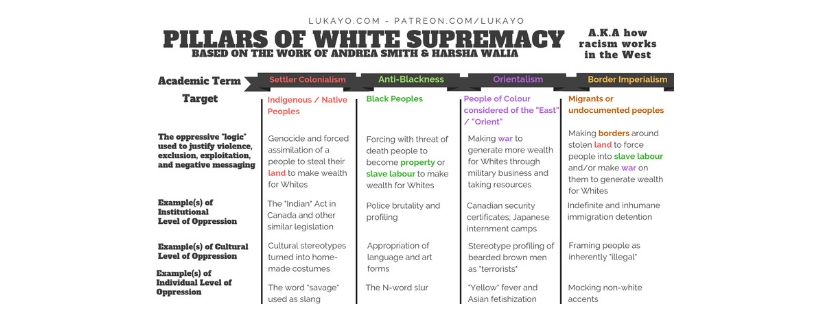
    Like the Dis/Ableism 101 visual tool, the Pillars of White Supremacy is an anti-racism 101 visual tool for sighted folks that goes well with the Oppression Triangle tool. The purpose of this poster/handout is to introduce folks to the different forms of racism in North American society, and it is based on the work of Andrea Smith and Harsha Walia. It’s extremely helpful for when different racialized people work together in coalition-building, as it delineates the specific ways we’re differently impacted by white supremacy, but can also support how we can organize together and work on our own internalized racism. Check out my article “More Than Minorities” on working with Indigenous folks and/or Black folks as a person of colour that is not oppressed by Anti-Blackness and/or Settler Colonialism. Please also check out the original article by Andrea Smith called “Heteropatriarchy and the Three Pillars of White Supremacy: Rethinking Women of Color Organizing“. If you can, pick up Harsha Walia’s book on Undoing Border Imperialism, though here’s an article with an interview and description of some of the concepts.

    Activity Ideas

    • Divide the group into the following categories of interest: accomplices/allies, direct action, policy, and programming. These categories are fluid– if there is no one interested in policy, for example, then that doesn’t have to be a group. If a group is interested in something not listed, like, for example, transformative justice or healing justice, then they can create a group for that. These are all types of anti-oppression/liberation strategies, which will be explained further in future posts.
    • Ask each group to choose one of the forms of racism to work with and narrow it down to one of the levels of oppression, if possible. They can also choose an example of oppression that is part of several forms of oppression, such as how police/border agent brutality and profiling impacts Indigenous folks, Black folks, migrants, and people of colour visibly coded as “Muslim” (even if they are Hindu, Sikh, etc.).
    • Each group can come up with a way to use their anti-oppression/liberation strategy with the example of a racist oppression they chose. For example, the direct action group can explain or act out how they could stage a protest at an immigration detention centre. Another example could be the accomplices/allies group creating a poster that explains other costumes to use instead of racist ones. A final example could be a non-profit organization writing an anti-racism policy that explicitly ensures that a certain percentage of their budget is used for anti-racism training and the benefit of racialized folks within and being served by their organization, with a communications plan that makes these policies transparent to the public.
    • Have the groups present to each other and debrief about the process of anti-oppressive collective planning. Did they ensure that racialized folks in the groups lead? Did they ensure that consultation and leadership of racialized folks was at the forefront of any of their strategies, even if there were no racialized folks in their group?

    Poster Description

    The poster is white with mostly dark grey font. At the top of the poster is written “lukayo.com – patreon.com/lukayo“. The title of the poster is “PILLARS OF WHITE SUPREMACY: A.K.A. how racism works in the West”. The poster is credited as “BASED ON THE WORK OF ANDREA SMITH & HARSHA WALIA”. After the title, there are five columns and six rows.

    The first row in the first column has the words: “Academic Term”.  The second row in the first column reads: “Target”. The third row in the first column reads: “The oppressive “logic” used to justify violence, exclusion, exploitation, and negative messaging”. The fourth row in the first column reads: “Example(s) of Institutional Level of Oppression”. The fifth row in the first column reads: “Example(s) of Cultural Level of Oppression”. The sixth and final row in the first column reads: “Example(s) of Individual Level of Oppression”.

    The second column is headed by the term “Settler Colonialism”. The target is “Indigenous/Native Peoples”. The logic is “Genocide and forced assimilation of a people to steal their land to make wealth for Whites”. The institutional example is “The “Indian” Act in Canada and other similar legislation.” The cultural example is “ Cultural stereotypes turned into home-made costumes”. The individual example is “The word “savage” used as slang”.

    The third column is headed by the term “Anti-Blackness”. The target is “Black Peoples”. The logic is “Forcing with threat of death people to become property or slave labour to make wealth for Whites”. The institutional example is “Police brutality and profiling.” The cultural example is “Appropriation of language and art forms”. The individual example is “ The N-word slur”.

    The fourth column is headed by the term “Orientalism”. The target is “People of Colour considered of the “East” / “Orient””. The logic is “Making war to generate more wealth for Whites through military business and taking resources”. The institutional examples are “Canadian security certificates; Japanese internment camps.” The cultural example is “Stereotype profiling of bearded brown men as “terrorists””. The individual example is “”Yellow” fever and Asian fetishization”.

    The fifth column is headed by the term “Border Imperialism”. The target is “Migrants or undocumented peoples”. The logic is “Making borders around stolen land to force people into slave labour and/or make war on them to generate wealth for Whites”. The institutional example is “Indefinite and inhumane immigration detention.” The cultural example is “Framing people as inherently “illegal””. The individual example is “Mocking non-white accents”.


    Want to have access to the larger full colour updated 2018 poster, the original photograph of the hand-drawn 2016 poster, and other anti-oppression related teaching tools? Click on the link below and subscribe for as little as $3/month. By becoming a patron, you support healing work among my communities, and the indigenous Elders that mentor me.

    https://www.patreon.com/posts/22120020

  • Musings Monday: More Than Minorities

    (5 Tips on Building Alliances with Indigenous Folks and/or Black Folks as a Person of Colour)

    Content Warning: anti-Black racism, settler colonialism

    .

    .

    .

    When I was a younger trans and queer person of colour (PoC), I remember the first time I was welcomed into a PoC-only space, and how ecstatic I was, that we finally got to let our guard down and relax, not having to worry about being talked down to, talked over, assumed to be aggressive and/or “child”-like if I was expressing emotions, fetishized, interrogated about my origins, compared to other folks of my race, used as an exception or standard of folks of my race, and other such micro-aggressions. But as I attended more events, and built closer relationships, it became clear that there were other dynamics at play, that there were still hierarchies based on skin tone and/or moves to innocence that ignored the importance of treaties and the thieving privilege of citizenship. We didn’t really know how to have each other’s backs half the time.

    Simply put, there were a lot of anti-Blackness and settler colonial nonsense among my fellow folks of colour (including myself), and when we were called out, we claimed an inability to be racist because of a lack of physical Whiteness, forgetting that the ideology of Whiteness and white supremacy can be internalized by virtue of being raised in anti-Black and settler colonial spaces. Racial discrimination and internalized racism is a real and serious issue among folks of colour, and to forget it is to jeopardize and oppress our accomplices and community members.

    So this article is a litany of my mistakes and the mistakes I’ve seen in others, that harmed folks, that hurt collectives, that stalled movements of anti-racist action and alliance. I mean, I may also probably mess up in the course of this article, in which case, please feel free to correct me and definitely I will offer reparations if the correction involves the labour of Indigenous and/or Black folks. Lastly, this article is an attempt at giving some fairly basic tips to other people of colour that are non-Black and also settlers/non-Indigenous. We’re not all in the same boat, but we’re still in this together.

    Here are the five tips altogether:

    • Work on your own stuff.
    • Work with your communities to co-organize workshops on undoing Anti-Blackness and Settler Colonialism.
    • Support Black-only spaces, Indigenous-only spaces, and Black and Indigenous-only spaces.
    • Centre Black and Indigenous leadership in people of colour spaces.
    • Reparations.

    Read the rest of the article here: https://www.patreon.com/posts/22115167

  • Workshop Wednesday: Dis/Ableism

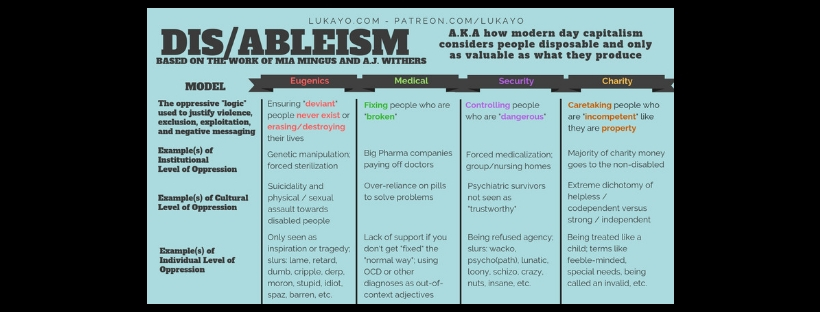
    This is a basic Dis/Ableism 101 visual tool for sighted folks that goes well with the Oppression Triangle tool. The purpose of this poster/handout is to introduce folks to the basic models of how dis/ableism works in North American society, and is based on the work of Mia Mingus and A.J. Withers. For a more in-depth look at the models discussed, please check out A.J. Withers’ book and website on Disability Politics. For an intersectional and deeper look at these models, especially in regards to desirability, the prison industrial complex, and the medical industrial complex, please check out Mia Mingus’s Medical Industrial Complex Visual.

    Activity Idea

    • Divide the group into the following categories of interest: accomplices/allies, direct action, policy, and programming. These categories are fluid– if there is no one interested in policy, for example, then that doesn’t have to be a group. If a group is interested in something not listed, like, for example, transformative justice or healing justice, then they can create a group for that. These are all types of anti-oppression/liberation strategies, which will be explained further in future posts.
    • Ask each group to choose one of the dis/ableism models to work with and narrow it down to one of the levels of oppression, if possible. They can also choose an example of oppression that is under multiple models, such as certain nursing/group homes can be considered both under the charity model and the security model.
    • Each group can come up with a way to use their anti-oppression/liberation strategy with the example of dis/ableist oppression they chose. For example, the direct action group can explain or act out how they could stage a protest at a pharmaceutical company that is lobbying doctors or at a group home that forces medicalization. Another example could be the accomplices/allies group creating a poster that explains other words to use instead of dis/ableist slurs. A final example could be a non-profit organization that is also a registered charity writing a disability justice policy that explicitly ensures that a certain percentage of their budget is used for accessibility and the benefit of disabled people, with a communications plan that makes these policies transparent to the public.
    • Have the groups present to each other and debrief about the process of anti-oppressive collective planning. Did they ensure that any disabled folks in the groups lead? Did they ensure that consultation and leadership of disabled folks was at the forefront of any of their strategies, even if there were no disabled folks in their group?

    Poster Description

    The poster is pale blue with mostly dark grey font. At the top of the poster is written “lukayo.com – patreon.com/lukayo“. The title of the poster is “DIS/ABLEISM: A.K.A. how modern day capitalism considers people disposable and only as valuable as what they produce”. The poster is credited as “BASED ON THE WORK OF MIA MINGUS AND A.J. WITHERS”. After the title, there are five columns and five rows.

    The first row in the first column has the words: “MODEL”. The second row in the first column reads: “The oppressive “logic” used to justify violence, exclusion, exploitation, and negative messaging”. The third row in the first column reads: “Example(s) of Institutional Level of Oppression”. The fourth row in the first column reads: “Example(s) of Cultural Level of Oppression”. The fifth and final row in the first column reads: “Example(s) of Individual Level of Oppression”.

    The second column is headed by the term “Eugenics”. The logic is “Ensuring “deviant” people never exist or erasing/destroying their lives”. The institutional examples are “Genetic manipulation; forced sterilization.” The cultural examples are “Suicidality and physical / sexual assault towards disabled people”. The individual examples are “Only seen as inspiration or tragedy; slurs: lame, retard, dumb, cripple, derp, moron, stupid, idiot, spaz, barren, etc.”.

    The third column is headed by the term “Medical”. The logic is “Fixing people who are “broken””. The institutional example is “Big Pharma companies paying off doctors”. The cultural example is “Over-reliance on pills to solve problems”. The individual examples are “Lack of support if you don’t get “fixed” the “normal way”; using OCD or other diagnoses as out-of-context adjectives”.

    The fourth column is headed by the term “Security”. The logic is “Controlling people who are “dangerous””. The institutional examples are “Forced medicalization; group/nursing homes”. The cultural example is “Psychiatric survivors not seen as “trustworthy””. The individual examples are “Being refused agency; slurs: wacko, psycho(path), lunatic, loony, schizo, crazy, nuts, insane, etc.”.

    The fifth column is headed by the term “Charity”. The logic is “Caretaking people who are “incompetent” like they are property”. The institutional example is “Majority of charity money goes to the non-disabled”. The cultural example is “Extreme dichotomy of helpless / codependent versus strong / independent”. The individual examples are “Being treated like a child; terms like feeble-minded, special needs, being called an invalid, etc.”.


    Want to have access to the larger full colour updated 2018 poster, the original photograph of the hand-drawn 2016 poster, and other anti-oppression related teaching tools? Click on the link below and subscribe for as little as $3/month. By becoming a patron, you support healing work among my communities, and the indigenous Elders that mentor me.

    https://www.patreon.com/posts/21975736

  • Musings Monday: I Am Not A Burden

    Content Warning: ableism, ED, chronic illness, mental illness

    Image Description: Black background with stylized yellow stars. In a greyish-white thought bubble are the words “I Am Not A Burden” in yellow. Beside the thought bubble in yellow text is the following: “5 TIPS AGAINST INTERNALIZED ABLEISM”. Below that in white text is “patreon.com/lukayo” and “lukayo.com”.

    When I first started to come to terms with how disabled I’d gotten, I was furious and then despairing. I had always been somewhat sickly– an asthmatic child that tired easily, and due to my large frame, spent years with an eating disorder that was undiagnosed despite the radical shifts in weight. The reality that I would have more to manage mentally, emotionally, and physically in unpredictable and drastic ways was daunting and left me with fatalistic ideation that I would soon come to recognize as “internalized ableism”. Over the years, I’ve reached out to other disabled folks asking them what they’ve done to stop their own attitudes and thoughts that just made things worse, and this is what I’ve learned.

    1) Educating yourself.

    I read everything I could by Eddie Ndopu, Patty Berne, Sins Invalid, Mia Mingus, Leah Lakshmi-Piepzna Samarasinha, AJ Withers, and Eli Clare. I also read the following articles on internalized ableism:

    Understanding that there’s a system at work, and it isn’t just about me, began the process of unlearning self-hatred, but it was usually an intellectual change, and my emotional gut reactions were still there.

    2) Reminding yourself.

    Since my emotions tended to erase a lot of theory that I’d read, I tended to put up reminders, either through a side tumblr filled with disability activist quotes, and print-outs I’d put up on my wall so I could see it when I woke up. I’d even try to post these reminder lists on my desktop. These are the ones I particularly like:

    If you want to make your on side tumblr and you’ve never done anything like that before, just pick a cute name (I chose the Bikol word for recovery), and then in the search bar type in search words, whether it’s “chronic illness”, or “disability justice”, or “disability rights”. You can even type in your diagnosis for specific kinds of affirmations and quotes on it. You may come across other tumblrs that also only re-blog quotes, theory, and affirmations, as well as hilarious and soothing memes. You can follow them and begin the process of accessing these kinds of reminders. You can also set it up so that when your browser opens, it immediately opens up to your side tumblr page.

    3) Reaching out.

    Here we get to some scary stuff, in my personal opinion. I found it easy looking for resources to read and use to remind myself. But actually reaching out to real, live people? Yikes. I did it anyway. I needed help. I went to free disability-focused conferences, like the Reclaiming Our Bodies & Minds Conference at Ryerson University. If I went to festivals and conferences that weren’t only about disability, I prioritized attending any workshops and sessions that were on disability– whether the events were about sexuality, gender, spirituality, or general activism. I prioritized spending time with my disabled friends and temporarily able-bodied folks who had high access intimacy with me. I made request posts looking to start a personal care collective.

    4) Sharing your story.

    This article is basically an illustration of tip #4. So were all the Facebook posts that honestly talked about my needs and barriers. So were all the filtered Facebook posts and secret side tumblr posts where I just broke down and word-vomited all my pain and frustration at what seems like an ever-increasing mountain of disability and ableism. I also shared with people over the phone, on private messenger, over text, in person in private rooms, classrooms, and public workshops. I shared, consensually, with family members, friends, strangers, and professional care workers. I wrote stories and poetry; I made art and music. I prayed and shared with Creator, my ancestors, gods, and spirits. I laid out all the internalized terrible nonsense inside of me, dragging it out so that the poison could be seen instead of left festering in my heart and soul.

    5) Accepting support.

    Of course, once I reached out and I shared, then came the offers of support. I thought I had done all the hard work already, but I was horrified when folks offered support, and horrified that I felt horror in the first place. Some of my concerns was legitimate– I was used to the folks who were already providing me care and I trusted them. I would have to go out on a limb and attempt to rely on people that I did not know very well and thus had not earned much of my trust. Sometimes I would not have the energy to face a new person in my personal space providing me care, and I would just go without the things that I needed, worrying as to whether I had let my internalized ableism win or whether I was rightfully cautious yet paying a price that was beyond my control. Either option was shitty. But when I did have the energy to take that risk, the joy and relief at having a new care collective member and/or friend that embodied the kind of world where interdependence and community care is the norm was overwhelming that I found myself weeping and/or laughing once they had left. I found myself overcome with hope and, after every time, the barrage of internalized ableist thoughts would quiet further and further. It’s a start.

    I hope these tips help you, especially if you’re beginning your journey of strategizing against your internalized ableism as a disabled person, just like me several years ago. Feel free to comment on this article or message me about it!


    Like what you read? Want to support my community and the Indigenous elders that mentor me? Please become a patron: https://www.patreon.com/posts/21944958

  • Throwback Thursday: Mnemosyne’s Carcass

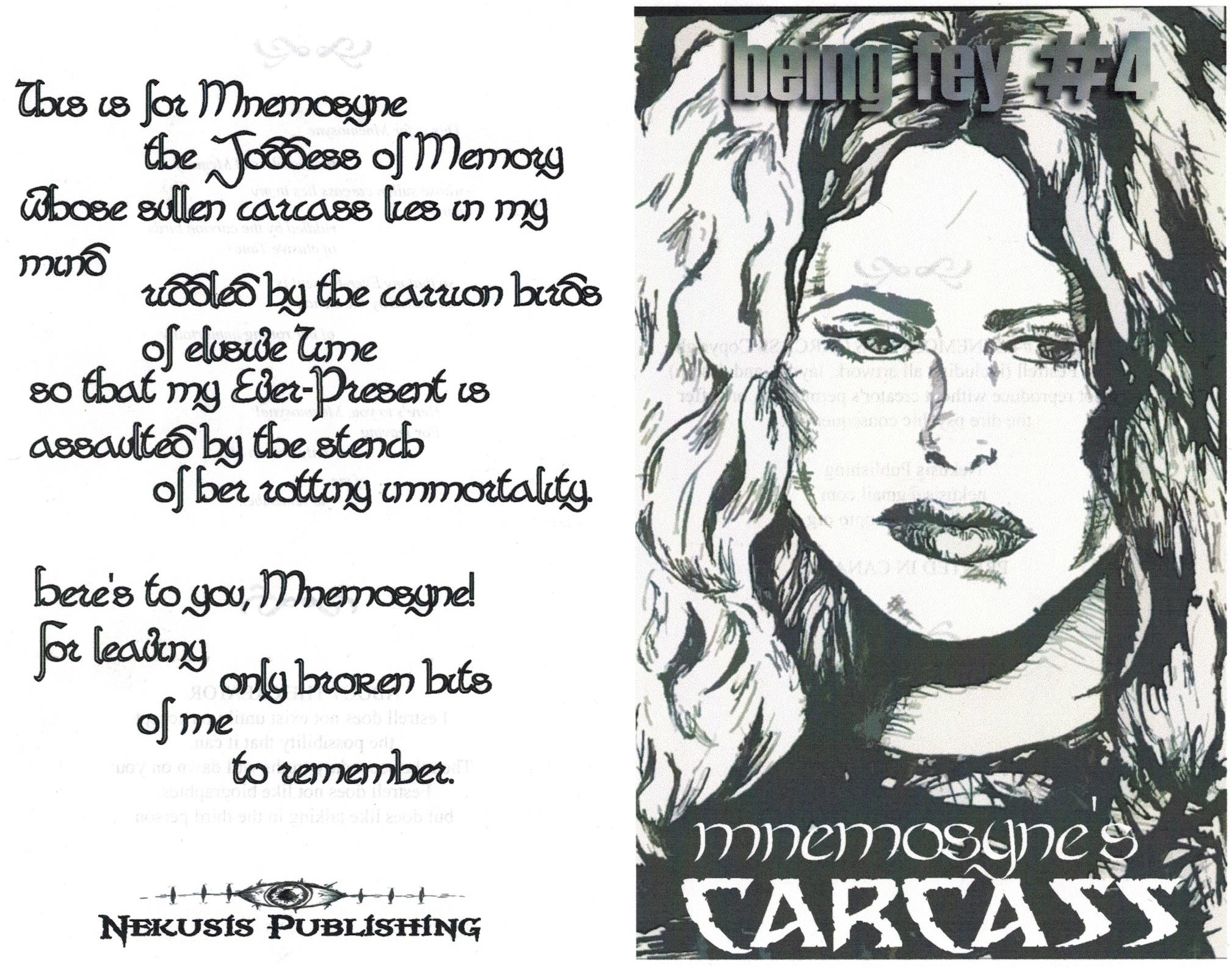
    Artwork from Mnemosyne’s Carcass, a zine I published in 2005 with my original illustrations and some creative non-fiction rambling.

    Image Descriptions

    The first scan is of the cover and back cover of a black and white ‘zine/chapbook. The cover is an inked drawing of a pale woman with pale hair. The title is “being fey #4” and the subtitle is “MNEMOSYNE’S CARCASS”. On the back cover is a poem in heavily stylized font. This is the poem:

    “This is for Mnemosyne
    the Goddess of Memory
    whose sullen carcass lies in my
    mind
    riddled by the carrion birds
    of elusive Time
    so that my Ever-Present is
    assaulted by the stench
    of her rotting immortality

    here’s to you, Mnemosyne!
    for leaving
    only broken bits
    of me
    to remember.”

    At the bottom of the poem there is a logo of an eye bursting out of stitches and the words “NEKUSIS PUBLISHING”.


    Wanna see the rest of the artwork from this zine? Better yet, want to commission me to draw something for you? Click on the link to become a patron. For as little as $1/month you can support healing work among my communities, and the indigenous Elders that mentor me.

    https://www.patreon.com/posts/21843836

  • Workshop Wednesday: Recognizing Privilege

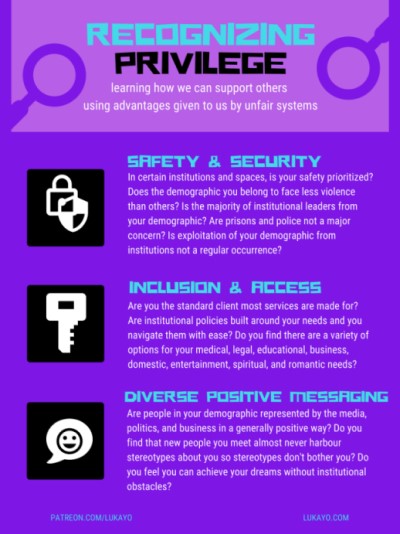
    This basic visual tool for sighted folks is best used for anti-oppression 101 workshops, and can be used as an alternative (or side-by-side) with privilege check-lists, privilege games and gaming analogies, and storytelling/group work activities. I especially like to use the handout Towards Healing All Our Relations / To Equalize Power Among Us by Margo Adair and Sharon Howell (Tools for Change) with this poster.

    I go deeper into the intricacies of teaching the anti-oppressive concept of privilege in my article The P-Word, but I’ll briefly quote relevant parts regarding privilege check-lists below, end with an image description of the poster, and a photo of the original.

    the point of explaining privilege is not to make people feel bad– it’s to realize the secret powers they never knew they had that can be used for the consensual benefit of their friends, loved ones, and communities.

    Whether it’s the White Privilege Knapsack or the Power Flower or PrivilegeWalk/StepForward/Across the Grass, there is a checklist, diagram, or activity out there that lists all the possible privileges people may or may not have. The privilege checklists have become more nuanced, as well, with lists on ableism, transmisogyny, ageism, and neurotypicalism/saneism. Here’s a good list of lists from Not Actually a Liberal.

    Pros:

    For people who have never thought of privilege before or can’t even imagine how they could be privileged, these lists lay it out in clear and concise terms.

    Cons:

    Taken on their own, without a discussion about how these privileges can be used to help others that don’t have them, these lists and activities make people feel angry, guilty, and all sorts of feelings that need to be worked through before they even consider building allyship (or become accomplices) with others.

    The lists lack nuance. They’re pretty one-dimensional, so it’s hard to illustrate how oppressions and privileges can intersect with each other, and how different institutions may enforce different kinds of barriers and oppression. For example, someone who doesn’t have white privilege but is able-bodied may have a completely different interaction with the able-bodied checklist than somebody who is able-bodied and white. Or they may not. Context also matters.

    For folks that have multiple oppressions, having to go through these privilege checklists during a workshop can be really triggering, reminding them of all the painful, humiliating, violent, and exclusionary bullshit they have to go through on a daily basis. Because of this, I would suggest making sure that you bring multiple checklists so that folks choose to read the privilege that they have, a technique taught to me by Jade Pichette, another great anti-oppression facilitator.

    Poster Description

    The background is bright purple. There is a paler purple rectangle that serves as the title of the poster, and then below it is three black squares in a vertical line with pictures in them. To the right of the squares are blocks of white text and aqua blue headers. The title of the poster is “RECOGNIZING PRIVILEGE” with the first word in aqua blue and the second word in black. There is a sub-title in white that reads “learning how we can support others using advantages given to us by unfair systems”. There are two stylized bright purple magnifying glasses that are part of the title, which merge with the rest of the poster. The first black square has a stylized white picture of a lock and a shield/badge overlaid together. The header reads “SAFETY & SECURITY”. The text reads “In certain institutions and spaces, is your safety prioritized? Does the demographic you belong to face less violence than others? Is the majority of institutional leaders from your demographic? Are prisons and police not a major concern? Is exploitation of your demographic from institutions not a regular occurrence?” The second black square has a stylized white key in it. The header reads “INCLUSION & ACCESS”. The text reads “Are you the standard client most services are made for? Are institutional policies built around your needs and you navigate them with ease? Do you find there are a variety of options for your medical, legal, educational, business, domestic, entertainment, spiritual, and romantic needs?” The final black square has a stylized white speech bubble with a smiley face inside. The header reads “DIVERSE POSITIVE MESSAGING”. The text reads “Are people in your demographic represented by the media, politics, and business in a generally positive way? Do you find that new people you meet almost never harbour stereotypes about you so stereotypes don’t bother you? Do you feel you can achieve your dreams without institutional obstacles?” The bottom of the poster has the links “patreon.com/lukayo” and “lukayo.com” in aqua blue.


    Want to have access to the larger full colour updated 2018 poster, the original photograph of the hand-drawn 2016 poster, and other anti-oppression related teaching tools? Click on the link below and subscribe for as little as $3/month. By becoming a patron, you support healing work among my communities, and the indigenous Elders that mentor me.

    https://www.patreon.com/posts/21819455

The site will be down Thursday, July 30th from Noon until 4pm EST for webhost transfer and maintenance.

Close Welcome Bar