Author: Lukayo

  • Throwback Thursday: Scars

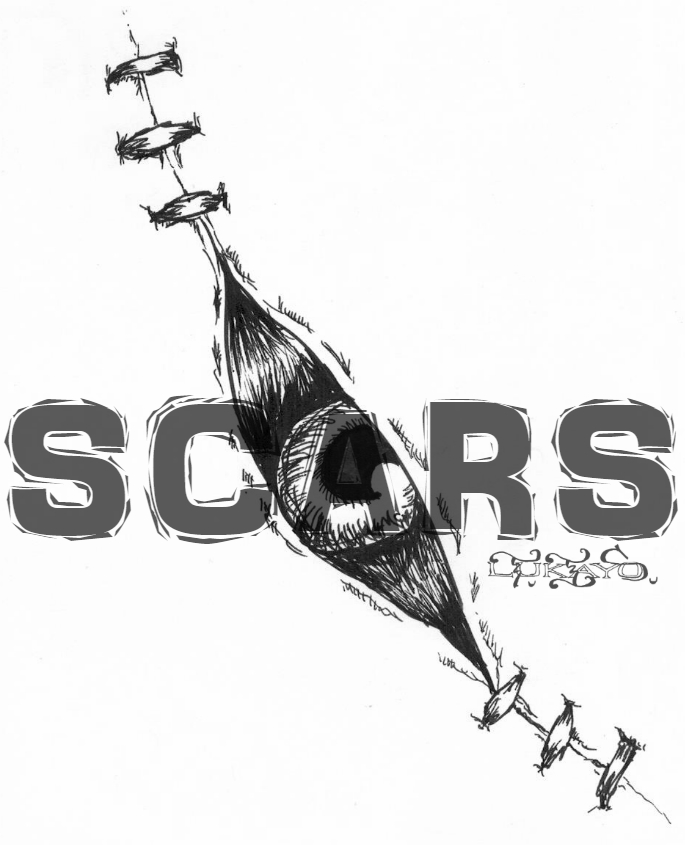
    Image Description: A black-and-white ink drawing of an eye with dark sclera emerging out of a wound with three stitches on either side. The word “SCARS” is superimposed on top and faded, with Lukayo’s signature in English and basahan/baybayin under the “R” and “S” of the word “SCARS”.

    Content Warning: allusions to death, sexual assault, self-harm, and bloodplay.

    Scars (Original 2008, Updated 2018)

    We push our boundaries, reaching for a sky full of stars
    Until we burst open, skin sprouting scars

    Like trophies
    And only lovers & doctors
    mothers & morticians
    Traced by hand and stethoscope and lips
    See these bodies go out with more than they came in with
    Bodies full of scars till we become subway system maps
    Each tendril of hard, healed flesh an underground tourist trap
    Staring down long dark tunnels of memory
    Hopping on that train of thought & theory
    Speeding all the way

    All the way to the end of the line
    Past the “Slow Down” and “Just Stop” signs

    Pushing boundaries, reaching for a sky full of stars
    Until we burst open, skin sprouting scars

    Like loathing
    A monster in human-skin-clothing
    Awkward in my kilt and ironed-out-white-blouse
    Because every boy was going to be my redemption
    Every boy my ticket out, every boy
    Had a height and a depth like a mountain
    So full they almost supernova’d right there
    In the locker-lined hallways
    And smoke-laced, booze-stained parties
    Their explosions forcing inside me all the way

    All the way to the end of the line
    Past the “Slow Down” and “Just Stop” signs

    Pushing boundaries, reaching for a sky full of stars
    Until we burst open, skin sprouting scars

    Like armor
    Because what doesn’t kill us only breaks us stronger
    And she is crying as I hold her close in the candle light
    Bedroom door locked as tight as her fingers around that knife
    And I’m wrestling with her pain, I’m pleading “baby, please let go”
    And one night she’ll toss the blade across the room in a fever
    Another night she’ll kiss me hard and ask me to do it with her
    Players in an Anne Rice-ian fairy tale fantasy
    Not satisfied with hickies of violets and daisies
    We had to go all the way

    All the way to the end of the line
    Past the “Slow Down” and “Just Stop” signs

    Pushing boundaries, reaching for a sky full of stars
    Until we burst open, skin sprouting scars

    Like forest fires
    Evidence against the two-faced and the liars
    While we rage against family dramas or corporate spires
    Fueled and sparked by our half-healed criss-crosses
    To keep fighting, keep fighting against our losses
    Because every wound made must be given time to close
    Every fissure in our fleshly fabric is as much a lesson as a blow
    To our pride, to our hubris, to our ego, to our core
    And if that’s not the point of dying,
    then what the fuck are we living for?
    We have to go all the way

    All the way to the end of the line
    Past the “Slow Down” and “Just Stop” signs

    Pushing boundaries, skin sprouting scars
    Until we burst open and finally
    reach that sky full of stars


    Wanna hear the rest of the poem? Better yet, want to commission me to write a poem and draw something for you? Click on the link to become a patron. For as little as $1/month you can support healing work among my communities, and the indigenous Elders that mentor me.

    https://www.patreon.com/posts/21260746

  • Workshop Wednesday: Accomplices & Allies

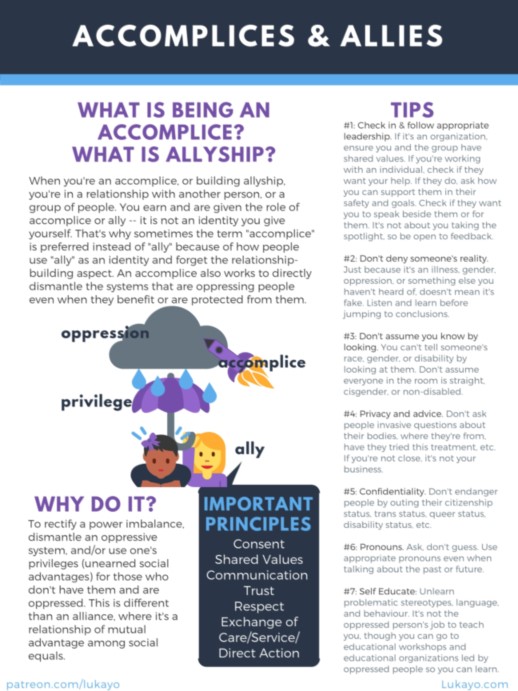
    The Accomplices & Allies poster/handout is a beginner’s visual tool for sighted folks that cover the basic concepts about using one’s privilege in a relationship to support the other person or people that don’t have those privileges. This article will include a full description of the poster, important links on the concept of accomplices, and the photo of the original hand-drawn Allyship poster that I made.

    Poster Description

    Title: “Accomplices & Allies”

    “WHAT IS BEING AN ACCOMPLICE? WHAT IS ALLYSHIP?
    When you’re an accomplice, or building allyship, you’re in a relationship with another person, or a group of people. You earn and are given the role of accomplice or ally — it is not an identity you give yourself. That’s why sometimes the term “accomplice” is preferred instead of “ally” because of how people use “ally” as an identity and forget the relationship-building aspect. An accomplice also works to directly dismantle the systems that are oppressing people even when they benefit or are protected from them.”

    “WHY DO IT?
    To rectify a power imbalance, dismantle an oppressive system, and/or use one’s privileges (unearned social advantages) for those who don’t have them and are oppressed. This is different than an alliance, where it’s a relationship of mutual advantage among social equals.”

    “IMPORTANT PRINCIPLES
    Consent
    Shared Values
    Communication
    Trust
    Respect
    Exchange of Care/Service/Direct Action”

    “TIPS

    #1: Check in & follow appropriate leadership. If it’s an organization, ensure you and the group have shared values. If you’re working with an individual, check if they want your help. If they do, ask how you can support them in their safety and goals. Check if they want you to speak beside them or for them. It’s not about you taking the spotlight, so be open to feedback.

    #2: Don’t deny someone’s reality. Just because it’s an illness, gender, oppression, or something else you haven’t heard of, doesn’t mean it’s fake. Listen and learn before jumping to conclusions.

    #3: Don’t assume you know by looking. You can’t tell someone’s race, gender, or disability by looking at them. Don’t assume everyone in the room is straight, cisgender, or non-disabled.

    #4: Privacy and advice. Don’t ask people invasive questions about their bodies, where they’re from, have they tried this treatment, etc. If you’re not close, it’s not your business.

    #5: Confidentiality. Don’t endanger people by outing their citizenship status, trans status, queer status, disability status, etc.

    #6: Pronouns. Ask, don’t guess. Use appropriate pronouns even when talking about the past or future.

    #7: Self Educate: Unlearn problematic stereotypes, language, and behaviour. It’s not the oppressed person’s job to teach you, though you can go to educational workshops and educational organizations led by oppressed people so you can learn.”

    The poster is divided into six main sections. The top section is a header with the title in white font on a dark blue rectangle, with a pale blue divider. On the right of the poster underneath the header is a column with all the TIPS, the title being in purple while the text is in dark blue and lighter blue. On the left of the poster underneath the header is the introductory section explaining what an accomplice and allyship is, with the title also being in purple and the text in dark blue. Underneath that introductory section is an image. Underneath the image are two small columns. On the left is the WHY DO IT? column with the title in purple and the main text in dark blue. On the right is the IMPORTANT PRINCIPLES column, with the title in pale blue, and main text in white on a dark blue square speech bubble that is coming out from the word ally in the image.

    The image is a cartoon. There is a dark grey cloud with blue rain drops coming out of it. The rain drops are hitting a purple umbrella being held by a pale smiling person with yellow hair and red lips, who is wearing a purple long-sleeved shirt. There is a dark-skinned person with a purple bow in their short black hair who is also under the umbrella, wearing a dark blue long-sleeved shirt and looking scared. There is a purple rocket with orange flames hitting the cloud. The cloud is described as “OPPRESSION”. The umbrella is described as “PRIVILEGE”. The rocket is described as “ACCOMPLICE.” The pale person holding the umbrella is described as “ALLY”.

    At the bottom of the poster in light blue are the following links: “patreon.com/lukayo” and “Lukayo.com“.

    Important Links on Being an Accomplice


    Want to have access to the larger full colour updated poster, the original photograph of the hand-drawn poster, and other anti-oppression related teaching tools? Click on the link below and subscribe for as little as $3/month. By becoming a patron, you support healing work among my communities, and the indigenous Elders that mentor me.

    https://www.patreon.com/posts/workshop-allies-21223071

  • Troubleshoot Tuesday: Side Punch

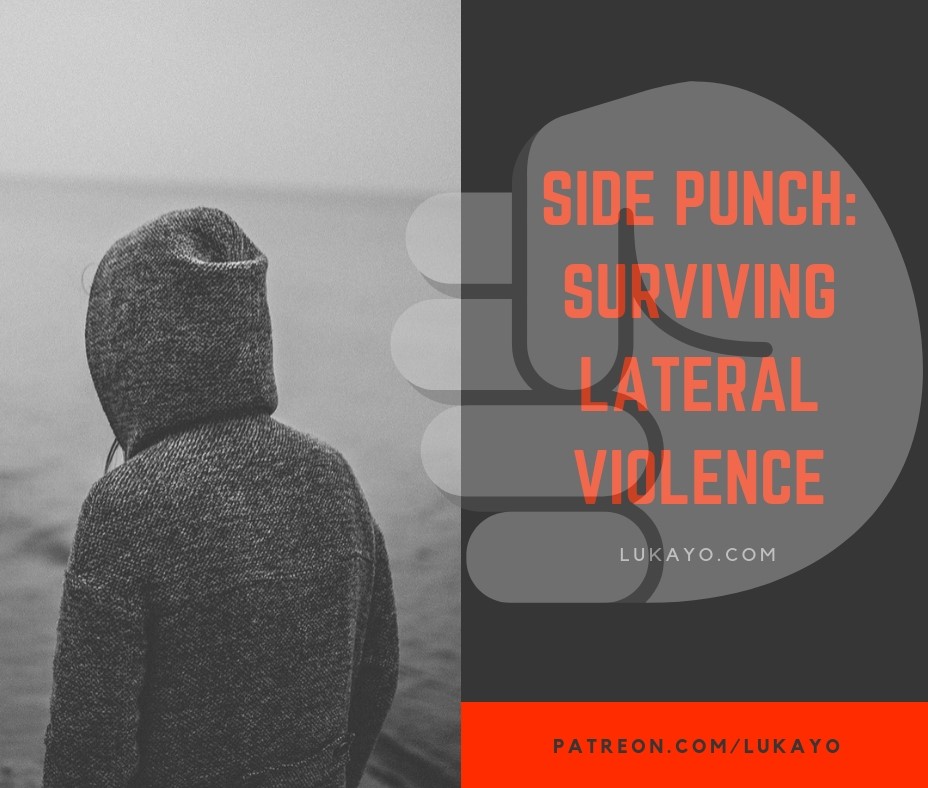
    Image Description: The picture is divided into two parts. On the left side is a black and white photo of a person in a grey hoodie, with their back towards the viewer, as they stare out at the water. On the right side is a semi-transparent graphic of a stylized grey fist on a dark grey background, aimed towards the person in the hoodie. In red are the words: “SIDE PUNCH: SURVIVING LATERAL VIOLENCE”. In light grey is written “LUKAYO.COM”. There is a red rectangle at the bottom of the right side of the picture, with the words “PATREON.COM/LUKAYO” in black.

    Every time it happens, the sense of betrayal is so vast, it feels more than just a psychological punch to the gut. I remember one of the first times, as a kid in the schoolyard, where I was being pushed around and laughed at by other Filipinos. My clothing wasn’t right, and I talked weird, and I wasn’t into the right things. I was too “white-washed”, I didn’t belong, but neither did they want me “too Filipino” either, like when I had first immigrated to Turtle Island/Canada. Other times I witnessed it among the Filipino adults who gossiped about each other and tried to shun each other at church or at parties. As I grew older, I noticed this phenomenon happened in queer communities, trans communities, and among other racialized groups.

    When it occurs in a workshop, it’s probably because you’re doing a teaching targeted towards your own community, and they immediately want to fight it out while you’re explaining concepts or during discussion. Maybe it occurs before the workshop– folks contact you about a conflict that’s happening and certain folks can’t come or if they come then another set of folks won’t come, and so it goes.

    We could just brush it off and call it “community drama”, but most likely what’s going on here is “lateral violence”, and it sucks. A lot. So how should you handle it, as a facilitator and as a community member? The short summary is that you should  remind yourself (and others) of the root cause, ensure the safety of yourself and your participants as much as possible, and try to reach out to folks from the same community who already support you and hopefully understand what lateral violence is.

    Remind yourself and others of the root cause.

    When I was a child, internalized racism ran deep, and I assumed that the nonsense that happened in my communities was because Filipinos innately are inferior in some way– I was ashamed of myself and ashamed of my community. I tried to run away from them and myself for a long time. It’s tempting to buy into all of that nonsense again, especially when you’re in the heat of the moment and it’s disrupting your educational environment and plans.

    But lateral violence isn’t innate. It isn’t the essence of a person or a community. It’s a habit, a trauma response, and/or a soul wound inherited throughout the generations where the pain of a people explodes on each other because they feel powerless against or seduced by the institutions that devastated their communities in the first place.

    Personally, when lateral violence happens in front of me, I look at the situation as if folks are being possessed by vengeful ghosts, so filled with anguish at the injustices done to them that they take the bodies of their descendants to release their rage. I am filled with compassion, even as I take safety precautions for myself and those around me, to figure out how to appease these ghosts and encourage the personality of the descendant to come through with their gifts and be more than their pain.

    This isn’t to say that you can’t hold people responsible for their actions– it just means that it helps to combat the shame placed inside you by oppression, and the ignorant perspectives of those outside of your community that comment on inter-community violence. It also means that, if there’s a way to call folks in on what they’re doing, that you could ask them to direct their anger at the source of their pain and channel it into activism.


    Are you a diversity coordinator, anti-oppression facilitator, or equity officer interested in reading the rest of this article? Click on the link and subscribe for $10/month to get anti-oppression tutorials, videos, posters, hand-outs, and trouble-shooting guides like this one twice a week. By becoming a patron, you support healing work among my communities, and the indigenous Elders that mentor me. 

    https://www.patreon.com/posts/21216326

  • Musings Monday: Why I Want to Start an Affordable Retreat Centre

    Content Warning: death, mental illness, ideation

    As folks have probably guessed by now, I’m the type of healer that is obsessed with healing because I’ve spent a lot of time (and still do!) working on my own healing journey. When my partner Steve died and I was imploding my other close relationships around me in the messiest way possible, struggling with suicidal ideation, alcoholism, codependence, and a host of other mental illness and trauma-related issues, I finally dragged myself to what I called “emo rehab”, and, as the cliché goes, it changed my life. At the time, a volunteer-run organization offered a weekend day retreat setting in the city of Ottawa/Odaawaa that was pay-what-you-can, where you worked on addiction, compulsive behaviours, trauma, etc.

    I had never been in a situation where I just focused on my healing before, and everyone else was focused on their healing, and we all kind of supported each other together. And we all kind of goteach other somehow. It was magical. Ever since then, I was hooked. I love going to retreats!

    I also have a critical mind, honed from Western education on critical theory, my father’s revolutionary spirit, and my mother’s sharp brain. So I noticed some patterns in the retreats I went to. I noticed that I was usually the only racialized person there, or the only queer person, or the only trans person, or one of the few folks in their twenties (this was 10 years ago when I started going). And that, aside from that first “emo rehab” experience, a lot of these retreats were really expensive! Like, $600-$1000 expensive! I had to save up a lot.

    The biggest critical factor for me, though, was that they often worked only from a medical and disease model of recovery. This came off as implying that Western science was a central authority, and that we were sick because of our own fault, and ignored contributing systemic factors like the intergenerational trauma of war and colonialism, or the ongoing onslaught of nableism, racism, sexism, cisgenderism/transphobia, and other daily indignities or brutal violence. Sometimes they would have a “spiritual factor” that supplemented the main model, either a version of Christianity that was only about prayer and surrender to God, or a mish-mash of culturally appropriated techniques from various other religions and faiths without any context or credit. These patterns created a cycle that would perpetuate a lack of diverse and marginalized folks from accessing these kinds of programs, the very folks that, in my opinion, would benefit from it a lot.

    I think I would have just continued to feel kind of sad that so many of my friends and loved ones couldn’t access these spaces even if they wanted to, if I hadn’t gone to camp. Now, this wasn’t just any camp– this was a leadership retreat for trans and queer youth and youth from trans and queer families. I went as an adult mentor/camp counselor type person. It was overnight, in the woods, reasonably affordable– and they had the systemic analysis! I had only ever experienced systemic analysis in activist and academic circles where it was treated with a kind of clinical reverence or desperate bludgeoning technique of “accountability”, but I had never witnessed a program trying to live these values with care, and love, and (so many!) emotional check-ins.

    This experience taught me so much– the power of intentional community, that I could help facilitate other folks’ healing, and, most importantly, that running a diverse, anti-oppressive retreat was possible.

    As the years went by and I got jobs in the non-profit and social work field, I started to accumulate different kinds of knowledge– how to fundraise, how to run conferences on a zero budget, attending spiritual ceremonies and retreats run by Elders, anti-oppression facilitation skills, accessibility and disability justice, a graduate program in critical social work, and building relationships across different nations, identities, and peoples.

    Through meditation, dreams, and visions, I feel that the knowledge I’ve gained and continue to gain, as well as my own love of communal healing, has given me the confidence to begin planning on running my own pay-what-you-can retreats in various cities, with the eventual hope that further down the line I can co-create a pay-what-you-can retreat centre with Elders that are Two Spirit, queer, and trans, who are also Black, Indigenous, and/or people of colour (QTBIPOC).

    In the meantime, my first goal is to focus on my own people in the diaspora, the ones called “Filipinos”, or, as the younger generation have re-named themselves “Pilipinx”, as part of a Latinx-inspired liberation movement. In these first retreats, I want to introduce folks to language, culture, history, activism, and pre-colonial indigenous spirituality and ceremony. As an artist, there will also be a lot of arts-based activities in music, theatre, dance, visual arts, chanting, and sculpture. Similar to the work of Maria Yellow Horse Brave Heart regarding the historical trauma of the Lakota people, the goal of these retreats would be to address the historical trauma of primarily youth, millennial, and Gen X diasporic Pilipinx, especially trans and queer Pilipinx– though as we continue I hope we can include a variety of other generations in the healing process too.

    If you’re interested in supporting this work, please become a patron. If you have any further questions about what I shared, you can comment here or email me feedback. If you’re interested in any of the other retreats, services, and organizations I mentioned in this post for you or your loved ones, please email or message me and I’ll give you all the info. I just don’t write it here because I don’t want to seem like I’m advertising for other organizations, especially without checking in with them.

    For QTBIPOC that are often ostracized by their families and different sections of society, as well as economically disenfranchised, being on a healing journey can change or save one’s life. Though there are many ways to heal, I firmly believe that the ways we can grieve and heal together should be accessible and available to all.

    www.patreon.com/lukayo

  • Fresh Friday: A Litany of Things That Were Never Yours For The Taking

    Content Warning: Sexual assault, franchise colonialism, settler colonialism, anti-Black racism, cisgenderism/transphobia, misogyny, femmephobia

    Image description: A photograph taken by Lukayo Estrella of the Mayon Volcano, with coconut trees and lush jungle in the foreground. The text over the photograph reads: “A Litany of Things That Were Never Yours For the Taking” and “patreon.com/lukayo“.

    A Litany of Things That Were Never Yours For The Taking by Lukayo Estrella

    My lips, my ass, my chest, my genitals, my skin
    Were never yours for the taking

    My skirt, my tights, my lipstick, my eyeliner, my outfit
    Were never yours for the taking

    My community of femmes and tender-hearted skin-showers
    Were never yours for the taking

    My land of volcanos and coconuts and underground metals
    Were never yours for the taking

    This land of beaver and white pine and tobacco and underground oil
    Were never yours for the taking

    This body and spirit you called your “island princess” and your “Asian school girl” and your “Pocahontas”
    Were never yours for the taking

    This body and spirit you said should be grateful a gay man would touch to prove I was a “real boy”
    Were never yours for the taking

    This body and spirit you said didn’t matter what gender as long as you could have me underneath you
    Were never yours for the taking

    Our language, our culture, our spirituality, our tattoos and art, the things you can profit from while my people starve
    Were never yours for the taking

    The Black bodies, and culture, and spirituality and art, the things you can profit from while Black people starve
    Were never yours for the taking

    I end this litany with a prayer and a curse
    Like my great grandmother Lola Colo would have done
    Village healer who prayed to angels from Latin bibles
    And called the ancestors to our rice-laden tables
    My father says I have her face

    So here is my prayer:

    Dearest Gugurang and Bathala
    Dearest Creator
    Dearest Ancestors
    Whose presence is always at my back
    Even when the weight of oppression is unbearable
    Even when the slurs and the sneers cut my flesh
    Even when they use my skin colour as an excuse to rape me
    Even when they use my clothes as an excuse to rape me
    Even when they use my genitals as an excuse to rape me
    Even when they use my disability as an excuse to rape me
    Even when they use my sexuality as an excuse to rape me
    Even when they use their superiority as an excuse to rape us and the earth

    Give me strength

    From the hundreds of years of repelling colonization from our shores and our hearts
    That I can share with those indigenous to these lands who have been repelling
    Colonization from their shores and hearts
    That I can share with those who have been stolen and enslaved and fighting for freedom

    Give me strength

    From the many babae and bakla and tibo and asog, the feminine and nonbinary
    That runs in my bloodlines and burns in my magma-hot chest
    Whose bodies died on the front line and were fed to crocodiles
    Whose curses still linger on their lips to be heard in my ears

    Give me strength

    From every body and spirit who shared space with me
    And believed me and supported me and uplifted me
    And told me I never, ever, fucking deserved this

    Give me strength

    To keep screaming to the fucking heavens
    And curling my small brown fists
    And existing, silent, and immovable
    To prove
    That there are some things, some people, some spirits in this world
    That cannot be taken
    That will keep fighting and loving and breathing
    For a world of offerings and consent

    And here is my curse:

    To all you conquistadors
    Still out there, thinking that
    Bodies and land are just here for the taking

    Lintian!
    May your heart be struck by lightning
    So that the flames of compassion consume you
    Until your life is devoted to giving back
    Until your every word is a prayer of healing and reparations
    Until your every deed is a litany of community transformation
    Until you make sure there are no longer any other conquistadors left
    Who believe there is anything that is theirs just for the taking


    Wanna hear the whole poem and have a larger version of this photo that I took? Better yet, want to commission me to write a poem and draw something for you? Check out the link below and become a patron. For as little as $1/month you can support healing work among my communities, and the indigenous Elders that mentor me,

    https://www.patreon.com/posts/21116998

  • Throwback Thursday: Self-Portrait

    [Image Description: A black-and-white self-portrait of Lukayo wearing a baseball cap and shirt that is falling off one shoulder to reveal the strap of an under-shirt. They have long hair on one side. Half of their face has facial hair, and the other half is shaved. The drawing has the word “SELF-PORTRAIT” at the top, and their signature in English and basahan/baybayin on the bottom.]

    Self-Portrait (Original 2006; Revised 2018)

    Ako si Lukayo

    And I am searching for the equation in the centre of the dream
    I am unraveling the thread of modern mythological seams

    Sino yan?
    An anti-hero unsung
    Sino yan?
    A faith healer just begun
    Sino yan?

    An ideological disaster blasting capitalism faster
    Than ricocheting bullets from a verbal Gatling gun

    Ako si Lukayo

    I am a construct of your bias, experience, and dreams
    I am a congruence of light and sound that insists I’m heard and seen

    Sino yan?
    Known by many names
    Sino yan?
    Burned by social flames
    Sino yan?

    Your entertainment one-stop, on a soap box with a joke dropped
    Between phrases carved from fire that heal as much as maim

    Ako si Lukayo

    And I am making poetry my temple so that I can be redeemed
    I am a voice, a vision, or an SJW laser beam

    Sino yan?
    An artist just for fun
    Sino yan?
    A trickster on the run
    Sino yan?

    A 33-year old catastrophe, no apathy or atrophy
    But tired of this poem so this intro’s finally done.


    Wanna hear the rest of the poem and get a larger version of the new artwork I drew? Better yet, want to commission me to write a poem and draw something for you? Click on the link to become a patron. For as little as $1/month you can support healing work among my communities, and the indigenous Elders that mentor me.

    https://www.patreon.com/posts/21101395

  • Workshop Wednesday: The Oppression Triangle

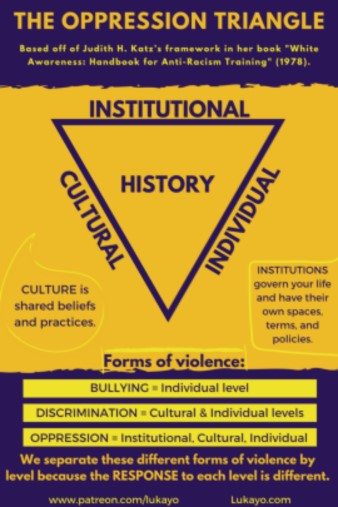
    [Image made using Canva. The poster is in colours of midnight-blue/indigo, mustard yellow, and lemon yellow. The top of the poster is yellow on blue, with the text “THE OPPRESSION TRIANGLE” and “Based off of Judith H. Katz’s framework in her book “White Awareness: Handbook for Anti-Racism Training” (1978)”. The middle part of the poster is blue on yellow. There is a large triangle facing downwards. On the top side of the triangle is the word “INSTITUTIONAL”. On the left side is “CULTURAL” and on the right side is “INDIVIDUAL”. In the centre of the triangle is the word “HISTORY”.  There is a faint yellow speech bubble with the words “CULTURE is shared belief and practices” on the left side. On the right side is a faint yellow speech bubble with the words “INSTITUTIONS govern your life and have their own spaces, terms, and policies”. At the bottom of the triangle is a faint yellow square introducing the next section in blue, with the title: “Forms of violence:”. Each form of violence is in a yellow rectangle with blue text on a blue background. The three forms of violence are “BULLYING = Individual level”, “DISCRIMINATION = Cultural & Individual levels”, and “OPPRESSION = Institutional, Cultural, Individual”. Below these rectangles are yellow text on blue: “We separate these different forms of violence by level because the RESPONSE to each level is different.” At the bottom of the poster are the links: “patreon.com/lukayo” and “Lukayo.com“.]

    “The Oppression Triangle” is a visual tool that can be used for sighted folks in the form of a handout or a poster to explain what oppression is and why anti-oppression is a different form of response to violence compared to anti-bullying and anti-discrimination methods.

    This Workshop Wednesday, we’re covering the following:

    • the different sides of the triangle
    • what each side of the triangle has to do with violence, and specifically the three forms of violence called bullying, discrimination, and oppression
    • how someone can tell the difference between oppressive bullying and non-oppressive bullying, and oppressive discrimination and non-oppressive discrimination
    • why we need to know the different levels of violence by describing the typical anti-violence responses to each
    • group work activities
    • the original photo of the poster

    The Sides of the Oppression Triangle

    The level of the individual has no explanation on the poster because it’s hoped that participants understand what individual interactions are, which are usually one-on-one in nature. Examples of this would be people having a conversation, or one person helping another person cross the street.

    Given that I define “culture” has “shared beliefs and practices”, the cultural level is when a group of people with shared beliefs and practices interacts with another group of people that has a different set of shared beliefs and practices– or a group to an individual. Examples of this would be “alternative lifestyle” cultures like goth and punk, where members of this culture have a shared belief in the concept of “goth” or “punk” (though they can argue exactly what that concept is) and have common practices. Other examples can be a culture based on geography (like Haligonians who are born or reside long-term in Halifax) or based on ethno-religious grounds (like Jewish culture).

    When you get to explaining Western institutions, you can either list the institutions first and ask what they have in common (and ask them not to look at the answer on the poster) or you can ask them to try to name institutions. Common ones are commerce/business/economic, government, military, legal, educational, medical, media, and certain religious institutions. I always add that not all religion is an institution, because not all religions govern your lives. Some religions can fall under culture instead, because it’s a shared belief and practice, but you can choose to opt out of it easier, unlike many of Western society’s institutions. I specify Western, but you can also say Westernized, as there is a possibility that other institutions outside of the West can work that way while others that are not Westernized do not work that way– for example there can be local tribal governments that only meet when needed and there is no permanent location for their meetings.

    History is in the middle of the triangle because in order for something to be all three levels of power (individual, cultural, and institutional), it would have had to take time to get there, thus, there would be a long history of it existing.

    Bullying, Discrimination, and Oppression

    When I talk about violence, I mean all kinds of violence– physical, verbal, social exclusion, negative messaging in images and misrepresentation/lack of representation, emotional, spiritual, etc.

    Bullying is largely regarded as a form of violence that is peer-to-peer and chronic, where a power imbalance between usually two people is created. Sometimes a power imbalance already exists and is used as a reason to bully. Generally regular bullying is on the individual level of violence.

    Discrimination is usually defined as when a person or group of people is violent towards a group, or a person belonging to a group, based on their skin colour, gender, disability status, sexual orientation, or other physical or social aspects that they cannot control. Discrimination is on the individual and cultural levels of violence. Discrimination manifests on the individual level as discriminatory bullying, when someone is chronically targeted by a peer for belonging to a specific group based on an aspect of themselves they can’t control.

    Oppression is institutional violence. This is when an institution, like, for example, the police, consistently targets groups of citizens because of an underlying logic that they are less than human, and so can be treated that way. Oppressive discrimination can manifest in the police force by masculine officers having a separate lounge that does not allow feminine officers (cultural level). Oppressive bullying can manifest in the police force by a cisgender police officer chronically harassing a transgender police officer (individual level). For a specific violent logic to get to the institutional level, there would already be a long history.

    Non-Oppressive Bullying and Non-Oppressive Discrimination

    Folks usually get stuck in trying to figure out what bullying looks like if it’s not discriminatory or oppressive, or what discrimination looks like if it’s not oppressive.

    If we consider bullying as peer-to-peer and chronic, but take away the existing power imbalances of institutions, or cultural groups, or aspects of oneself that you can’t control, then we have bullying that creates a power imbalance. These power imbalances can be based on what sports team people like, or whether they like Stars Wars versus Star Trek. People can choose whatever they want to be violent towards you on a regular basis, but it’s not discrimination or oppression without that cultural or institutional level of power.

    If we consider discrimination that is executed without the historical support of institutions, then we are looking at violence towards people solely based on aspects of themselves that they cannot control. In this regard, it is possible to racially discriminate against folks with pale skin or are considered white, as well it is possible for a group of women to discriminate against men.

    Anti-Bullying, Anti-Discrimination, and Anti-Oppression

    So why should we make all these distinctions that just seem super nit-picky? Well, for one, it helps to lay them out for folks who believe reverse-racism or reverse-sexism is a thing– it’s not. Let’s break this down in the anti-violence responses.

    When regular bullying happens in a school yard or at an office or in a neighbourhood, what would be the courses of action? To stop the violence, usually we’d go to an institutional authority figure– a teacher in the school, the human resources department at work, or the police officer from the nearest precinct. Anti-bullying measures are then put in place by the institution.

    When discrimination happens in those same settings from our peers, we can go to those same authority figures. If they don’t do anything, we can go to legal institutions, such as the Ontario Human Rights Tribunal if the discrimination happened in the province of Ontario. Anti-discrimination punishments are then put in place by the institutions.

    But when bullying and discrimination are oppressive, appealing to these institutions don’t workbecause it’s these very institutions that have the history and current practice of bullying and discriminating against the group that’s being targeted. That’s why common forms of anti-oppression involve collective organizing among oppressed groups and their allies to give alternate services that these institutions should be providing to the oppressed, protecting the oppressed from these violent institutions, and/or exposing and opposing the violence in these institutions through direct action.

    Let’s return to the dilemma of reverse-racism and reverse-sexism. When people get into arguments about this, what’s actually happening is one person is trying to talk about racial and sexist oppression via institutions while the other person is talking about racial and sexist discrimination from groups. If it’s an honest misunderstanding, maybe going through The Oppression Triangle infographic might help them out. However, sometimes these arguments are rooted in the emotionally-based belief that institutions can do no wrong or that these institutions can’t possibly influence people on a social and individual level, which, at best, makes the oppressed sound like they are complaining for no reason, and, at worst, makes the oppressed look like terrorists that are exposing and opposing benevolent social mechanisms. In that case, I would suggest folks conserve their energies for those who truly want to learn once they realize a person refuses to look deeper into history and how institutions are operating in the present day.

    Group Work Activities

    Yikes! This was super long-winded. How are you going to get folks to even stay awake through all these definitions? Here’s some ways to do so by group work activities! Pro-tip: Give space to have groups present via music, dance, art, and theatre, not just by talking!


    Want to have access to the rest of the article, the larger full colour updated poster, the original photograph of the hand-drawn poster, and other anti-oppression related teaching tools? Click on the link below and subscribe for as little as $2/month. By becoming a patron, you support healing work among my communities, and the indigenous Elders that mentor me.

    https://www.patreon.com/posts/21075614

  • Workshop Wednesday Special! Relationship Charts

    In celebration of the Kinaban Patreon reaching our first goal of $150, here’s a freebie post on charting your relationships!

    I’m going to ramble about the following:

    • why chart your relationships?
    • needs, wants, and boundaries
    • the space-time continuum
    • feeling special
    • sharing lives together
    • when to use the charts
    • a link to the relationship charts in .pdf

    Why chart your relationships?

    Some folks like the organic, flowing, magical mystery of getting to know someone bit by incremental bit, or just U-hauling it and figuring it out afterwards. Not me. Well, not 30-something me. Definitely teenybopper me and 20-something-living-catastrophe me was into that high-risk fun and games. Now, as a person with multiple ethical relationships that have varying levels of physical, emotional, sexual, and spiritual intimacy, logistics are a large part of my life– from my Google calendar, to my written agenda, to my online spreadsheets, to these relationship charts. They help me sort out my priorities and how I want to make them reality, while respecting what was negotiated with those closest to me. The charts specifically help me figure out what I want out of my life, and then with whom and how do I want to share my life with.
     
    I also created these charts for political and anti-oppressive reasons. I wanted a way for folks who have relationships that weren’t necessarily heteronormative and/or amatonormative to be able to have a template to create the kinds of relationship networks and communities they want. As charts, they’re not a set of rules or guidelines, but something that can start an idea, or be rearranged and built on depending on who needs them for what. I wanted to give folks an easy way to challenge what society teaches us is “the one true way” to have relationships in our lives by giving them the option to create their own way.


    Needs, Wants, and Boundaries

    “Cool story, Lukayo,” you say, “but how the hell do you know what you want from your life?” Good question, imaginary yet beloved reader. For me, it definitely was trial-by-error, especially because my definition of what a “want” and what a “need” changed so often. I only figured things out after I’d been in a string of relationships that taught me so many lessons. You’re going to have to figure this out for yourself, too. If you already have, awesome! Then you can just fill out the charts based on order of priority. If you haven’t figured stuff out completely, you can use these charts by taking the titles of each row and considering these questions:

    • Is this something that I need absolutely in my life?
    • Is this something I want but it’s okay if it’s not in my life ever?
    • Is this something I absolutely do not want ever, and thus is a boundary?

    That way you can start figuring out your basic needs, wants, and boundaries without anyone else in the picture first. You can put N, W, or B beside each row that corresponds to the concept of each letter. Or you can make up your own questions based on your own definitions of what a need, want, and boundary is! I’d love to read about them in the comments.

    The Space-Time Continuum

    Obviously, we all need time and space as 3-dimensional (4-dimensional?) beings. But before you fill out this chart with other people in mind, first ask yourself, how much time do I need to myself? Will I climb up the walls and want to run away to the woods if I constantly see people every single day from when I wake up to when I go to bed? Or will I love the hell out of it and cry if I wake up alone? Also, how much space do you want? Can you never absolutely share another bed with a person? Another room? Do you need your own bathroom and kitchen?

    After thinking about what’s important to you, then you can start thinking about how much you’re willing to share with others. Is there some kinds of relationship you’re willing to give more time and space to? Traditional Western monogamy prioritizes a single person for all your emotional, romantic, and sexual needs. Are you also willing to give “best friends” some time and space? If you spend all your time with a romantic partner, are you content, or will you flip out because you’re not spending time with your pals or in community work? Are you okay ever living with complete strangers or do they have to be friends or partners?

    If you’re thinking about giving this chart to someone, then you can also fill out this section based on how much time and space you’re okay with spending with this particular person. You can also add how much you may be willing to spend in the future as your maximum amount, just to add some clarity and to show, if that’s where you’re at, that you’re thinking of this person in the long-term.

    Feeling Special

    This section of the charts, entitled “Am I Special to You?”, can be filled out like the previous one, in that you first consider how you make yourself feel special, how you’d like others to make you feel special in general, how you’d like other to feel special in general, and/or how you’d like the specific person who is receiving your chart to feel special.

    For “Titles/Names”, I’d like to suggest that you don’t have to choose titles that already exist or are common. You can have a new name for a non-romantic, non-sexual committed relationship because this person shares over 5 areas of their life with you in a long-term way. Examples of alternate names of relationship types or partners include: queerplatonic, quasiplatonic, zucchini, relationshipmate, cupcake, honeybee, packmate, etc.

    I especially like this section because it gives options to aromantic, asexual, polyamorous and/or relationship anarchistic folks. Monogamy clearly spells out that you’re one, chosen sexual and romantic partner is the one that gets the special title, has special ceremonies (anniversaries and weddings), attends events together as the “plus one”, has tokens like rings, and is the one you exclusively have sex and kids with.  For those that don’t have sexual partners, or romantic partners, or have multiple sexual and romantic partners, there are other ways to express your caring for other folks to show how important they are, and you can plan that out together.

    Sharing Lives Together

    In the two-paged chart “What part(s) of your life do you want to share with me?”, I know the title focuses on the “sharing” part, but actually you should start with “is this area even important to me?” for each row before you consider if you want to share it with somebody else. Another exercise you could do with this chart is  figure out how many people you want to share each area with. Maybe only 1 person gets to share the sexuality/kink parts of your life, but hundreds of people can share in your community work. You can also denote what parts of the chart have a limited boundary, where there needs to be more time and trust built for someone to access that area (like children or being an emergency contact) versus you’ll manage with whoever gets stuck with you (like work). These categories are also really broad– you can make sub-categories, especially if you want different folks fulfilling them. You might want a different buddy to go to the gym with you versus go to the spa with you (both fall under “Physical Maintenance”) or you may keep your hockey game watching bros strictly separate from your Live Action Roleplaying community (which can either be “Social Events” or “Hobbies/Creativity”). Lastly, don’t forget to add new categories! I don’t know your lives better than you do, and if there’s an area that you prioritize and/or want to share, put it on there!

    When to Use the Charts

    Though you’re free to use the charts whenever you want, here are a few suggestions on possible ways you could use them:

    • when you feel stuck in your own life and want to figure out whether you’re spending enough time with yourself or what areas of your life need more attention
    • when you’re not in any chosen relationships and you’re trying to consider what you want out of your social life and/or friendships and/or romance
    • when you’re starting a new relationship and want to communicate what you’d like to offer to another person
    • when you’re in a relationship with another person and you’re unclear what they want from you, so you ask them to fill out this chart
    • when one of your relationships needs to transition into another form and you’d like to work that out with the other person as to what will decrease, increase, end, change, or be maintained in the relationship

    Hopefully this gives you some ideas of when and how to use these charts! Though they’re good for organizing, always remember that they can’t replace good ol’ communication.

    Link to the charts: Relationship Charts


    Want access to more awesome educational content like this? Check out and subscribe to www.patreon.com/lukayo.

  • WE DID IT! WE REACHED THE FIRST GOAL!

    [Image made with Canva. The background is black with white text. On the left are three photos placed vertically. The top photo is of Noah Heart, a brown-skinned man with black hair and glasses wearing a long-sleeved shirt praying to the statue of an angel and lit up by a ball of light. The middle photo is of Nanay Myrna Pula, a smiling brown-skinned woman with black hair wearing beaded and hand-stitched T’Boli regalia in colours of black, yellow, red, white, and green. The final photo is a picture of Lukayo at a microphone wearing a T’Boli t’nalak vest, white short-sleeved barong and black pants, holding their Anishinaabe drum Iba, explaining the painting on it that came from a dream sent by the Ancestors and Creator about indigenous solidarity and uniting tribes across the ocean. They were performing at an Obo Manobo fundraiser. On the right of the three photos, there is rainbow coloured confetti, streamers, and balloons. One balloon says “CONGRATS”. The text says “WE REACHED THE FIRST $150 GOAL ON PATREON! DIYOS MABALOS! Thank you to everyone that shared and became a patron! WWW.LUKAYO.COM”]

    In celebration of this first milestone in achieving our $150 goal, I will be making TWO posts on Workshop Wednesday this week, and one of them will be free!

    Thanks to all the people that liked, shared, and/or became a patron, I can now send at least 2000 piso a month to my uncle Noah Heart in supporting his healing work in the Philippines, and 2000 piso a month to Nanay Myrna Pula in building a school for the T’Boli community in her region. The rest of the $50 CAD a month will be going to my Obo Manobo Elder and teacher to support the education of the tribe through building a cultural festival and sending members to school. I do not have a picture of that elder up as I have been asked not to put up their name or photo in public, so instead I put up a photo of myself speaking at a fundraiser for the Obo Manobo organized by Luyos MaryCarl.

  • Troubleshoot Tuesday: When Participants Get Triggered

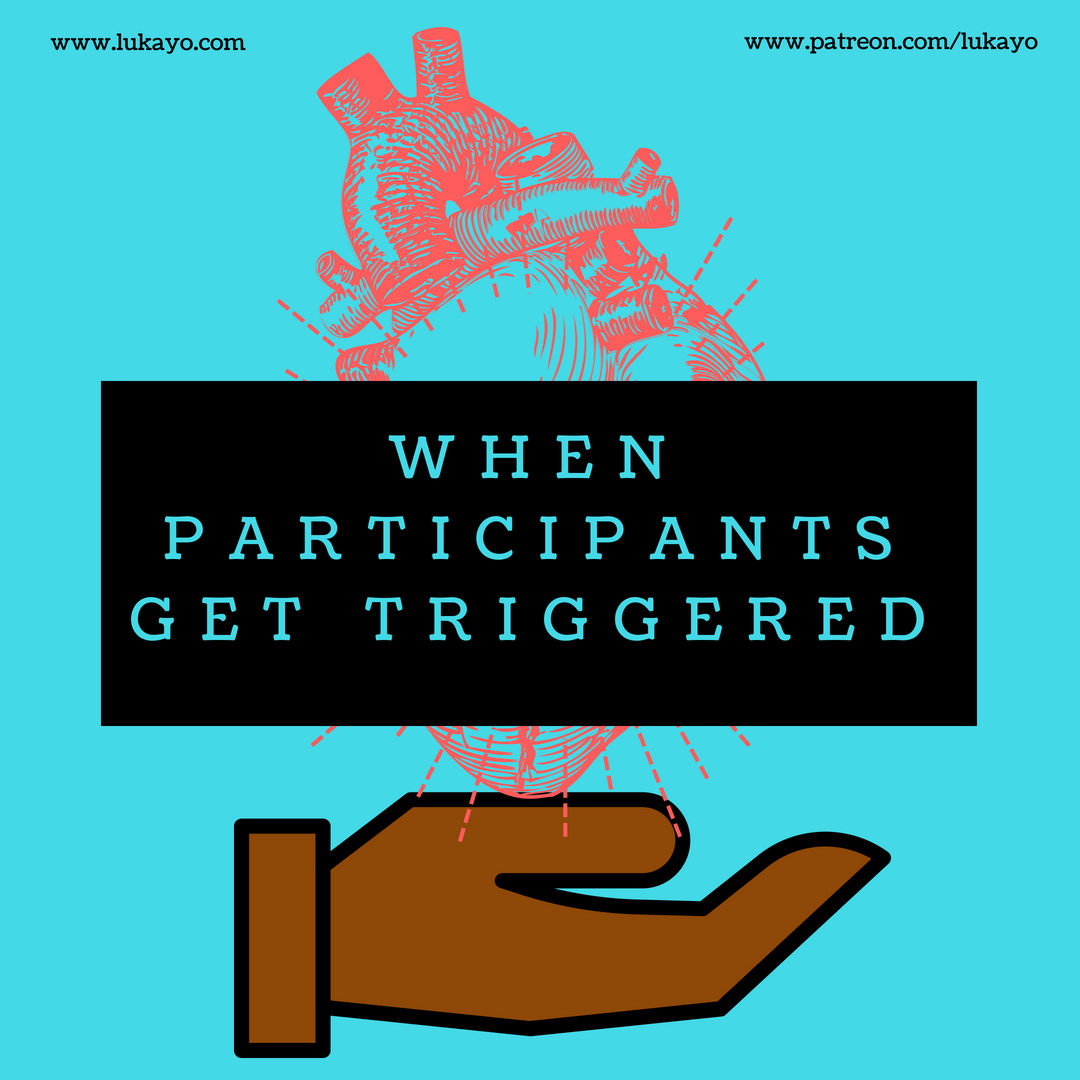
    [Image made using Canva. The background is teal, with a cartoon brown hand holding an anatomically correct bright red heart that has lines radiating from it. In a black box in the foreground is teal text that reads: “WHEN PARTICIPANTS GET TRIGGERED”. At the top of the graphic are the websites “www.lukayo.com” and “www.patreon.com/lukayo”.]

    I am super passionate about how to support participants that get triggered in workshops, and also I have a bunch of rants on it (like how the word “trigger” is being mocked and thus craps on people with trauma, as well as other people misusing the word “triggered” when they’re just feeling uncomfortable). Most of the rants, however, can be traced to what seems like folks who have never experienced trauma have no idea what trauma is (which is fair) and then proceed to say they do have it or just make fun of it (not cool, people).

    So before we get into the check-list of tips that I’ve now gotten into the habit of making (because lists are FUN!), what is trauma? Well, there’s a Western medical model of trauma, and a decolonial model of trauma (check out Renee Linklater’s Decolonizing Trauma Work for more info).

    The Western medical model that I learned about in grad school, in training at the Somatic Experiencing Trauma Institute, in Pete Walker’s book on Complex PTSD, and when I went to trauma recovery programs for my own C-PTSD, talks about an event that a person experiences (directly or indirectly) and it messes them up because their understanding of the world is shaken and their threat response (fight, flight, freeze, appease/fawn) doesn’t get to complete, becoming a trauma response that gets trapped in their body and triggered when they’re not actually under threat. That’s how we get the word trigger there– it’s something that reminds you, consciously or not, about a threat that is not happening in the present.

    The decolonial model is based on Eduardo Duran’s work in Healing the Soul Wound, but is built on Linklater’s discussions with Anishinaabe practitioners in Oniatario/Ontario. I’ve also experienced this in my own healing journey and in the spiritual counselling I do for others. Instead of just focusing on the symptoms, like the medical model, this model focuses on how trauma is a wound to your soul/spirit, that separates you from yourself and from your community. Healing consists of programs and ceremonies/rituals to bring you or your soul piece back to yourself in the container of a loving community, or in a group ritual where everyone is healing together. Community isn’t just the two-leggeds related to you or around you, but consists of all the relations– the stars, the sun, the moon, the wind, the earth, the trees, the plants, the rocks, the water, the four-legged, the winged, the finned, the crawlers, sacred fire, sacred tools and technology, the Ancestors, and the Creator. I believe we were not born with the ability to truly see ourselves, and so our community is the mirror that reflects our gifts, our purpose, and our love.

    All right, so now that that’s covered, what happens when we’re doing a presentation or running a workshop, and folks with trauma begin to respond as if threatened or if their soul wound begins to bleed out in front of us all? Which model should we use or should we use both?

    For the latter question, it’s difficult to make a snap judgement on which model the person would prefer we approach them with– that really has to be determined in a safe and trusting environment of support and/or therapy and/or ritual. Your workshop on anti-oppression or whatever topic that can be potentially triggering doesn’t have the capacity for that, and is more of a learning environment than a healing one. The tips I’m going to lay out here is adaptable for both models of trauma that honours the learning environment you’ve set up while still honouring the need for healing of those who may attend.

    1. Check-in with organizers if you can get support people and a quiet room at your workshop
    2. Mention support people, trauma, and triggers in the promo of the workshop
    3. Ask if there are other mental health access needs for participants in the registration process
    4. Have a list of mental health phone lines, spiritual practitioners, and centres to go to at the back of the workshop
    5. Talk about trauma and triggers at the beginning of your presentation, referencing all the supports that are available at the workshop and apologizing for the ones that aren’t
    6. Discuss with participants what would be the best way to check in with people if they suddenly leave the room, or if they’re having a mental health crisis in the workshop and can’t leave the room
    7.  Have signage on large flip chart paper in the room listing what was already planned, as well as what was decided upon as a group

    Are you a diversity coordinator, anti-oppression facilitator, or equity officer interested in reading the rest of this article? Click on the link and subscribe for $10/month to get anti-oppression tutorials, videos, posters, hand-outs, and trouble-shooting guides like this one twice a week. By becoming a patron, you support healing work among my communities, and the indigenous Elders that mentor me. 

    https://www.patreon.com/posts/21042512

The site will be down Thursday, July 30th from Noon until 4pm EST for webhost transfer and maintenance.

Close Welcome Bar