Category: Anti-Oppression

  • Creation & Prophecy: The Seed and Fruit of My Healing Justice Work [Patreon Post Excerpt]

    Much of the work I do is rooted in my understanding of Creation, which grows and flowers into Prophecy. I do believe all Creation stories have the seed of Prophecy, and all Prophecies beget new Creation stories.

    Cryptic, I know. Let me try to explain further, for my politics and my spirituality are the same to me.

    For folks who grew up in the West, and specifically like me in the settler colonial state of Canada, we are steeped in the narrative of European-based North American superiority in knowledge, beauty standards, and values. What those in academia would call “cultural imperialism”. I began to try to understand myself outside of this when I was doing my Bachelor in Humanities in university. By third year, professors and other racialized students taught me about colonization and colonialism. That all the self-hatred and shame I carried was something I could let go of, that the rage I had turned inward on myself could be crafted into determination, into community organizing. This sparked a renewed interest in understanding my ancestry, and a long journey of aligning myself with Indigenous struggle and decolonization on Turtle Island, as well as the broader global indigenous struggle and indigenization movements.

    Part of this process is tearing myself away from the “cultural imperialist” view of things, and understanding myself and my communities from other points of view. Though I acknowledge being raised in the West has influenced me, and continues to influence me and my understanding of Creation stories in general, it is the Creation stories specific to my ethnicity/people/region (primarily Bikol, but also with the neighbouring Tagalog and Bisayan influences) that helped root myself in a new world view. This world view didn’t find me inherently inferior and deserving of violence, shame, erasure/destruction, and exploitation/fetishization. This world view helped me to understand my gifts, my own personal narratives, and what I had already observed and felt about the world around me.

    ***

    I am rooted in the past as I dream of a wondrous future. This keeps me grounded in the present, in my purpose, in what I have to do.

    I hope we all can connect to a Creation story and a Prophecy of our people, the one that teaches us to be connected and good to each other, to heal and be whole, instead of to divide and punish. As we grow into protectors, healers, storytellers, visionaries, leaders, caregivers, workers– all of us need to again respect the sovereignty of the land itself, and the sovereignty and self-determination of the stewards of those lands, the original peoples, who are now called the indigenous peoples, while also honouring and respecting those who have been stolen, who are now called Black peoples. This is more important than ever, right now, as I, a non-Black settler, write during Black History Month, while Black people are still being discriminated against in settler colonial Canada, while the Wet’suwet’en are persecuted for protecting the land and their people, while the Anishinaabe on whose territory I reside continue to have their land and sacred waterfalls stolen by settlers and the Crown.

    If we can fulfill this Prophecy of protecting and healing the land, the spirits, the ancestors, and ourselves, through accompliceship and reparation, then we can again begin something new. Another Creation story awaits us.

    ***

    Want to read the whole article? Click on the link below and subscribe for as little as $1/month. By becoming a patron, you support healing work among my communities, and the indigenous Elders that mentor me.

  • Workshop Wednesday: Pickup Planets

    Image Description: The title in white reads: “Pickup Planets”. The sub-title in pale grey reads: “A Game of Privilege and Oppression”. The backdrop is outer space, with stylized white stars and one shooting star on a black background. There are five planets– a small red one, a giant yellow one, a medium-sized blue one, a giant purple one with a thin ring on a vertical axis, and a medium-sized green one with a thick ring on a horizontal axis. The URLs in white read “patreon.com/lukayo” and “lukayo.com“.

    What’s The Source?

    The Pickup Planets Game was first taught to me at a LGBTQ+ youth leadership retreat called Project Acorn in 2010. The facilitators learned it a few years prior from Karen B.K. Chan (http://www.fluidexchange.org/), who had facilitated the creation of the earliest version of the game with youth of colour in Toronto.

    What’s The Point?

    This game shows the ways people come from different social locations and deal with systemic pressures. It illustrates basic understandings of racial and class privilege and oppression.

    Who’s It For?

    This game is best for ages 12 and up.

    What You Need

    • Pickup Planet Activity Cards
    • Red buttons/stickers/ribbons/etc. equal to the amount of Red Pickup Planet Cards you have
    • 10-40 players/participants

    What You Do

    1. You hand out Pickup Planet Activity Cards to all participants.
    2. Make sure all Red Cards come with a button/sticker/ribbon/etc. for the participant to wear.
    3. Make sure there’s at least two of every card given out (Red, Blue, Yellow, Green, and Purple).
    4. First, tell the participants that they can read their cards but can’t show their cards to anyone.
    5. Secondly, tell the participants that they have to act out whatever the card tells them to (but keep your hands to yourself!).
    6. Lastly, tell the participants that the point of the game is to “pick up” as many friends as possible, and they have 5-10 minutes to do so.
    7. After 5-10 minutes, ask the participants to sit down in a circle together and start a discussion.

    What You Talk About

    1) [Do this for every card: Red, Blue, Yellow, Green, Purple] Who was from the [insert colour] Planet? Can one of you read your card out loud? What did it feel like to be from the [insert colour] Planet? What did everyone else feel and think about the [insert colour] Planet?

    2) What kind of real life examples do these cards talk about? Examples:

    • Green Planet is an example of newcomers who are still learning the dominant language.
    • Purple Planet is an example of newcomers and peoples who have different cultural values and behaviours.
    • Red Planet is an example of privileged and supremacist-thinking folks.
    • Yellow Planet is an example of folks whose people have been demonized and oppressed for generations.
    • Blue Planet is an example of folks who have been colonized and/or oppressed for generations and are pro-assimilation.

    3) Explain that this game is a great example of privilege. You, as the game facilitator, are the system of privilege that sets up everything up. No one earned or were chosen to be from Red Planet, and no one earned or were chosen to be from Yellow Planet—it was randomly chosen. Privilege is that unearned advantage, and oppression is that unearned disadvantage. It doesn’t mean the system is right, and it can be undone.

    4) Imagine if the goal of the game wasn’t to get as much friends as possible, but also to get jobs, land, resources, opportunities, and livelihoods. How can we work together to make sure people feel less alienated and oppressed? Examples:

    • Cultural exchanges where we try to learn each other’s cultures and languages.
    • Individual interactions where we think about why we react a certain way and work to understand where the other person is coming from, without jumping to assumptions and stereotypes.
    • Going through anti-oppression and decolonization training.

    Want to have access to the Activity Cards of this game, and other anti-oppression related teaching games and tools? Click on the link below and subscribe for as little as $4/month. By becoming a patron, you support healing work among my communities, and the indigenous Elders that mentor me.

    https://www.patreon.com/posts/27040291

  • Troubleshoot Tuesday: The Place of Rage Pt 3

    Image Description: The background is hot pink. There is a gradient pink and yellow circle with a giant yellow “angry” emoji/emoticon in it. The title text is yellow and reads “The Place of Rage Part 3”. The links in black are “lukayo.com” and “patreon.com/lukayo“. The other title pages are yellow circles or gradient yellow-pink circles on a hot pink background with a yellow border. 

    Content warning: trauma, police, prisons.

    Transcript:

    Mabuhay! If you haven’t already checked out part one and two, I suggest you listen to them first. The links are in the video transcript, along with links to writers that informed this series.

    This week we’re focusing on the question of “what happens when expressions of anger have harmed someone in a space?” Especially if it’s a space that you’re facilitating or leading for skill-sharing and educational purposes? My approach tries to take into consideration two core concepts: trauma and ethics.

    Before we get into it, I just want to put a content warning up, since we’ll be talking about trauma, prison, and police systems.

    So why are we talking about trauma? First of all, my understanding of trauma was covered in a previous Troubleshoot Tuesday article, which I’ve also linked in the transcript. To sum it up in a really basic way, trauma is a reaction to being or witnessing wounding and harm, and it messes up your threat response. The idea is that we have the capacity to choose our threat response when we are threatened or harmed (like fight, flight, freeze, appease/fawn, etc.) but when we are traumatized, a threat response gets “stuck” and starts automatically before we can even think about it. This is what being “triggered” means in trauma theory. So for me it’s important to introduce concepts like triggers and trauma into my workshop early on, like in the Community Agreements, and discuss how to hold space for those stuck threat responses. That way when anyone does get triggered, whether they know if they have trauma or not, other people in the workshop are prepared and there’s some guidelines in place on how to support everyone.

    But how about when folks can choose their behaviour when they feel threatened or when they witness or experience harm? That’s ethics. There’s so many concepts out there about what folks think are moral, i.e. “good and bad”, so I’m just gonna cover some of my own ethics and how that’s informed my responses in my workshops. I’m hoping that this sharing will help you figure out or rethink your own courses of action in your teaching spaces.

    In my previous video on The Place of Rage, I talked about considering power dynamics in the space, which I think is foundational to intersectional anti-oppressive ethics. My ethics is also relationship-based, and is part of a decolonial and disability justice framework. Lastly, I believe in transformative justice (TJ), and I think that TJ makes sense as a form of ethics that also comes out of, if not the same as, intersectional anti-oppression, decolonization, and disability justice.

    My understanding of TJ is informed by workshops run by the Just Practice Collaborative in Chicago, writings by the Bay Area Transformative Justice Collective in Oakland, California, and the zine and book The Revolution Starts At Home (all of these linked in the video transcript below). As well, transformative and restorative practices are deeply embedded in the practices of many Indigenous peoples to Turtle Island, and their teachings in informal and formal gatherings, in social media and over messenger, and the hard and necessary work that is done alongside the settler colonial Canadian prison industrial complex with Gladue sentencing, also has informed my understanding, and I owe a debt to them as do many settlers and non-Indigenous to Turtle Island folks when trying to practice transformative justice. Though I will not cover it in this series, my understanding of transformative justice is deeply informed by ceremony with my own people and indigenous peoples in Turtle Island and in the Philippines.

    The first thing I try to do when responding to harm in a workshop space I am facilitating, a harm traced directly from someone’s expression of anger, is that I try to slow down or redirect any responses I have that come from my own trauma, and focus on consequences and the impact of the harm on everyone involved, and perhaps communities that aren’t even in the space right now but are connected in some way.

    Thinking and feeling about consequences is important, and I try to go there instead of immediately wanting to punish, exile, and control. My understanding of the settler colonial and racist prison and police systems that I’ve grown up in is that they operate on systems to control that are enforced through punishment and exile– “I’m going to make this person hurt, I’m going to make this person lose, I’m going to make this person feel worthless and take away as much of their humanity as possible because they are bad and wrong”. These systems got into my head, mixed up with my trauma, when I was growing up, and it takes a lot of practice and conscious effort every day not to fall back on them. I don’t want to make people disposable because this is against my values of intersectional and decolonial anti-oppression and disability justice. I don’t want the prison and police in my head to win, because I believe there is another way to go about things.


    Want to listen to/read the rest of the video? Please subscribe for $10 per month to gain access to weekly interactive posts where you can ask questions about the creative process and troubleshoot your anti-oppressive workshops. Supporters will also receive a mailed package with print-outs of anti-oppression activities and posters. All funds raised go to healing work among my communities. 


    Links:

  • Workshop Wednesday: So It Begins!

    [Image Description: A black and white photo with a light bulb, two pencils, and an eraser on top of a blank piece of paper. The photo is part of a cover page that is in turquoise, light grey, and dark grey. There are also pyramid shapes in monochrome. The title is “So It Begins!” and the URLs are lukayo.com and patreon.com/lukayo.]
     
    Transcript:
     
    Mabuhay to Lukayo’s Workshop Wednesday Video Series! For our first episode, I’m going to offer some suggestions about how to begin your workshop, specifically a workshop grounded in anti-oppression.
     
    We’re going to look at the following 5 different parts: introducing yourself, land accountability and gratitude, community agreements, checking in with the participants, and icebreakers.
     
    Introducing Yourself
     
    Basic components involve your name and your pronouns. You can even talk a little bit about yourself, like if you represent an organization, or come from a certain school, or why you wanted to do this workshop.
     
    I like to introduce myself in my native language. “Mabuhay! Lukayo ako. Taga-saan Bikol ako.” Welcome, my name is Lukayo, and I am of the Bikol people. My pronouns are “they/them/their”.
     
    This is important to me because I want to honour my ancestors and people, as well as show that I don’t completely follow the Westernized way of sharing knowledge.
     
    Sometimes, if I know the language of the land, I may say hello in that language to honour the people of that land. For example, if I’m in Anishinaabe territory, I may say hello in Anishinaabemowin.
     
    Land Accountability & Gratitude
     
    At this point, I like to give thanks in gratitude to the people of the land, and also mention the treaties that that specific area is under. If possible, if I’m presenting on land that I’m not indigenous to, I also try to explain what happened to the treaties and what the responsibilities are that settlers have to indigenous folks. I consider that my responsibility as a settler, especially one sharing knowledge in a gathering.
     
    So how do I find out about all of this info? I attend indigenous education trainings from the people of the land I’m currently residing on, put together by Native Friendship Centres or grassroots indigenous collectives. I also check out websites like DecolonialAtlas.wordpress.com and Native-Land.ca.
     
    Lastly, I talk about how settler responsibilities have expanded beyond just respecting treaties, especially in areas where the treaties have been broken, or land was outright stolen and no treaties were made. I talk about reparations as a form of accountability, and current ways I am offering reparations in accordance with what has been asked by local Indigenous collectives and grassroots organizations, as well as further ideas for reparations for anyone attending, such as supporting local Indigenous grassroots initiatives in regards to reclaiming sacred areas and land, justice for missing and murdered Indigenous Two spirit peoples, women, and men, and healing initiatives led by Indigenous peoples for Indigenous peoples.

    Want to listen to/read the rest of the video? Please subscribe to my Patreon for $5 per month to gain access to anti-oppression workshop tutorials and videos. All funds raised go to healing work among my communities. Original article here: https://www.patreon.com/posts/26879671

    Links:
  • Troubleshoot Tuesday: The Place of Rage Pt 2

    Image Description: A cellphone with a giant angry emoji/emoticon on the screen, lying on top of a wooden surface.

    Transcript:

    Mabuhay! If you haven’t already checked out part one, I suggest you give that a listen first, before jumping in. I’m going to build on what I talked about last week, which was in favour of emotions and anger, by discussing this idea of “too much”, which leads into concepts of conflict, abuse, bullying, and oppression (so content warning for all those things).

    Here’s the core question for me: When is the expression of emotions and anger considered “too much” in a given context, especially a workshop setting, without perpetuating oppression by policing, silencing, and invalidating people’s trauma and pain? How do we figure that line out? And, if we have that line figured out, what do we do when it’s crossed?

    I wonder if this is more a question of ethics than it is anti-oppression– but to me anti-oppression and decolonial thinking is a form of ethics. I just find the ways that this ethics is interpreted or practiced on the daily is so different from one person to the next, from one social group to the next. This gets into complicated territory of “are we gaslighting survivors?” and “are we believing survivors?”, as well as “are we apologizing for abusers?” and “are we scapegoating other survivors as abusers when we don’t ask for evidence or their side of the story?”

    Now, before I get deeper into how I would attempt to figure this line out, let me state briefly that, speaking for myself –while encouraging other people, groups, and collectives too– the attempt must be made, because the consequences are dire. I have witnessed harm occur when anger is expressed violently and abusively, and I have witnessed harm occur when anger is expressed and it was arguably not violent or abusive but the backlash towards the expression was violent and abusive. I have witnessed harm occur when people have done nothing and when people have intervened. The stakes are high, and I want to grow and move forward– I want our movements and our campaigns to grow and move forward too.


    Want to listen to/read the rest of the video? Please subscribe to my Patreon for $10 per month to gain access to weekly interactive posts where you can ask questions about the creative process and troubleshoot your anti-oppressive workshops. Supporters will also receive a mailed package with print-outs of anti-oppression activities and posters. All funds raised go to healing work among my communities. Original article here: https://www.patreon.com/posts/26851147


    Links:

  • Troubleshoot Tuesday: The Place of Rage

    Image Description: A cellphone with a giant angry emoji/emoticon on the screen, lying on top of a wooden surface.

    Transcript: 

    Mabuhay! This Troubleshoot Tuesday, I’m going to briefly talk about what Katherine Cross writes as “call-out culture, purity politics, and the veneration of rage in activist circles” (the link to her article in Feministing is in the transcript to this video). This is a multi-part series because of how huge this topic is.

    I am not going to talk about social media scapegoating because these tutorial videos are about supporting folks facilitating workshops and running programming in their schools, communities, and workplaces. I think that the dynamic and nuanced discussion on social media scapegoating and shunning culture is super important, and I’ve offered links below to folks who have a lot to say about it.

    In the next few videos I’m going to talk about different strategies to handle rage in participants (and yourself) during a workshop. In this particular video I want to argue in favour of emotions, and in favour of anger, and how to make space for it.

    I’ve noticed historically and currently how “being emotional” is equated with “being less than” in regards to feminized people and racialized people, and that anger is only permitted for the masculinized– and white. It’s a tactic of silencing, where a person or people’s pain is minimized or erased by the underlying message that they have no right to be angry at all. Giving space for emotions and anger in our workshops for folks who have been told they are “too angry” and “too emotional” is about validating the pain and trauma that folks have endured under oppressive circumstances.

    So how do we make space for these feelings? You can say it openly, right at the beginning of the workshop or discussion. That it’s okay to cry, to get angry, to need to walk out, to ask for space, or a hug, or to shake with fear and anxiety. Talk about your own feelings, how they affect you, how they may express themselves during the workshop. I talk about how sometimes I sing when I’m nervous, and I cry suddenly, and that’s okay to let me cry. That when I get angry, I clench my fists, and I scream into pillows but my voice doesn’t rise.

    I think it’s also important to bring this up during the Community Agreements part of your workshop (a video on that coming up soon). I don’t think it’s responsible to hold space for emotions without checking in with everyone about any trauma they’re willing to disclose regarding triggers, as well as agreements made on how to manage conflict and feedback between participants, and if there are support people to check in on folks who step out in the midst of great distress.

    Anyway, that’s it for today! Don’t forget to comment on this post with your own concerns and questions, and I’ll be happy to answer and troubleshoot with you any situations that have come up for you in your own work and discussions. Tune in next week for more on The Place of Rage!

    Links:


    If you liked this video, please become a patron, where all funds raised goes directly to healing work in my communities. Link to original article here: https://www.patreon.com/posts/26681270


  • Workshop Wednesday (Pt 3): Direct Action

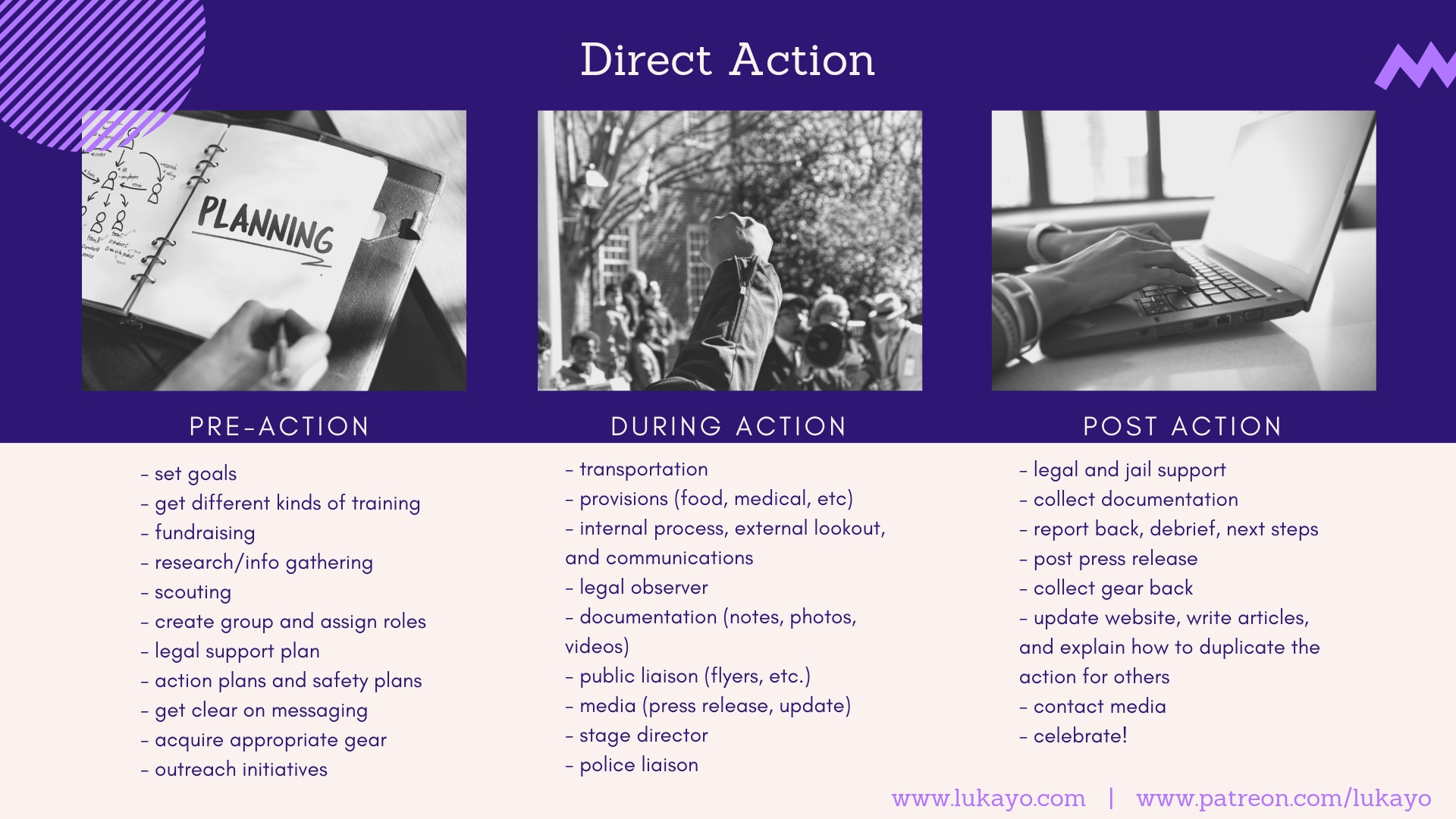
    This is a visual tool that gives the basic outline and/or check-list on putting together a direct action. Though direct actions can be violent (such as sabotage and property destruction) and non-violent (such as strikes, sit-ins, and blockades), the goal is always to stop, change, or reveal an oppressive institutional mechanism.

    This tool is best presented with the tools on Inclusive Policies & Procedures and Inclusive Programming.

    Activity Idea

    Divide the group into three, and assign each group one of each of the following posters:  Dis/Ableism 101, the Pillars of White Supremacy, and The Gender Binary. Each group then has to work as a small collective on planning a direct action against an institutional form of the oppression they were assigned.

    Poster Description

    The top half of the poster is in indigo, and the lower half of the poster is in mauve.

    In the indigo section there are pale purple graphics like a sliced up circle on the left corner and a jagged line on the right. In white there is the title “Direct Action”. Below the title are three black and white photos. The first photo has a notebook open with some drawings of stick figures and the word “PLANNING” written down by a light-skinned hand holding a pen. Underneath that photo is the word “PRE-ACTION”. The second photo has a dark-skinned fist raised in the foreground; the background has people, one holding a megaphone, in front of buildings and trees. Underneath that photo are the words “DURING ACTION”. The third photo has dark-skinned hands typing on a laptop. Underneath the photo are the words “POST ACTION”.

    In the mauve section of the poster are three columns of indigo words, as well as “lukayo.com” and “patreon.com/lukayo” at the bottom right corner of the poster in pale purple.

    The first column under the title “PRE-ACTION” has the following text:

    ” – set goals
    – get different kinds of training
    – fundraising
    – research/info gathering
    – scouting
    – create group and assign roles
    – legal support plan
    – action plans and safety plans
    – get clear on messaging
    – acquire appropriate gear
    – outreach initiatives”

    The second column under the title “DURING ACTION” has the following text:

    “- transportation
    – provisions (food, medical, etc)
    – internal process, external lookout, and communications
    – legal observer
    – documentation (notes, photos, videos)
    – public liaison (flyers, etc.)
    – media (press release, update)
    – stage director
    – police liaison”

    The third column under the title “POST ACTION” has the following text:

    “- legal and jail support
    – collect documentation
    – report back, debrief, next steps
    – post press release
    – collect gear back
    – update website, write articles, and explain how to duplicate the action for others
    – contact media
    – celebrate!”


    Want to have access to the larger full colour updated 2019 poster, the original photograph of the hand-drawn 2016 poster, and other anti-oppression related teaching tools? Click on the link below and subscribe for as little as $3/month. By becoming a patron, you support healing work among my communities, and the indigenous Elders that mentor me.

    https://www.patreon.com/posts/25012822

  • Workshop Wednesday (Pt 2): Inclusive Programming

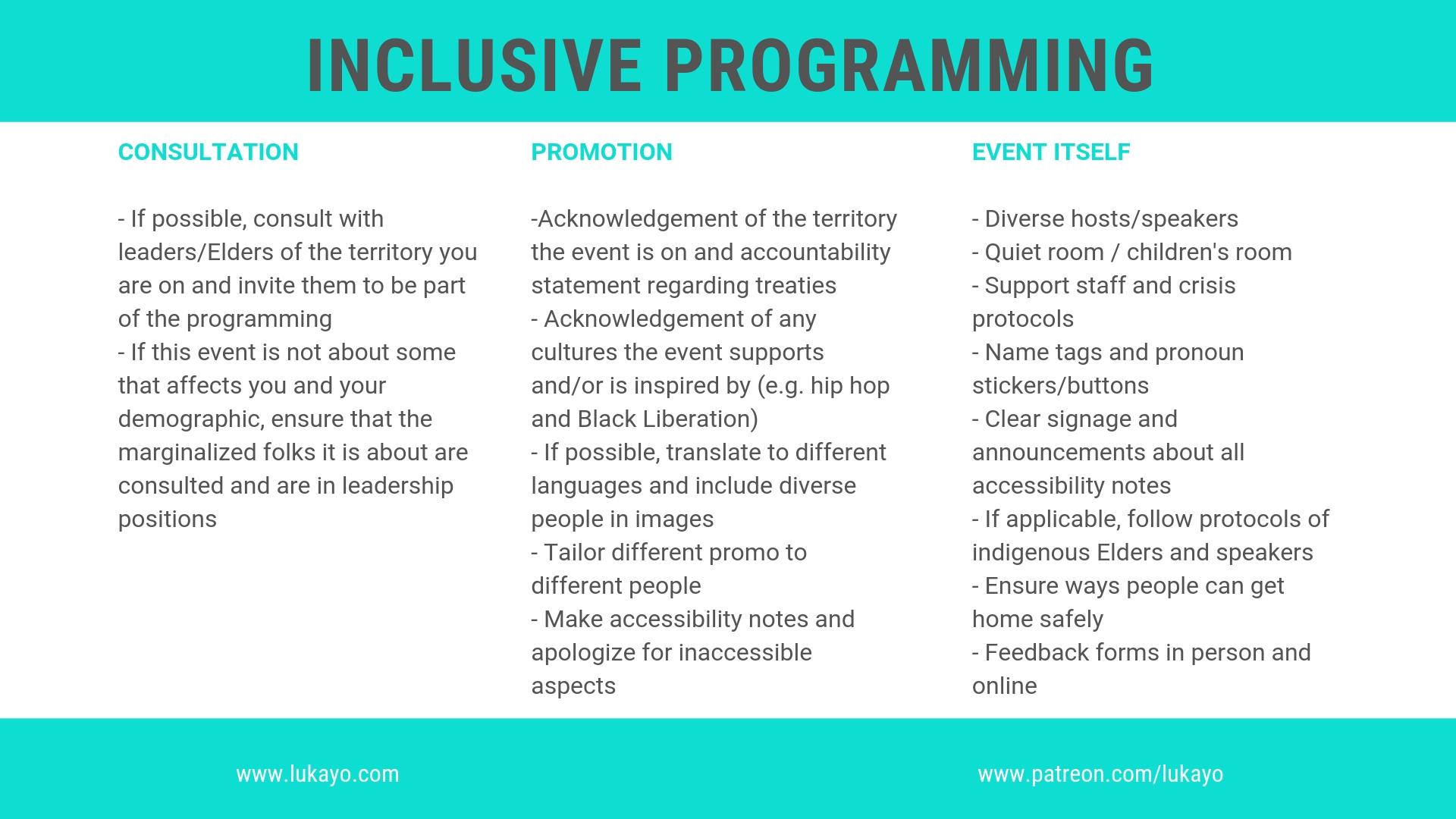
    This is a visual tool that gives the basic outline on how to plan an inclusive program or event. Ideally, events and programming would center those most affected by the issue that the event is about, as well as have them in leadership positions, so they would not have to be considered simply “included”.

    Events, whether they’re knowledge exchanges, presentations, gatherings, or celebrations, are ways that folks can build the communities and anti-oppressive world that we want. That’s why I think it’s so important that our events have to reflect our anti-oppressive theory and prevent the perpetuation of further exclusion and marginalization.

    This tool is best presented with the tools on Inclusive Policies & Procedures and Direct Action.

    Activity Idea

    Divide the group into three, and assign each group one of each of the following posters: Dis/Ableism 101, the Pillars of White Supremacy, and The Gender Binary.  Each group then has to work as a small collective on planning an event centered on or raising awareness about the specific oppression they were assigned.

    Poster Description

    The poster has a turquoise header and footer, with the center having a white background. The header, in dark grey font, has the title “INCLUSIVE PROGRAMMING”. In the footer, in white font, has “lukayo.com” and “patreon.com/lukayo“.

    There are three columns, with a turquoise title and dark grey text.

    The first column has the following text:

    “CONSULTATION
    – If possible, consult with leaders/Elders of the territory you are on and invite them to be part of the programming
    – If this event is not about some that affects you and your demographic, ensure that the marginalized folks it is about are consulted and are in leadership positions”

    The second column has the following text:

    “PROMOTION
    -Acknowledgement of the territory the event is on and accountability statement regarding treaties
    – Acknowledgement of any cultures the event supports and/or is inspired by (e.g. hip hop and Black Liberation)
    – If possible, translate to different languages and include diverse people in images
    – Tailor different promo to different people
    – Make accessibility notes and apologize for inaccessible aspects”

    The third column has the following text:

    “EVENT ITSELF
    – Diverse hosts/speakers
    – Quiet room / children’s room
    – Support staff and crisis protocols
    – Name tags and pronoun stickers/buttons
    – Clear signage and announcements about all accessibility notes
    – If applicable, follow protocols of  indigenous Elders and speakers
    – Ensure ways people can get home safely
    – Feedback forms in person and online”


    Want to have access to the larger full colour updated 2019 poster, the original photograph of the hand-drawn 2016 poster, and other anti-oppression related teaching tools? Click on the link below and subscribe for as little as $3/month. By becoming a patron, you support healing work among my communities, and the indigenous Elders that mentor me.

    https://www.patreon.com/posts/25012437

  • Workshop Wednesday (Pt 1): Inclusive Policies & Procedures

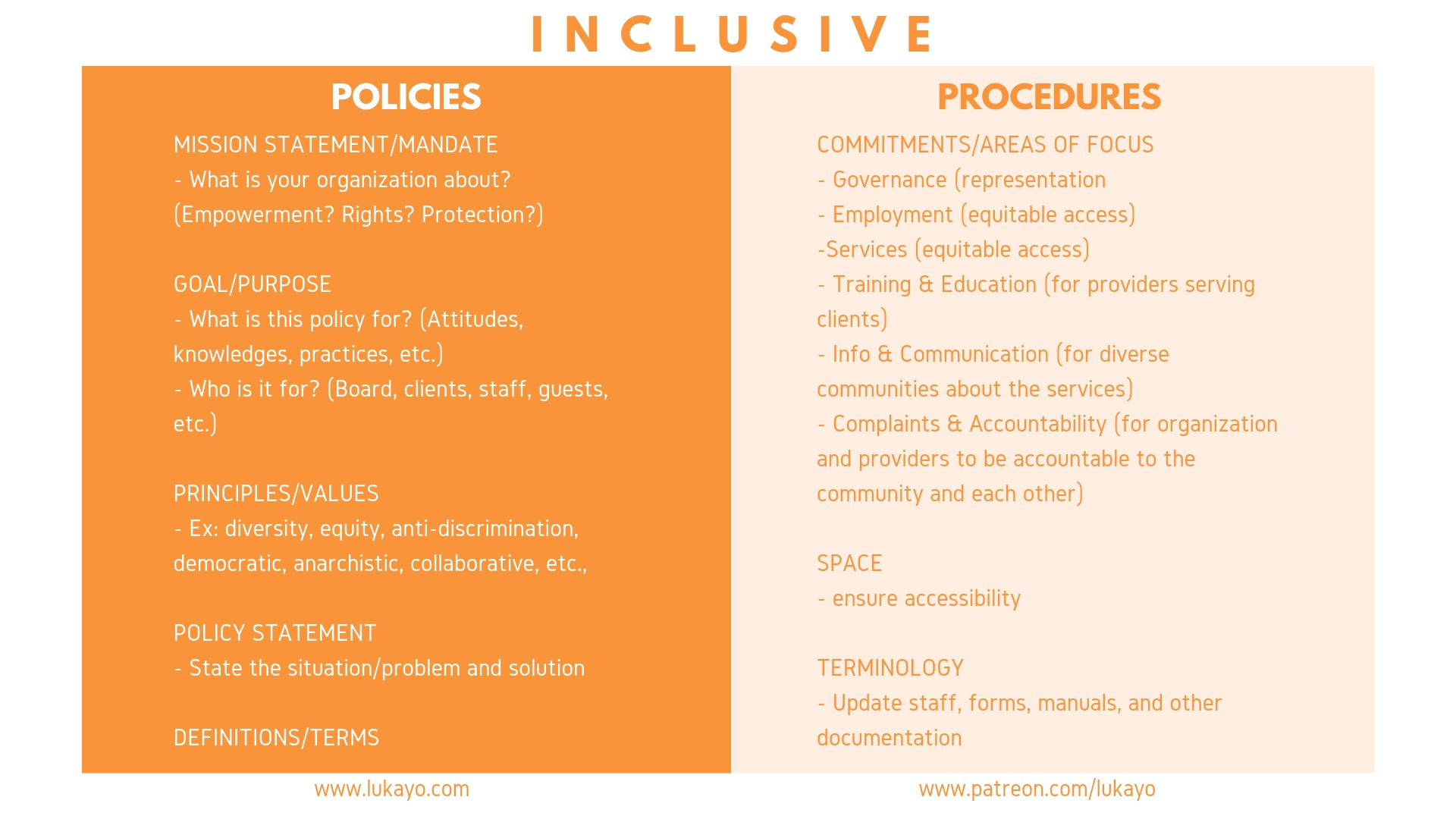
    This is a visual tool that gives a basic outline on how to plan the sections for creating inclusive policies and procedures for your organization, collective, or group. Ideally, these policies and procedures would center those most affected by the mission and ideals of the group, as well as have them in leadership positions, so they would not have to be considered simply “included”.

    Having something written down ensures that even if individual members of the group leaves, these words can continue afterwards as part of the group’s story, a record that helps guide new members to live out the group’s ideals. On top of that, when the group needs to align more with its ideals, the policies can be changed to continue to reflect the growth of the group.

    This tool is best presented with the tools on Inclusive Programming and Direct Action.

    Activity Idea

    Divide the group into three, and assign each group one of each of the following posters: Dis/Ableism 101, the Pillars of White Supremacy, and The Gender Binary. Each group then has to work as a small collective writing policies and procedures to combat the specific oppression they were assigned within their organization.

    Poster Description

    The main colours are white and orange. At the top of the post is the word “INCLUSIVE”. The is a dark orange and light orange box underneath the word.

    In the dark orange box, in white font, is the following text:

    “POLICIES

    MISSION STATEMENT/MANDATE
    – What is your organization about? (Empowerment? Rights? Protection?)

    GOAL/PURPOSE
    – What is this policy for? (Attitudes, knowledges, practices, etc.)
    – Who is it for? (Board, clients, staff, guests, etc.)

    PRINCIPLES/VALUES
    – Ex: diversity, equity, anti-discrimination, democratic, anarchistic, collaborative, etc.,

    POLICY STATEMENT
    – State the situation/problem and solution

    DEFINITIONS/TERMS”

    In the light orange box, in dark orange font, is the following text:

    “PROCEDURES

    COMMITMENTS/AREAS OF FOCUS
    – Governance (representation
    – Employment (equitable access)
    -Services (equitable access)
    – Training & Education (for providers serving clients)
    – Info & Communication (for diverse communities about the services)
    – Complaints & Accountability (for organization and providers to be accountable to the community and each other)

    SPACE
    – ensure accessibility

    TERMINOLOGY
    – Update staff, forms, manuals, and other documentation”

    At the bottom of the poster, in dark orange font, has “lukayo.com” and “patreon.com/lukayo“.


    Want to have access to the larger full colour updated 2019 poster, the original photograph of the hand-drawn 2016 poster, and other anti-oppression related teaching tools? Click on the link below and subscribe for as little as $3/month. By becoming a patron, you support healing work among my communities, and the indigenous Elders that mentor me.

    https://www.patreon.com/posts/25011935

  • Workshop Wednesday: The Gender Binary

    This visual teaching tool is based on the knowledge I received from the work of multiple writers and groups, such as b. binaohan, bell hooks, Janet Mock, Jennifer Coates, Julia Serano, Michael Warner, the Asexual Visibility and Education Network (AVEN), and the Positive Space Initiative (PSI) of the Ontario Council of Agencies Serving Immigrants (OCASI).

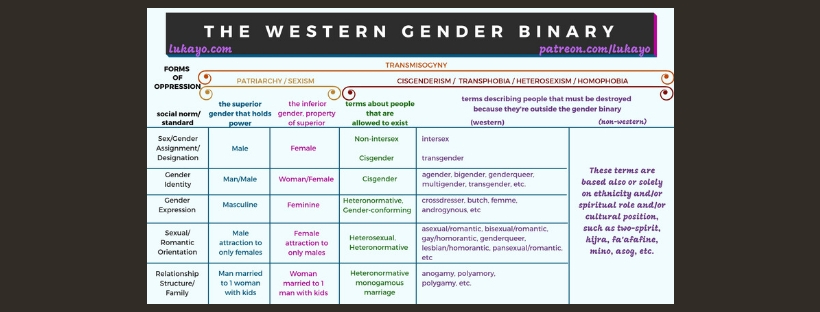
    The Gender Binary tool works best with the Oppression Triangle tool, as well as Dis/Ableism 101 and the Pillars of White Supremacy. The purpose of this poster/handout is to introduce the forms of oppression that the Western Gender Binary perpetuates, how they’re made up of social norms/standards, and the terms that go along with or disrupt the system. It may be a little advanced for folks who are just starting to understand that there are more than just two genders/sexes, but it attempts to sketch a basic outline for those who want to learn how patriarchy, cisgenderism, heterosexism, and transmisogyny are inter-related. This is also a work-in-progress that continues to evolve as our understanding of the Gender Binary and how to dismantle the violence it perpetuates continues to evolve. 

    Note: Transmisogyny refers to a specific oppression that affects folks who were assigned male at birth but identify and/or express themselves as female and/or feminine. This is different than folks who are trans, female assigned at birth, and experience misogyny and transphobia.

    Activity Ideas

    • Draw and write out a large version of the first three columns of the handout, and in chalk, pencil, or eraseable marker, work with the participants on what kind of line would be drawn through these columns based on the terms shown on the rest of the tool. For example, “heterosexual male” would look like a straight line starting from “Male” to “Man married to 1 woman with kids”. Discuss how the Gender Binary creates the threat of violence every time the line deviates from being straight.
    • Divide the participants into 3-4 groups, and have each group focus on one of the following: patriarchy/sexism, transmisogyny, cisgenderism and/or heterosexism. Have them present to each other what they understand these forms of oppression are based on their section of the handout, and how the 5 social norms influences these oppressions.
    • Divide the participants as described above, but instead of just presenting the concepts, have them choose a level of oppression (e.g. individual, cultural, or institutional) to give an example, and a liberation strategy (such as accomplices/allies, direct action, policy, programming, etc) to provide a possible way to respond to the oppressive example.
    • Draw and write out a large version of the poster, but leave most of it blank, except for the forms of oppression, the first column that has all the social norms/standards, and the headers in the first row. Everything else should be on small strips of paper or cards with tape on them that the participants must figure out together where they go on the chart.

    Poster Description

    The background is pale blue, and the title in a black box bordered by blue and pink reads “The Western Gender Binary” with online addresses underneath in purple to “lukayo.com” and “patreon.com/lukayo“. The first column of the chart in black font has seven sections: “forms of oppression”, “social norm / standard”, “Sex/Gender Assignment/Designation”, “Gender Identity”, “Gender Expression”, “Sexual/Romantic Orientation”, and “Relationship Structure/Family”. There are five other columns after this one.

    The first row for “Forms of Oppression” has the word “transmisogyny” in orange on an orange line that encompasses the five other columns, as well as the terms “patriarchy / sexism” and “cisgenderism / transphobia / heterosexism / homophobia”. The words “patriarchy / sexism” in yellow on a yellow line encompasses the first two columns only. The words  “cisgenderism / transphobia / heterosexism / homophobia”  in red on a red line encompasses the last three columns only.

    The second row that has “social norm / standard” in the first column also has the headers for the other columns. The second column is “the superior gender that holds power” in blue. The third column is “the inferior gender, property of superior” in pink. The fourth column is “terms about people that are allowed to exist” in green. The fifth column and sixth column have the same header with a slight difference. The fifth column is “terms describing people that must be destroyed because they’re outside the gender binary (western)” in purple. The sixth column is “terms describing people that must be destroyed because they’re outside the gender binary (non-western)” in purple. The sixth column does not have rows 2-7, because these terms are outside of the social norms and standards that are described in the first column.

    Under the second column called the “superior gender that holds power” in blue, the five ways it manifests with the five social norms and standards in the first column are as follows:  “Sex/Gender Assignment/Designation” : “Male”,  “Gender Identity” : “Man/Male”,  “Gender Expression” : “Masculine”,  “Sexual/Romantic Orientation” : “Male attraction only to females”, and “Relationship Structure/Family” : “Man married to 1 woman with kids”.

    Under the third column called the “inferior gender, property of superior” in pink, the five ways it manifests with the five social norms and standards in the first column are as follows:  “Sex/Gender Assignment/Designation” : “Female”,  “Gender Identity” : “Woman/Female”,  “Gender Expression” : “Feminine”,  “Sexual/Romantic Orientation” : “Female attraction only to males”, and “Relationship Structure/Family” : “Woman married to 1 man with kids”.

    Under the fourth column called the “terms about people that are allowed to exist” in green, the five ways it manifests with the five social norms and standards in the first column are as follows:  “Sex/Gender Assignment/Designation” : “Non-Intersex” and “Cisgender,  “Gender Identity” : “Cisgender”,  “Gender Expression” : “Heteronormative, Gender-conforming”,  “Sexual/Romantic Orientation” : “Heterosexual, Heteronormative”, and “Relationship Structure/Family” : “Heteronormative monogamous marriage”.

    Under the fifth column called the “terms describing people that must be destroyed because they’re outside the gender binary (western)” in purple, the five ways it manifests with the five social norms and standards in the first column are as follows:  “Sex/Gender Assignment/Designation” : “intersex” and “transgender”,  “Gender Identity” : “agender, bigender, genderqueer, multigender, transgender, etc”,  “Gender Expression” : “crossdresser, butch, femme, androgynous, etc”,  “Sexual/Romantic Orientation” : “asexual/romantic, bisexual/romantic, gay/homoromantic, lesbian/homoromantic, pansexual/romantic, etc”, and “Relationship Structure/Family” : “anogamy, polyamory, polygamy, etc”.

    Under the sixth column called “terms describing people that must be destroyed because they’re outside the gender binary (non-western)” in purple, the text reads “These terms are based also or solely on ethnicity and/or spiritual role and/or cultural position, such as two-spirit, hijra, fa’afafine, mino, asog, etc.”


    Want to have access to the larger full colour updated 2018 poster, the original photograph of the hand-drawn 2016 poster, and other anti-oppression related teaching tools? Click on the link below and subscribe for as little as $3/month. By becoming a patron, you support healing work among my communities, and the indigenous Elders that mentor me.

    https://www.patreon.com/posts/23426260

The site will be down Friday, June 12th from 8pm until Midnight EST for webhost transfer and maintenance.

X