
Category: Anti-Oppression

  • Workshop Wednesday: Pillars of White Supremacy

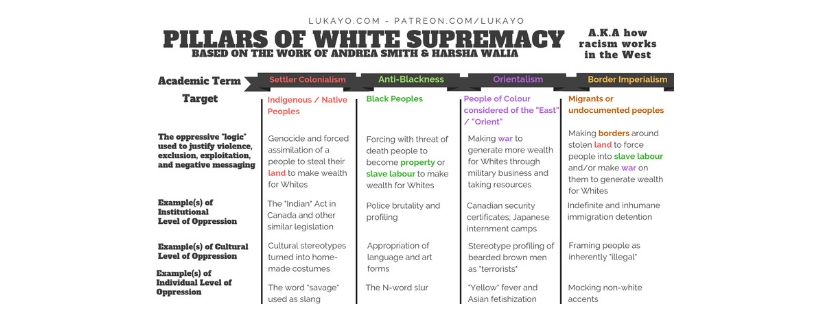
    Like the Dis/Ableism 101 visual tool, the Pillars of White Supremacy is an anti-racism 101 visual tool for sighted folks that goes well with the Oppression Triangle tool. The purpose of this poster/handout is to introduce folks to the different forms of racism in North American society, and it is based on the work of Andrea Smith and Harsha Walia. It’s extremely helpful for when different racialized people work together in coalition-building, as it delineates the specific ways we’re differently impacted by white supremacy, but can also support how we can organize together and work on our own internalized racism. Check out my article “More Than Minorities” on working with Indigenous folks and/or Black folks as a person of colour that is not oppressed by Anti-Blackness and/or Settler Colonialism. Please also check out the original article by Andrea Smith called “Heteropatriarchy and the Three Pillars of White Supremacy: Rethinking Women of Color Organizing“. If you can, pick up Harsha Walia’s book on Undoing Border Imperialism, though here’s an article with an interview and description of some of the concepts.

    Activity Ideas

    • Divide the group into the following categories of interest: accomplices/allies, direct action, policy, and programming. These categories are fluid– if there is no one interested in policy, for example, then that doesn’t have to be a group. If a group is interested in something not listed, like, for example, transformative justice or healing justice, then they can create a group for that. These are all types of anti-oppression/liberation strategies, which will be explained further in future posts.
    • Ask each group to choose one of the forms of racism to work with and narrow it down to one of the levels of oppression, if possible. They can also choose an example of oppression that is part of several forms of oppression, such as how police/border agent brutality and profiling impacts Indigenous folks, Black folks, migrants, and people of colour visibly coded as “Muslim” (even if they are Hindu, Sikh, etc.).
    • Each group can come up with a way to use their anti-oppression/liberation strategy with the example of a racist oppression they chose. For example, the direct action group can explain or act out how they could stage a protest at an immigration detention centre. Another example could be the accomplices/allies group creating a poster that explains other costumes to use instead of racist ones. A final example could be a non-profit organization writing an anti-racism policy that explicitly ensures that a certain percentage of their budget is used for anti-racism training and the benefit of racialized folks within and being served by their organization, with a communications plan that makes these policies transparent to the public.
    • Have the groups present to each other and debrief about the process of anti-oppressive collective planning. Did they ensure that racialized folks in the groups lead? Did they ensure that consultation and leadership of racialized folks was at the forefront of any of their strategies, even if there were no racialized folks in their group?

    Poster Description

    The poster is white with mostly dark grey font. At the top of the poster is written “lukayo.compatreon.com/lukayo“. The title of the poster is “PILLARS OF WHITE SUPREMACY: A.K.A. how racism works in the West”. The poster is credited as “BASED ON THE WORK OF ANDREA SMITH & HARSHA WALIA”. After the title, there are five columns and six rows.

    The first row in the first column has the words: “Academic Term”.  The second row in the first column reads: “Target”. The third row in the first column reads: “The oppressive “logic” used to justify violence, exclusion, exploitation, and negative messaging”. The fourth row in the first column reads: “Example(s) of Institutional Level of Oppression”. The fifth row in the first column reads: “Example(s) of Cultural Level of Oppression”. The sixth and final row in the first column reads: “Example(s) of Individual Level of Oppression”.

    The second column is headed by the term “Settler Colonialism”. The target is “Indigenous/Native Peoples”. The logic is “Genocide and forced assimilation of a people to steal their land to make wealth for Whites”. The institutional example is “The “Indian” Act in Canada and other similar legislation.” The cultural example is “ Cultural stereotypes turned into home-made costumes”. The individual example is “The word “savage” used as slang”.

    The third column is headed by the term “Anti-Blackness”. The target is “Black Peoples”. The logic is “Forcing with threat of death people to become property or slave labour to make wealth for Whites”. The institutional example is “Police brutality and profiling.” The cultural example is “Appropriation of language and art forms”. The individual example is “ The N-word slur”.

    The fourth column is headed by the term “Orientalism”. The target is “People of Colour considered of the “East” / “Orient””. The logic is “Making war to generate more wealth for Whites through military business and taking resources”. The institutional examples are “Canadian security certificates; Japanese internment camps.” The cultural example is “Stereotype profiling of bearded brown men as “terrorists””. The individual example is “”Yellow” fever and Asian fetishization”.

    The fifth column is headed by the term “Border Imperialism”. The target is “Migrants or undocumented peoples”. The logic is “Making borders around stolen land to force people into slave labour and/or make war on them to generate wealth for Whites”. The institutional example is “Indefinite and inhumane immigration detention.” The cultural example is “Framing people as inherently “illegal””. The individual example is “Mocking non-white accents”.


    Want to have access to the larger full colour updated 2018 poster, the original photograph of the hand-drawn 2016 poster, and other anti-oppression related teaching tools? Click on the link below and subscribe for as little as $3/month. By becoming a patron, you support healing work among my communities, and the indigenous Elders that mentor me.
    https://www.patreon.com/posts/22120020

  • Musings Monday: More Than Minorities

    (5 Tips on Building Alliances with Indigenous Folks and/or Black Folks as a Person of Colour)

    Content Warning: anti-Black racism, settler colonialism

    .

    .

    .

    When I was a younger trans and queer person of colour (PoC), I remember the first time I was welcomed into a PoC-only space, and how ecstatic I was, that we finally got to let our guard down and relax, not having to worry about being talked down to, talked over, assumed to be aggressive and/or “child”-like if I was expressing emotions, fetishized, interrogated about my origins, compared to other folks of my race, used as an exception or standard of folks of my race, and other such micro-aggressions. But as I attended more events, and built closer relationships, it became clear that there were other dynamics at play, that there were still hierarchies based on skin tone and/or moves to innocence that ignored the importance of treaties and the thieving privilege of citizenship. We didn’t really know how to have each other’s backs half the time.

    Simply put, there were a lot of anti-Blackness and settler colonial nonsense among my fellow folks of colour (including myself), and when we were called out, we claimed an inability to be racist because of a lack of physical Whiteness, forgetting that the ideology of Whiteness and white supremacy can be internalized by virtue of being raised in anti-Black and settler colonial spaces. Racial discrimination and internalized racism is a real and serious issue among folks of colour, and to forget it is to jeopardize and oppress our accomplices and community members.

    So this article is a litany of my mistakes and the mistakes I’ve seen in others, that harmed folks, that hurt collectives, that stalled movements of anti-racist action and alliance. I mean, I may also probably mess up in the course of this article, in which case, please feel free to correct me and definitely I will offer reparations if the correction involves the labour of Indigenous and/or Black folks. Lastly, this article is an attempt at giving some fairly basic tips to other people of colour that are non-Black and also settlers/non-Indigenous. We’re not all in the same boat, but we’re still in this together.

    Here are the five tips altogether:

    • Work on your own stuff.
    • Work with your communities to co-organize workshops on undoing Anti-Blackness and Settler Colonialism.
    • Support Black-only spaces, Indigenous-only spaces, and Black and Indigenous-only spaces.
    • Centre Black and Indigenous leadership in people of colour spaces.
    • Reparations.

    Read the rest of the article here: https://www.patreon.com/posts/22115167

  • Workshop Wednesday: Dis/Ableism

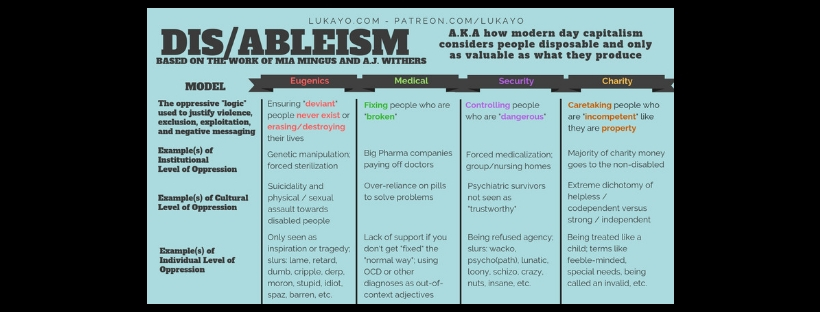
    This is a basic Dis/Ableism 101 visual tool for sighted folks that goes well with the Oppression Triangle tool. The purpose of this poster/handout is to introduce folks to the basic models of how dis/ableism works in North American society, and is based on the work of Mia Mingus and A.J. Withers. For a more in-depth look at the models discussed, please check out A.J. Withers’ book and website on Disability Politics. For an intersectional and deeper look at these models, especially in regards to desirability, the prison industrial complex, and the medical industrial complex, please check out Mia Mingus’s Medical Industrial Complex Visual.

    Activity Idea

    • Divide the group into the following categories of interest: accomplices/allies, direct action, policy, and programming. These categories are fluid– if there is no one interested in policy, for example, then that doesn’t have to be a group. If a group is interested in something not listed, like, for example, transformative justice or healing justice, then they can create a group for that. These are all types of anti-oppression/liberation strategies, which will be explained further in future posts.
    • Ask each group to choose one of the dis/ableism models to work with and narrow it down to one of the levels of oppression, if possible. They can also choose an example of oppression that is under multiple models, such as certain nursing/group homes can be considered both under the charity model and the security model.
    • Each group can come up with a way to use their anti-oppression/liberation strategy with the example of dis/ableist oppression they chose. For example, the direct action group can explain or act out how they could stage a protest at a pharmaceutical company that is lobbying doctors or at a group home that forces medicalization. Another example could be the accomplices/allies group creating a poster that explains other words to use instead of dis/ableist slurs. A final example could be a non-profit organization that is also a registered charity writing a disability justice policy that explicitly ensures that a certain percentage of their budget is used for accessibility and the benefit of disabled people, with a communications plan that makes these policies transparent to the public.
    • Have the groups present to each other and debrief about the process of anti-oppressive collective planning. Did they ensure that any disabled folks in the groups lead? Did they ensure that consultation and leadership of disabled folks was at the forefront of any of their strategies, even if there were no disabled folks in their group?

    Poster Description

    The poster is pale blue with mostly dark grey font. At the top of the poster is written “lukayo.compatreon.com/lukayo“. The title of the poster is “DIS/ABLEISM: A.K.A. how modern day capitalism considers people disposable and only as valuable as what they produce”. The poster is credited as “BASED ON THE WORK OF MIA MINGUS AND A.J. WITHERS”. After the title, there are five columns and five rows.

    The first row in the first column has the words: “MODEL”. The second row in the first column reads: “The oppressive “logic” used to justify violence, exclusion, exploitation, and negative messaging”. The third row in the first column reads: “Example(s) of Institutional Level of Oppression”. The fourth row in the first column reads: “Example(s) of Cultural Level of Oppression”. The fifth and final row in the first column reads: “Example(s) of Individual Level of Oppression”.

    The second column is headed by the term “Eugenics”. The logic is “Ensuring “deviant” people never exist or erasing/destroying their lives”. The institutional examples are “Genetic manipulation; forced sterilization.” The cultural examples are “Suicidality and physical / sexual assault towards disabled people”. The individual examples are “Only seen as inspiration or tragedy; slurs: lame, retard, dumb, cripple, derp, moron, stupid, idiot, spaz, barren, etc.”.

    The third column is headed by the term “Medical”. The logic is “Fixing people who are “broken””. The institutional example is “Big Pharma companies paying off doctors”. The cultural example is “Over-reliance on pills to solve problems”. The individual examples are “Lack of support if you don’t get “fixed” the “normal way”; using OCD or other diagnoses as out-of-context adjectives”.

    The fourth column is headed by the term “Security”. The logic is “Controlling people who are “dangerous””. The institutional examples are “Forced medicalization; group/nursing homes”. The cultural example is “Psychiatric survivors not seen as “trustworthy””. The individual examples are “Being refused agency; slurs: wacko, psycho(path), lunatic, loony, schizo, crazy, nuts, insane, etc.”.

    The fifth column is headed by the term “Charity”. The logic is “Caretaking people who are “incompetent” like they are property”. The institutional example is “Majority of charity money goes to the non-disabled”. The cultural example is “Extreme dichotomy of helpless / codependent versus strong / independent”. The individual examples are “Being treated like a child; terms like feeble-minded, special needs, being called an invalid, etc.”.


    Want to have access to the larger full colour updated 2018 poster, the original photograph of the hand-drawn 2016 poster, and other anti-oppression related teaching tools? Click on the link below and subscribe for as little as $3/month. By becoming a patron, you support healing work among my communities, and the indigenous Elders that mentor me.
    https://www.patreon.com/posts/21975736

  • Musings Monday: I Am Not A Burden

    Content Warning: ableism, ED, chronic illness, mental illness

    Image Description: Black background with stylized yellow stars. In a greyish-white thought bubble are the words “I Am Not A Burden” in yellow. Beside the thought bubble in yellow text is the following: “5 TIPS AGAINST INTERNALIZED ABLEISM”. Below that in white text is “patreon.com/lukayo” and “lukayo.com”.

    When I first started to come to terms with how disabled I’d gotten, I was furious and then despairing. I had always been somewhat sickly– an asthmatic child that tired easily, and due to my large frame, spent years with an eating disorder that was undiagnosed despite the radical shifts in weight. The reality that I would have more to manage mentally, emotionally, and physically in unpredictable and drastic ways was daunting and left me with fatalistic ideation that I would soon come to recognize as “internalized ableism”. Over the years, I’ve reached out to other disabled folks asking them what they’ve done to stop their own attitudes and thoughts that just made things worse, and this is what I’ve learned.

    1) Educating yourself.

    I read everything I could by Eddie Ndopu, Patty Berne, Sins Invalid, Mia Mingus, Leah Lakshmi-Piepzna Samarasinha, AJ Withers, and Eli Clare. I also read the following articles on internalized ableism:

    Understanding that there’s a system at work, and it isn’t just about me, began the process of unlearning self-hatred, but it was usually an intellectual change, and my emotional gut reactions were still there.

    2) Reminding yourself.

    Since my emotions tended to erase a lot of theory that I’d read, I tended to put up reminders, either through a side tumblr filled with disability activist quotes, and print-outs I’d put up on my wall so I could see it when I woke up. I’d even try to post these reminder lists on my desktop. These are the ones I particularly like:

    If you want to make your on side tumblr and you’ve never done anything like that before, just pick a cute name (I chose the Bikol word for recovery), and then in the search bar type in search words, whether it’s “chronic illness”, or “disability justice”, or “disability rights”. You can even type in your diagnosis for specific kinds of affirmations and quotes on it. You may come across other tumblrs that also only re-blog quotes, theory, and affirmations, as well as hilarious and soothing memes. You can follow them and begin the process of accessing these kinds of reminders. You can also set it up so that when your browser opens, it immediately opens up to your side tumblr page.

    3) Reaching out.

    Here we get to some scary stuff, in my personal opinion. I found it easy looking for resources to read and use to remind myself. But actually reaching out to real, live people? Yikes. I did it anyway. I needed help. I went to free disability-focused conferences, like the Reclaiming Our Bodies & Minds Conference at Ryerson University. If I went to festivals and conferences that weren’t only about disability, I prioritized attending any workshops and sessions that were on disability– whether the events were about sexuality, gender, spirituality, or general activism. I prioritized spending time with my disabled friends and temporarily able-bodied folks who had high access intimacy with me. I made request posts looking to start a personal care collective.

    4) Sharing your story.

    This article is basically an illustration of tip #4. So were all the Facebook posts that honestly talked about my needs and barriers. So were all the filtered Facebook posts and secret side tumblr posts where I just broke down and word-vomited all my pain and frustration at what seems like an ever-increasing mountain of disability and ableism. I also shared with people over the phone, on private messenger, over text, in person in private rooms, classrooms, and public workshops. I shared, consensually, with family members, friends, strangers, and professional care workers. I wrote stories and poetry; I made art and music. I prayed and shared with Creator, my ancestors, gods, and spirits. I laid out all the internalized terrible nonsense inside of me, dragging it out so that the poison could be seen instead of left festering in my heart and soul.

    5) Accepting support.

    Of course, once I reached out and I shared, then came the offers of support. I thought I had done all the hard work already, but I was horrified when folks offered support, and horrified that I felt horror in the first place. Some of my concerns was legitimate– I was used to the folks who were already providing me care and I trusted them. I would have to go out on a limb and attempt to rely on people that I did not know very well and thus had not earned much of my trust. Sometimes I would not have the energy to face a new person in my personal space providing me care, and I would just go without the things that I needed, worrying as to whether I had let my internalized ableism win or whether I was rightfully cautious yet paying a price that was beyond my control. Either option was shitty. But when I did have the energy to take that risk, the joy and relief at having a new care collective member and/or friend that embodied the kind of world where interdependence and community care is the norm was overwhelming that I found myself weeping and/or laughing once they had left. I found myself overcome with hope and, after every time, the barrage of internalized ableist thoughts would quiet further and further. It’s a start.

    I hope these tips help you, especially if you’re beginning your journey of strategizing against your internalized ableism as a disabled person, just like me several years ago. Feel free to comment on this article or message me about it!


    Like what you read? Want to support my community and the Indigenous elders that mentor me? Please become a patron: https://www.patreon.com/posts/21944958

  • Workshop Wednesday: Systems That Spread Empire & Oppression

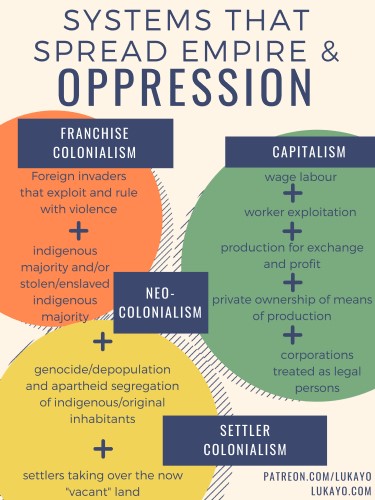
    This poster is a visual tool for sighted folks that can be used in conjunction with The Taking Tree tool or separately as a way to explain how oppression based on Western empire has spread and continues to spread by capitalism, franchise colonialism, settler colonialism, and neo-colonialism. The purpose of this tool is to add another nuance and dimension in understanding how oppression works, with the end goal of discovering ways to resist and transform it.

    Activity Ideas

    • Group Work: Divide participants into two groups, with one of them explaining the different iterations of capitalism since it began roughly 200 years ago, and the other group explaining colonialism and its two main types (franchise and settler). As part of their presentations, have them search for historical and current examples using news articles. After they present to each other, ask all of the participants to explain how the two systems combine to create neo-colonialism, and how some of their examples can be changed to reflect a neo-colonial process as opposed to simply a capitalist or colonial process. Remember to give your own examples of neo-colonialism to help the participants along. If you need examples, message me on my Patreon page or send me an email.
    • Puppet Theatre (Intro): You can either use puppets or have participants do the group activity above, but with puppets. The reason I suggest using puppets instead of having the participants act it out is because it reduces re-traumatization of participants who have lived through generations of colonialism and/or capitalistic exploitation. Please have supports in place in case it is still triggering for folks. As for the puppets, they can be as simple as a set of objects like markers representing people, and two desks representing different areas of land.
    • Puppet Theatre (Migration & Colonization): Start the puppet show with explaining migration by moving the group of people from one land to another. Then explain colonization by having two areas of land, then one group (orange markers) topples the second group (green markers) and declares control of both pieces of land. Franchise colonialism can be explained with the first land filled with orange markers and the second land filled with green markers and one or two orange markers controlling the rest of the green markers and having them send money back to the first land, where the money can be represented by scrap paper. Settler colonialism can be represented by green markers being killed off through engineered diseases or murder, so that more orange markers can take up that area of land, that way the scrap paper doesn’t have to be sent over, they can just enjoy the land and all the scrap paper that comes with it.
    • Puppet Theatre (Capitalism): When explaining capitalism, add an extra object, like erasers, and another set of puppets– perhaps blue markers. Have one orange marker declare that it “owns the means of production” by writing on a piece of paper that it owns this entire piece of land (one of the desks) and all the rubber trees that grow there. The orange marker lives on the other piece of land without the rubber trees, but hires green markers to work and pick the trees. The blue markers haves scrap paper, i.e. money. The orange marker makes a second declaration, that the green markers will earn a “wage”, that is, for every hour they work, they will receive one scrap of paper. Then, the orange marker makes a third declaration, that erasers made from the rubber trees will cost 5 scraps of paper. All the green markers work for an hour and each produces an eraser. A blue marker buys an eraser from the green markers and hands the orange marker 5 scraps of paper for each eraser. The orange marker gives out 1 scrap of paper to each green marker. Where does the rest of the scraps of paper go? To the orange marker. Have a discussion with the participants about how they would enact the corporate side of capitalism with the puppets, as well as how the green markers can fight for their labour rights if one scrap of paper per hour isn’t a living or thriving wage. For an added bonus, you can also show how capitalism is related to slavery by having the orange marker refuse to give any scraps of paper to the green markers, and keep all the paper scraps to themselves while threatening the green markers with death if they stop working.

    Description

    The poster is beige, with font in dark blue. There are four dark blue rectangles with white font inside, and three large circles with dark blue shadowed effects. One circle is orange, the other green, and the bottom one yellow. The title of the poster reads “SYSTEMS THAT SPREAD EMPIRE & OPPRESSION”. The orange circle has a dark blue rectangle near the top of it that reads “FRANCHISE COLONIALISM”. Inside the orange circle is text that reads “Foreign invaders that exploit and rule with violence + indigenous majority and/or stolen/enslaved indigenous majority”. The yellow circle, which is attached to the orange circle, continues with text that reads ” + genocide/depopulation and apartheid segregation of indigenous/original inhabitants + settlers taking over the now “vacant” land”. The yellow circle has a dark blue rectangle attached to it that reads “SETTLER COLONIALISM”. The green circle on the right of the poster has a dark blue rectangle with the text “CAPITALISM”. Inside the green circle is the following text: “wage labour + worker exploitation + production for exchange and profit + private ownership of means of production + corporations treated as legal persons”. There is a dark blue rectangle that touches all three circles, and it reads “NEO-COLONIALISM”. At the bottom right of the poster is text that reads “PATREON.COM/LUKAYO” and “LUKAYO.COM“.


    Want to have access to the larger full colour updated 2018 poster, the original photograph of the hand-drawn 2016 poster, and other anti-oppression related teaching tools? Click on the link below and subscribe for as little as $3/month. By becoming a patron, you support healing work among my communities, and the indigenous Elders that mentor me.
    https://www.patreon.com/posts/21656301

  • Workshop Wednesday: The Taking Tree (2018 Version)

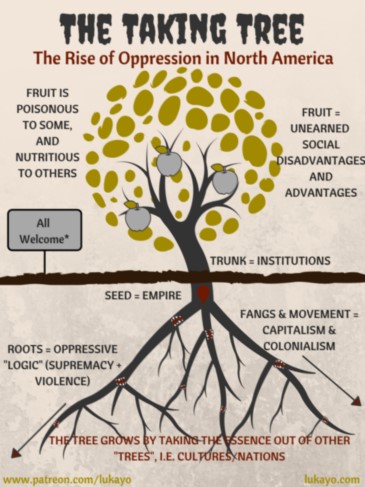
    The Taking Tree is a visual tool for sighted folks that can be drawn piece-by-piece or used as a poster/handout to give a rough overview of the rise of oppression in North America. The purpose of this tool is to show the many intersectional moving parts of how oppression grows and works over time. For a more in-depth version of the Taking Tree, check out the 2015 Prezi version, which is linked further below. For this simpler version, you can use it to explain the following concepts:

    • oppression in North America grows from Western empire
    • empire held supremacies that were and are enacted through violence against those that aren’t able-bodied, neurotypical, non-intersex, white, heterosexual, cisgender, able-bodied, upper class, anglophone, etc., etc.
    • empire continues to grow and “take” through global corporate capitalism and colonialism
    • empire grows institutions (economic, government, medical, educational, legal, military, police, media, etc) which then provide social mechanisms of “order” and “prosperity” to be accessed by the people who live off of the tree
    • when people fall on the “right” side of one or more of the supremacies of empire, they attain some form of safety, prosperity, and social advantage, i.e. privilege, from the institutions
    • when people fall on the “wrong” side of one or more of the supremacies of empire, they face numerous kinds of violence and barriers, i.e. oppression, from the institutions
    • many people are not aware that institutions can be poisonous to some and not poisonous to others because the roots/supremacies are under ground, i.e. hidden
    • empire allegedly welcomes all people to live off of its fruits, but it’s actually a false “sign” in an attempt to hide the supremacies while enticing people to, unknowingly, become part of “inferior” groups that oppressors or privileged folks can be “superior” over
    • cultural appropriation occurs when the vampiric roots take the essence from other cultures and those cultural artifacts appear on the Taking Tree but are poisonous/inaccessible to the very people it came from because it passes through the supremacist roots and can now only be accessed by those privileged by empire
    • each oppression root is similar and intersectional in that they all work on an oppressive “logic”, grow from a shared history of empire, and corrupt institutions
    • each oppression root is different because each supremacy and violence is different and people can experience more than one root at the same time (for example, Orientalism targets people considered from the “East” for war while misogyny targets people considered female and/or feminine for servitude to those considered male and/or masculine– and those who are impacted by both Orientalism and misogyny can be sought as “war trophies” that need liberating or they need to be fought in order to serve)

    Origins

    I learned The Taking Tree while preparing to co-facilitate my first anti-oppression workshop with Reem Girgrah and Casper in the summer of 2010 on unceded Algonquin territory, Ottawa, Canada. Reem taught me a more bare-bones version of the tool that just described the roots, the trunk, and the branches/fruit. She said it came from an Internet source, but we haven’t been able to find out what it was, after all these years. A similar tree, called The Tree of Colonial Oppression, was published in Honouring Indigenous Women: Hearts of Nations (Vol. 1) booklet in 2011 by Indigenous Peoples Solidarity Movement Ottawa (IPSMO). There is also a similar Oppression Tree used in workshops for McGill University Residences first year students, but the earliest version I can find is dated 2014. It’s possible that all these trees have a common origin in the Ottawa-Montreal area, or originated from the contributors to the IPSMO booklet a year before it was published. If folks come up with a specific origin, I will attribute and credit appropriately. The seed, fangs, and sign of the Taking Tree, as far as I can tell, I came up with originally.

    Activity Ideas

    While presenting the Taking Tree, you can interact with participants in the following ways:

    • tell the Taking Tree as a story, starting from the seed, to the roots, to the trunk, to the fruit, to the sign and the fangs
    • ask folks to name different oppressions when you get to the part of the roots
    • ask folks to name different institutions when you get to the trunk
    • ask folks to name different social problems and privileges based on oppressive institutions when you get to the poisoned fruit
    • ask folks to describe how they would stop an actual vampiric tree, and then try to brainstorm how their metaphors can be translated into direct action and reality

    Poster Description

    The poster has a dark grey tree with sickly green leaves and pale grey fruit. Under a rough brown line that represents the ground, it shows a red seed at the centre of the tree, and dark grey roots continue downwards. The roots have tiny red mouths with white fangs in them. There are two grey and red arrows that show that the roots are moving outwards underground. There is a grey sign which reads “All Welcome*”. The title of the poster reads “THE TAKING TREE: The Rise of Oppression in North America”. Text near the fruit read “FRUIT IS POISONOUS TO SOME, AND NUTRITIOUS TO OTHERS” and “FRUIT = UNEARNED SOCIAL DISADVANTAGES AND ADVANTAGES”. Near the trunk the text reads “TRUNK = INSTITUTIONS”. Near the seed text reads “SEED = EMPIRE”. To the right of the root network text reads “FANGS & MOVEMENT = CAPITALISM AND COLONIALISM”. To the left of the root network text reads “ROOTS = OPPRESSIVE “LOGIC” (SUPREMACY + VIOLENCE)”. At the bottom of the root network red text reads “THE TREE GROWS BY TAKING THE ESSENCE OUT OF OTHER “TREES”, I.E. CULTURES/NATIONS”. At the bottom of the poster, it reads “patreon.com/lukayo” and “lukayo.com“.

    Link to The Taking Tree Prezi (2015 Version)

    https://prezi.com/k_e7roi3wl-h/the-taking-tree/


    Want to have access to the larger full colour updated 2018 poster, the original photograph of the hand-drawn 2016 poster, and other anti-oppression related teaching tools? Click on the link below and subscribe for as little as $3/month. By becoming a patron, you support healing work among my communities, and the indigenous Elders that mentor me.
    https://www.patreon.com/posts/21521937

  • Workshop Wednesday: Accomplices & Allies

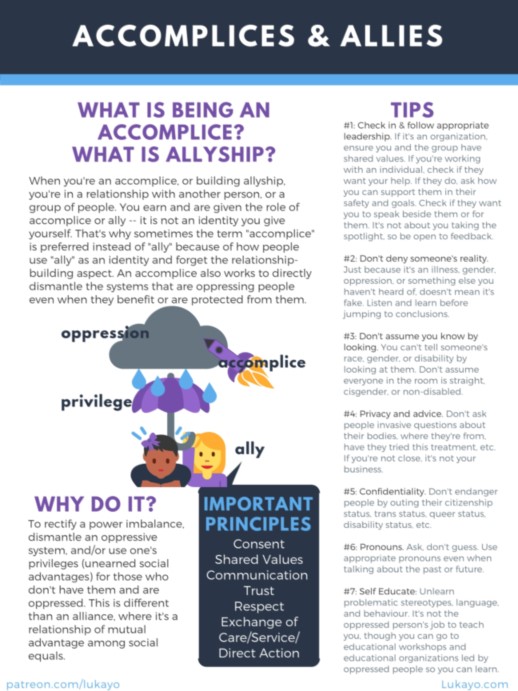
    The Accomplices & Allies poster/handout is a beginner’s visual tool for sighted folks that cover the basic concepts about using one’s privilege in a relationship to support the other person or people that don’t have those privileges. This article will include a full description of the poster, important links on the concept of accomplices, and the photo of the original hand-drawn Allyship poster that I made.

    Poster Description

    Title: “Accomplices & Allies”

    “WHAT IS BEING AN ACCOMPLICE? WHAT IS ALLYSHIP?
    When you’re an accomplice, or building allyship, you’re in a relationship with another person, or a group of people. You earn and are given the role of accomplice or ally — it is not an identity you give yourself. That’s why sometimes the term “accomplice” is preferred instead of “ally” because of how people use “ally” as an identity and forget the relationship-building aspect. An accomplice also works to directly dismantle the systems that are oppressing people even when they benefit or are protected from them.”

    “WHY DO IT?
    To rectify a power imbalance, dismantle an oppressive system, and/or use one’s privileges (unearned social advantages) for those who don’t have them and are oppressed. This is different than an alliance, where it’s a relationship of mutual advantage among social equals.”

    “IMPORTANT PRINCIPLES
    Consent
    Shared Values
    Communication
    Trust
    Respect
    Exchange of Care/Service/Direct Action”

    “TIPS

    #1: Check in & follow appropriate leadership. If it’s an organization, ensure you and the group have shared values. If you’re working with an individual, check if they want your help. If they do, ask how you can support them in their safety and goals. Check if they want you to speak beside them or for them. It’s not about you taking the spotlight, so be open to feedback.

    #2: Don’t deny someone’s reality. Just because it’s an illness, gender, oppression, or something else you haven’t heard of, doesn’t mean it’s fake. Listen and learn before jumping to conclusions.

    #3: Don’t assume you know by looking. You can’t tell someone’s race, gender, or disability by looking at them. Don’t assume everyone in the room is straight, cisgender, or non-disabled.

    #4: Privacy and advice. Don’t ask people invasive questions about their bodies, where they’re from, have they tried this treatment, etc. If you’re not close, it’s not your business.

    #5: Confidentiality. Don’t endanger people by outing their citizenship status, trans status, queer status, disability status, etc.

    #6: Pronouns. Ask, don’t guess. Use appropriate pronouns even when talking about the past or future.

    #7: Self Educate: Unlearn problematic stereotypes, language, and behaviour. It’s not the oppressed person’s job to teach you, though you can go to educational workshops and educational organizations led by oppressed people so you can learn.”

    The poster is divided into six main sections. The top section is a header with the title in white font on a dark blue rectangle, with a pale blue divider. On the right of the poster underneath the header is a column with all the TIPS, the title being in purple while the text is in dark blue and lighter blue. On the left of the poster underneath the header is the introductory section explaining what an accomplice and allyship is, with the title also being in purple and the text in dark blue. Underneath that introductory section is an image. Underneath the image are two small columns. On the left is the WHY DO IT? column with the title in purple and the main text in dark blue. On the right is the IMPORTANT PRINCIPLES column, with the title in pale blue, and main text in white on a dark blue square speech bubble that is coming out from the word ally in the image.

    The image is a cartoon. There is a dark grey cloud with blue rain drops coming out of it. The rain drops are hitting a purple umbrella being held by a pale smiling person with yellow hair and red lips, who is wearing a purple long-sleeved shirt. There is a dark-skinned person with a purple bow in their short black hair who is also under the umbrella, wearing a dark blue long-sleeved shirt and looking scared. There is a purple rocket with orange flames hitting the cloud. The cloud is described as “OPPRESSION”. The umbrella is described as “PRIVILEGE”. The rocket is described as “ACCOMPLICE.” The pale person holding the umbrella is described as “ALLY”.

    At the bottom of the poster in light blue are the following links: “patreon.com/lukayo” and “Lukayo.com“.

    Important Links on Being an Accomplice


    Want to have access to the larger full colour updated poster, the original photograph of the hand-drawn poster, and other anti-oppression related teaching tools? Click on the link below and subscribe for as little as $3/month. By becoming a patron, you support healing work among my communities, and the indigenous Elders that mentor me.
    https://www.patreon.com/posts/workshop-allies-21223071

  • Troubleshoot Tuesday: Side Punch

    Image Description: The picture is divided into two parts. On the left side is a black and white photo of a person in a grey hoodie, with their back towards the viewer, as they stare out at the water. On the right side is a semi-transparent graphic of a stylized grey fist on a dark grey background, aimed towards the person in the hoodie. In red are the words: “SIDE PUNCH: SURVIVING LATERAL VIOLENCE”. In light grey is written “LUKAYO.COM”. There is a red rectangle at the bottom of the right side of the picture, with the words “PATREON.COM/LUKAYO” in black.

    Every time it happens, the sense of betrayal is so vast, it feels more than just a psychological punch to the gut. I remember one of the first times, as a kid in the schoolyard, where I was being pushed around and laughed at by other Filipinos. My clothing wasn’t right, and I talked weird, and I wasn’t into the right things. I was too “white-washed”, I didn’t belong, but neither did they want me “too Filipino” either, like when I had first immigrated to Turtle Island/Canada. Other times I witnessed it among the Filipino adults who gossiped about each other and tried to shun each other at church or at parties. As I grew older, I noticed this phenomenon happened in queer communities, trans communities, and among other racialized groups.

    When it occurs in a workshop, it’s probably because you’re doing a teaching targeted towards your own community, and they immediately want to fight it out while you’re explaining concepts or during discussion. Maybe it occurs before the workshop– folks contact you about a conflict that’s happening and certain folks can’t come or if they come then another set of folks won’t come, and so it goes.

    We could just brush it off and call it “community drama”, but most likely what’s going on here is “lateral violence”, and it sucks. A lot. So how should you handle it, as a facilitator and as a community member? The short summary is that you should  remind yourself (and others) of the root cause, ensure the safety of yourself and your participants as much as possible, and try to reach out to folks from the same community who already support you and hopefully understand what lateral violence is.

    Remind yourself and others of the root cause.

    When I was a child, internalized racism ran deep, and I assumed that the nonsense that happened in my communities was because Filipinos innately are inferior in some way– I was ashamed of myself and ashamed of my community. I tried to run away from them and myself for a long time. It’s tempting to buy into all of that nonsense again, especially when you’re in the heat of the moment and it’s disrupting your educational environment and plans.

    But lateral violence isn’t innate. It isn’t the essence of a person or a community. It’s a habit, a trauma response, and/or a soul wound inherited throughout the generations where the pain of a people explodes on each other because they feel powerless against or seduced by the institutions that devastated their communities in the first place.

    Personally, when lateral violence happens in front of me, I look at the situation as if folks are being possessed by vengeful ghosts, so filled with anguish at the injustices done to them that they take the bodies of their descendants to release their rage. I am filled with compassion, even as I take safety precautions for myself and those around me, to figure out how to appease these ghosts and encourage the personality of the descendant to come through with their gifts and be more than their pain.

    This isn’t to say that you can’t hold people responsible for their actions– it just means that it helps to combat the shame placed inside you by oppression, and the ignorant perspectives of those outside of your community that comment on inter-community violence. It also means that, if there’s a way to call folks in on what they’re doing, that you could ask them to direct their anger at the source of their pain and channel it into activism.


    Are you a diversity coordinator, anti-oppression facilitator, or equity officer interested in reading the rest of this article? Click on the link and subscribe for $10/month to get anti-oppression tutorials, videos, posters, hand-outs, and trouble-shooting guides like this one twice a week. By becoming a patron, you support healing work among my communities, and the indigenous Elders that mentor me. 
    https://www.patreon.com/posts/21216326

  • Workshop Wednesday: The Oppression Triangle

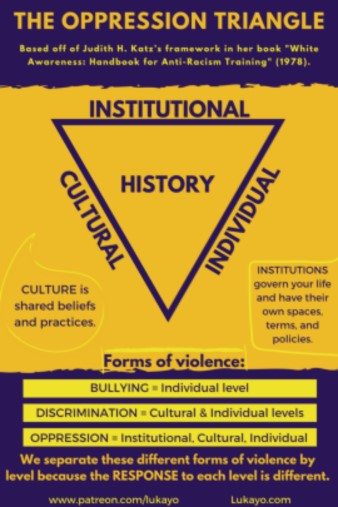
    [Image made using Canva. The poster is in colours of midnight-blue/indigo, mustard yellow, and lemon yellow. The top of the poster is yellow on blue, with the text “THE OPPRESSION TRIANGLE” and “Based off of Judith H. Katz’s framework in her book “White Awareness: Handbook for Anti-Racism Training” (1978)”. The middle part of the poster is blue on yellow. There is a large triangle facing downwards. On the top side of the triangle is the word “INSTITUTIONAL”. On the left side is “CULTURAL” and on the right side is “INDIVIDUAL”. In the centre of the triangle is the word “HISTORY”.  There is a faint yellow speech bubble with the words “CULTURE is shared belief and practices” on the left side. On the right side is a faint yellow speech bubble with the words “INSTITUTIONS govern your life and have their own spaces, terms, and policies”. At the bottom of the triangle is a faint yellow square introducing the next section in blue, with the title: “Forms of violence:”. Each form of violence is in a yellow rectangle with blue text on a blue background. The three forms of violence are “BULLYING = Individual level”, “DISCRIMINATION = Cultural & Individual levels”, and “OPPRESSION = Institutional, Cultural, Individual”. Below these rectangles are yellow text on blue: “We separate these different forms of violence by level because the RESPONSE to each level is different.” At the bottom of the poster are the links: “patreon.com/lukayo” and “Lukayo.com“.]

    “The Oppression Triangle” is a visual tool that can be used for sighted folks in the form of a handout or a poster to explain what oppression is and why anti-oppression is a different form of response to violence compared to anti-bullying and anti-discrimination methods.

    This Workshop Wednesday, we’re covering the following:

    • the different sides of the triangle
    • what each side of the triangle has to do with violence, and specifically the three forms of violence called bullying, discrimination, and oppression
    • how someone can tell the difference between oppressive bullying and non-oppressive bullying, and oppressive discrimination and non-oppressive discrimination
    • why we need to know the different levels of violence by describing the typical anti-violence responses to each
    • group work activities
    • the original photo of the poster

    The Sides of the Oppression Triangle

    The level of the individual has no explanation on the poster because it’s hoped that participants understand what individual interactions are, which are usually one-on-one in nature. Examples of this would be people having a conversation, or one person helping another person cross the street.

    Given that I define “culture” has “shared beliefs and practices”, the cultural level is when a group of people with shared beliefs and practices interacts with another group of people that has a different set of shared beliefs and practices– or a group to an individual. Examples of this would be “alternative lifestyle” cultures like goth and punk, where members of this culture have a shared belief in the concept of “goth” or “punk” (though they can argue exactly what that concept is) and have common practices. Other examples can be a culture based on geography (like Haligonians who are born or reside long-term in Halifax) or based on ethno-religious grounds (like Jewish culture).

    When you get to explaining Western institutions, you can either list the institutions first and ask what they have in common (and ask them not to look at the answer on the poster) or you can ask them to try to name institutions. Common ones are commerce/business/economic, government, military, legal, educational, medical, media, and certain religious institutions. I always add that not all religion is an institution, because not all religions govern your lives. Some religions can fall under culture instead, because it’s a shared belief and practice, but you can choose to opt out of it easier, unlike many of Western society’s institutions. I specify Western, but you can also say Westernized, as there is a possibility that other institutions outside of the West can work that way while others that are not Westernized do not work that way– for example there can be local tribal governments that only meet when needed and there is no permanent location for their meetings.

    History is in the middle of the triangle because in order for something to be all three levels of power (individual, cultural, and institutional), it would have had to take time to get there, thus, there would be a long history of it existing.

    Bullying, Discrimination, and Oppression

    When I talk about violence, I mean all kinds of violence– physical, verbal, social exclusion, negative messaging in images and misrepresentation/lack of representation, emotional, spiritual, etc.

    Bullying is largely regarded as a form of violence that is peer-to-peer and chronic, where a power imbalance between usually two people is created. Sometimes a power imbalance already exists and is used as a reason to bully. Generally regular bullying is on the individual level of violence.

    Discrimination is usually defined as when a person or group of people is violent towards a group, or a person belonging to a group, based on their skin colour, gender, disability status, sexual orientation, or other physical or social aspects that they cannot control. Discrimination is on the individual and cultural levels of violence. Discrimination manifests on the individual level as discriminatory bullying, when someone is chronically targeted by a peer for belonging to a specific group based on an aspect of themselves they can’t control.

    Oppression is institutional violence. This is when an institution, like, for example, the police, consistently targets groups of citizens because of an underlying logic that they are less than human, and so can be treated that way. Oppressive discrimination can manifest in the police force by masculine officers having a separate lounge that does not allow feminine officers (cultural level). Oppressive bullying can manifest in the police force by a cisgender police officer chronically harassing a transgender police officer (individual level). For a specific violent logic to get to the institutional level, there would already be a long history.

    Non-Oppressive Bullying and Non-Oppressive Discrimination

    Folks usually get stuck in trying to figure out what bullying looks like if it’s not discriminatory or oppressive, or what discrimination looks like if it’s not oppressive.

    If we consider bullying as peer-to-peer and chronic, but take away the existing power imbalances of institutions, or cultural groups, or aspects of oneself that you can’t control, then we have bullying that creates a power imbalance. These power imbalances can be based on what sports team people like, or whether they like Stars Wars versus Star Trek. People can choose whatever they want to be violent towards you on a regular basis, but it’s not discrimination or oppression without that cultural or institutional level of power.

    If we consider discrimination that is executed without the historical support of institutions, then we are looking at violence towards people solely based on aspects of themselves that they cannot control. In this regard, it is possible to racially discriminate against folks with pale skin or are considered white, as well it is possible for a group of women to discriminate against men.

    Anti-Bullying, Anti-Discrimination, and Anti-Oppression

    So why should we make all these distinctions that just seem super nit-picky? Well, for one, it helps to lay them out for folks who believe reverse-racism or reverse-sexism is a thing– it’s not. Let’s break this down in the anti-violence responses.

    When regular bullying happens in a school yard or at an office or in a neighbourhood, what would be the courses of action? To stop the violence, usually we’d go to an institutional authority figure– a teacher in the school, the human resources department at work, or the police officer from the nearest precinct. Anti-bullying measures are then put in place by the institution.

    When discrimination happens in those same settings from our peers, we can go to those same authority figures. If they don’t do anything, we can go to legal institutions, such as the Ontario Human Rights Tribunal if the discrimination happened in the province of Ontario. Anti-discrimination punishments are then put in place by the institutions.

    But when bullying and discrimination are oppressive, appealing to these institutions don’t workbecause it’s these very institutions that have the history and current practice of bullying and discriminating against the group that’s being targeted. That’s why common forms of anti-oppression involve collective organizing among oppressed groups and their allies to give alternate services that these institutions should be providing to the oppressed, protecting the oppressed from these violent institutions, and/or exposing and opposing the violence in these institutions through direct action.

    Let’s return to the dilemma of reverse-racism and reverse-sexism. When people get into arguments about this, what’s actually happening is one person is trying to talk about racial and sexist oppression via institutions while the other person is talking about racial and sexist discrimination from groups. If it’s an honest misunderstanding, maybe going through The Oppression Triangle infographic might help them out. However, sometimes these arguments are rooted in the emotionally-based belief that institutions can do no wrong or that these institutions can’t possibly influence people on a social and individual level, which, at best, makes the oppressed sound like they are complaining for no reason, and, at worst, makes the oppressed look like terrorists that are exposing and opposing benevolent social mechanisms. In that case, I would suggest folks conserve their energies for those who truly want to learn once they realize a person refuses to look deeper into history and how institutions are operating in the present day.

    Group Work Activities

    Yikes! This was super long-winded. How are you going to get folks to even stay awake through all these definitions? Here’s some ways to do so by group work activities! Pro-tip: Give space to have groups present via music, dance, art, and theatre, not just by talking!


    Want to have access to the rest of the article, the larger full colour updated poster, the original photograph of the hand-drawn poster, and other anti-oppression related teaching tools? Click on the link below and subscribe for as little as $2/month. By becoming a patron, you support healing work among my communities, and the indigenous Elders that mentor me.
    https://www.patreon.com/posts/21075614

  • Troubleshoot Tuesday: When Participants Get Triggered

    [Image made using Canva. The background is teal, with a cartoon brown hand holding an anatomically correct bright red heart that has lines radiating from it. In a black box in the foreground is teal text that reads: “WHEN PARTICIPANTS GET TRIGGERED”. At the top of the graphic are the websites “www.lukayo.com” and “www.patreon.com/lukayo”.]

    I am super passionate about how to support participants that get triggered in workshops, and also I have a bunch of rants on it (like how the word “trigger” is being mocked and thus craps on people with trauma, as well as other people misusing the word “triggered” when they’re just feeling uncomfortable). Most of the rants, however, can be traced to what seems like folks who have never experienced trauma have no idea what trauma is (which is fair) and then proceed to say they do have it or just make fun of it (not cool, people).

    So before we get into the check-list of tips that I’ve now gotten into the habit of making (because lists are FUN!), what is trauma? Well, there’s a Western medical model of trauma, and a decolonial model of trauma (check out Renee Linklater’s Decolonizing Trauma Work for more info).

    The Western medical model that I learned about in grad school, in training at the Somatic Experiencing Trauma Institute, in Pete Walker’s book on Complex PTSD, and when I went to trauma recovery programs for my own C-PTSD, talks about an event that a person experiences (directly or indirectly) and it messes them up because their understanding of the world is shaken and their threat response (fight, flight, freeze, appease/fawn) doesn’t get to complete, becoming a trauma response that gets trapped in their body and triggered when they’re not actually under threat. That’s how we get the word trigger there– it’s something that reminds you, consciously or not, about a threat that is not happening in the present.

    The decolonial model is based on Eduardo Duran’s work in Healing the Soul Wound, but is built on Linklater’s discussions with Anishinaabe practitioners in Oniatario/Ontario. I’ve also experienced this in my own healing journey and in the spiritual counselling I do for others. Instead of just focusing on the symptoms, like the medical model, this model focuses on how trauma is a wound to your soul/spirit, that separates you from yourself and from your community. Healing consists of programs and ceremonies/rituals to bring you or your soul piece back to yourself in the container of a loving community, or in a group ritual where everyone is healing together. Community isn’t just the two-leggeds related to you or around you, but consists of all the relations– the stars, the sun, the moon, the wind, the earth, the trees, the plants, the rocks, the water, the four-legged, the winged, the finned, the crawlers, sacred fire, sacred tools and technology, the Ancestors, and the Creator. I believe we were not born with the ability to truly see ourselves, and so our community is the mirror that reflects our gifts, our purpose, and our love.

    All right, so now that that’s covered, what happens when we’re doing a presentation or running a workshop, and folks with trauma begin to respond as if threatened or if their soul wound begins to bleed out in front of us all? Which model should we use or should we use both?

    For the latter question, it’s difficult to make a snap judgement on which model the person would prefer we approach them with– that really has to be determined in a safe and trusting environment of support and/or therapy and/or ritual. Your workshop on anti-oppression or whatever topic that can be potentially triggering doesn’t have the capacity for that, and is more of a learning environment than a healing one. The tips I’m going to lay out here is adaptable for both models of trauma that honours the learning environment you’ve set up while still honouring the need for healing of those who may attend.

    1. Check-in with organizers if you can get support people and a quiet room at your workshop
    2. Mention support people, trauma, and triggers in the promo of the workshop
    3. Ask if there are other mental health access needs for participants in the registration process
    4. Have a list of mental health phone lines, spiritual practitioners, and centres to go to at the back of the workshop
    5. Talk about trauma and triggers at the beginning of your presentation, referencing all the supports that are available at the workshop and apologizing for the ones that aren’t
    6. Discuss with participants what would be the best way to check in with people if they suddenly leave the room, or if they’re having a mental health crisis in the workshop and can’t leave the room
    7.  Have signage on large flip chart paper in the room listing what was already planned, as well as what was decided upon as a group

    Are you a diversity coordinator, anti-oppression facilitator, or equity officer interested in reading the rest of this article? Click on the link and subscribe for $10/month to get anti-oppression tutorials, videos, posters, hand-outs, and trouble-shooting guides like this one twice a week. By becoming a patron, you support healing work among my communities, and the indigenous Elders that mentor me. 

    https://www.patreon.com/posts/21042512

The site will be down Friday, June 12th from 8pm until Midnight EST for webhost transfer and maintenance.

X