Category: Blog

  • Musings Monday: 4 Suggestions on Supporting the Grief-Stricken

    Content Warning: death, grief.

    For multiply marginalized people, dealing with death in our communities due to institutional violence, mental health crises, war, and chronic/terminal illness is just a reality of our lives. For me, creating grief ceremonies and offering spiritual counsel to the bereaved is part of my healing justice practice. On top of that, I’ve been thinking of support work regarding death due to recent events in one of the communities I’m a part of, which has inspired me to write this post for those who are blessedly unfamiliar with grief on the daily.

    When my partner, Steve Sauve, died nearly ten years ago, folks had no idea how to manage me. For those who don’t know me personally, I was an extreme kind of character in my late teens and early twenties, and becoming a widower-type person pushed me over the edge. I quit my job, I moved out of my apartment, I rushed into one-night stands yet quit drinking altogether. I covered all my mirrors in black cloth. I went to support groups. I started my own business but couldn’t make enough to pay the bills. I isolated myself and moved in with an ex, then tried to burn down my social and spiritual life by dating people that were not actually compatible with me. I vacillated between putting myself in harm’s way and trying to be the kind of person that would make life worth living now that he was gone. 

    I needed support. There were some folks that stepped up, and others that I just wanted to punch in the face so I could shut them up. Folks judged you if you mourned “too long”, folks judged you if you didn’t mourn “enough”. Looking back on it all, while also adding my experiences of supporting other people who have lost parents, children, best friends, and partners, I’d like to present to you some hard-won suggestions if you’re the type who wants to give support to somebody close to you but are afraid you’ll mess up.

    1) Grief takes energy.

    Before even offering support, I want you to remember this. I know that it’s common in Western society to say “everybody grieves in their own way”, and I’m not disputing that there’s some truth in that. However, I firmly believe that all grief does take energy to process. Now, some people are also enraged as hell, like I was, and that gave me energy to move out of my bachelor apartment, start a business, throw myself into problematic rebounds– all in an attempt to avoid the actual grieving that I hated to feel so much, because it sapped me completely.

    When I grieved, I could barely move. I could barely eat. I could barely think, or speak. Mostly I would cry. From the outside, you might see me and think “wow, this person hasn’t moved from their bed in days, they must feel so rested”. I wasn’t– I was exhausted, because to emotionally process all the time I spent with Steve and all the dreams we would never have now that he was gone felt like a marathon every day. Because of this, I needed help getting food, making food, going outside, cleaning my apartment, being reminded to do basic hygiene, and anything else that able-bodied, neurotypical, non-grieving folks would take for granted.

    2) Check yourself. How are you actually doing?

    Is the loss of your loved one or friend also your loss? Are you trying to avoid asking for help by offering help? Do you think by “saving” them you can save yourself? Get real with yourself. I’ve done this and I’ll probably do this again, it’s a thing I always have to check on. Some signs that you may be trying to “rescue” is that your own support network notices you’ve been acting off, that you don’t have energy to do what you regularly do, or you’re doing “risky” behaviours that aren’t like you.

    Since I brought up support networks, make sure that you have one– whether it’s a close friend that’s not part of the immediate circle of mourners, or a counselor. If you’re going to go into support mode, make sure that if things get intense for you, you have a place of refuge to recharge. I hated feeling like a burden to the people close to me, and if I had found out a friend suffered a breakdown trying to give me support, that would have worsened my grief and pain.

    One resource that you should have emotionally is patience. If you don’t have that going into this, I’d really suggest you not offer any support. I seriously tested folks’ patience, refusing help when I looked like I needed it, lashing out when I shouldn’t have, and indulging in exasperating behaviours. While you should clearly enforce and protect your own boundaries, also be aware that it’s not personal– rage and grief sometimes are colliding in people’s bodies and they shoot out or clamp down in ways most won’t expect, and that requires a lot of patience to manage if you’re a support person.


    Read the rest of the article here: https://www.patreon.com/posts/21030486

  • Fresh Friday: Niyog

    Image Description: A black-and-white ink drawing of a coconut tree. The roots of the tree are entwined with a giant humanoid skull and a skeleton of a serpentine creature with wings. The word NIYOG is off-centre, with the “I” being represented by the trunk of the coconut tree. At the top left corner is Lukayo’s signature in English and in basahan/baybayin.

    Niyog

    There was no grave for me to weep over.

    His ashes were ensconced in the home of
    a woman who I had once asked “Who are you?”
    in the waiting room.

    She had said “His mother” but
    his photos and stories told me otherwise.

    I held my tongue,
    the feel of his dying body still imprinted
    in my arms as she took
    his remains away from me

    But what really remains?

    Did Bathala ever ask this,
    weeping over the grave of
    Galang Kaluluwa?

    What is my grief compared
    to a god’s infinite loneliness,
    knowing that the only being
    ze ever loved lies buried
    beside zir enemy?

    I’ve buried no enemies–
    unless you count the faces
    I’ve seen in my mirror,
    past, messy, dangerous selves
    laid to rest
    in the soil of my memories:
    my brutal behaviours
    intertwined with our first date,
    my tantrums and his kisses,
    my terrors and his perseverance;
    from this, our love grew.

    They say Bathala knew immediately
    when, upwards, out of both graves,
    with the winged and serpentine body of zir adversary
    and the round, brown head of zir beloved,
    that a new being had been born
    meant to care for and challenge
    the humans Bathala would create
    to populate the empty Earth
    the same way Galang Kaluluwa
    had cared for Bathala when ze was alive,
    the same way Ulilang Kaluluwa
    had challenged Bathala when ze was alive.

    Sometimes I tell my life’s story
    like a ledger of losses,
    more challenge than care:
    broken childhoods, dysphoric genders,
    stolen tongues, dead lovers…

    I shy away from sympathetic gazes
    — not out of pride, but confusion.

    Can’t they see that it’s the losses which forged me?

    Each a transformation unveiling a new connection.

    My Ancestors’ blood pulsing within.
    Their hands.
    My hands.
    Weaving new legacies.

    The Dead fuel the Living.

    I remember this, always
    when I search for what remains
    of Ulilang Kaluluwa
    and Galang Kaluluwa:
    oil on my tongue,
    incense in my hair,
    wood in my grip.

    Together, their bodies, and
    Bathala’s tears
    created the first
    coconut tree
    to shelter us and feed us
    to remind us in their silence
    that even from the deepest grief,
    even from the starkest death,
    grows life,
    grows the sacred.


    Wanna hear the whole poem and have a larger version of this new artwork that I drew? Better yet, want to commission me to write a poem and draw something for you? Check out the link below and become a patron. For as little as $1/month you can support healing work among my communities, and the indigenous Elders that mentor me.

    https://www.patreon.com/posts/20946725

  • Throwback Thursday: Why I Wear Black

    I had other pieces I wanted to release this week on Thursday and Friday, but due to the death in the Ontario pagan community, I’m moved to post my poems on grief. Consider this your content warning.

    (The original piece was written in the summer of 2009 and called “Slam Noir”. This is the updated 2018 version. The graphic was made using Canva.)

    Why I Wear Black

    Because I’m bored.
    Because I’m weird.
    Because I’m hoping you’ll re-examine your belief systems.
    Because chicks dig it, bro.
    Because it’s my armour.
    Because I like to sweat.
    Because it probably hasn’t occurred to you that in certain cultures this is a symbol of prosperity.
    Because I’m such a rebel.
    Because I’m so sophisticated.
    Because it’s harder to stain.
    Because I’m actually the government and I’ve been sent to monitor your activities very, very closely… we’re watching you, Mr. Anderson.
    Because it makes me feel sexy.
    Because I feel angry and depressed.
    Because… Viva la Revolution!
    Because I’m a ninja. Seriously. I’m a ninja, I’m Asian, it all makes sense. I’m dangerous and I’m invisible and I clearly know karate.
    Because it looks good with anything. Especially rainbows.
    Because he broke my heart.
    Because she broke my heart.
    Because they broke my heart.
    Because my heart was broken a long time ago when I was raised to believe I had to be whiter, thinner, and a specific gender to be loved and to be beautiful.
    Because… face it, you don’t give a shit.
    Because I’m a cynical misanthrope.
    Because I want you to think twice about jumping me in the street.
    Because I want to feel powerful without having to dominate.
    Because I want to be closer to my Ancestors.
    Because it’s supposed to hide my imperfections.
    Because, like, y’know, whatever.
    Because I don’t want to contribute to a culture of consumerism by promoting brands that claim to symbolize one set of values while actually championing emotional manipulation and economic exploitation.
    Because everybody hates me.
    Because I want attention. HEY! HEY! Pay attention to ME! Thanks!
    Because I want to be a superhero.
    Because I’m just like everybody else.
    Because he died.
    Because so many have died, and there’s so much injustice in the world that sometimes we forget to live. Well, I want to REMEMBER.
    Because I want to have a choice.
    Because it IS my choice.
    Because your reaction tells me more about YOU than it does about ME.
    Because I’m what you fear.
    Because I’m not anything to be ashamed of.
    Because grief is not anything to be ashamed of.
    Because someone has to mourn the world.


    I wear it for the sick and lonely old
    For the reckless ones whose bad trip left them cold
    I wear the black in mourning for the lives that could have been
    – Johnny Cash, “Man In Black”

    Wanna hear the rest of the poem? Click on the link to become a patron. For as little as $1/month you can support healing work among my communities, and the indigenous Elders that mentor me.

    https://www.patreon.com/posts/throwback-why-i-20931783

  • Workshop Wednesday: Calling Out and Calling In

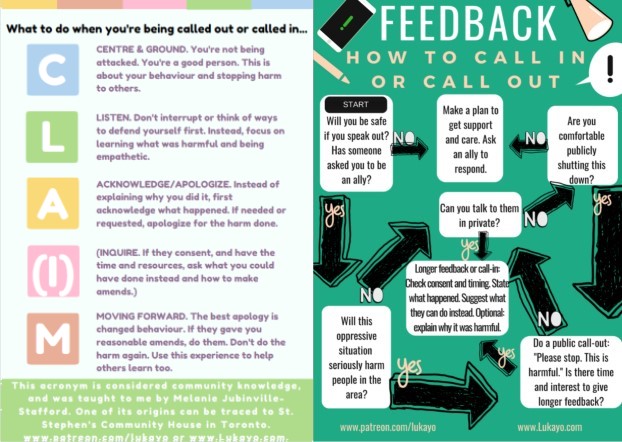
    Both posters were made using Canva.

    This Workshop Wednesday, we’re going to explore the tricky subject of call-outs and call-ins, a.k.a. giving feedback, using the two posters above. Here’s what we’re going to cover:

    • Where these posters came from
    • Benefits of using these posters
    • How to explain these posters
    • Problems and controversies with these posters (e.g. abusive dynamics, tone policing and respectability politics, etc.)
    • Image descriptions of the posters for screen readers and folks with certain neurodivergence
    • The original photos of the hand-drawn version of these posters

    Source of the Posters

    Ever since the amazing RJ Jones created a graphic of the CLA(I)M poster, I’ve been getting a lot of inquiries and a lot of praise for “inventing” it, as well as questions about whether folks had permission to use it. This is a complicated subject. The “How To Give Feedback” poster I totally did make up, so absolutely credit me on that one. But the CLA(I)M acronym I learned from Melanie Jubinville-Stafford at Project Acorn, probably circa 2012. We can trace one of the origins to St. Stephen’s Community House in Tkaronto/Toronto, but it’s considered community knowledge. Each facilitator who uses the acronym adapts their own unique knowledges to it. For example, I made up each paragraph on the poster that explained each letter of the acronym. Lastly, instead of paying me for the use of these graphics/posters, I would prefer folks become patrons to the causes I’m supporting, or hire me or other anti-oppression facilitators for your communities.

    Benefits

    If you need an easy couple of tools on giving and receiving feedback in an anti-oppressive educational environment for a group of sighted folks that learn best visually, these posters are great to use.

    Framing

    These posters are best used together, paired up, in the context of a workshop on any kind of anti-oppressive topic with a facilitator who can explain and troubleshoot situations regarding the posters, as well as frame these concepts in different ways for a variety of learners and folks with varying abilities. 

    I prefer to use these posters at the beginning of a workshop, when we’re doing “Community Agreements”. Standard Community Agreements usually range from “make space for everyone and yourself”, “respect people’s pronouns”, “don’t assume gender/race/disability/etc”, to “trigger warnings” and “check on people if they leave the space abruptly”. After those agreements, I ask the group how they’d like to give each other feedback. If folks don’t have ideas, or after they share their ideas, I then introduce these posters and ask their opinions about them.

    Issues/Controversies

    These posters don’t make enough sense out of context. I know the CLA(I)M one got circulated without comment for awhile, and I think that’s my fault for letting it happen as I didn’t quite understand how virally it would spread around the Internet. I thought the poster would just circulate with folks that have taken my anti-oppression workshops. I believe that without an explanation about what calling in and calling out is, the CLA(I)M poster can be very dangerous. Folks can attempt to enforce these suggestions as rules on people in situations where they’re abusing someone or where they’re actually in a place of privilege trying to get an oppressed person to “listen”. Without the context of a workshop where people feel it’s okay to challenge the guidelines and create their own, folks can believe that CLA(I)M is “the one true way”, and that’s not it at all. Anti-oppression should be a collaborative, collective approach. I, or any of the work I do, should not have a “one true way” because people and society are always evolving and growing together, introducing new contexts and nuances.

    Even when CLA(I)M is paired up with the Feedback poster to explain what calling out and calling in is, it’s still just a reductionist, simplified explanation of a constantly evolving and nuanced subject. Also, this is just one opinion/suggestion on what calling out and calling in is. A common and fair criticism from various communities is that call-outs should not just be reserved for emergencies, and that some people result to “call-out culture” because they’re powerless in other avenues of their life and this is the only way they can stand up to power. It’s an ongoing discussion/debate as to whether criticizing “call-out culture” is tone policing and respectability politics, or whether letting “call-out culture” go unchecked becomes abusive and disposability politics. In a workshop, I’d be happy to support and continue these discussions with a group that’s learning together and has already made agreements to care for each other in that context, but without that social and physical container, these posters can cause damage, confusion, or further division among activists and their communities.

    Last but not least, these posters are not accessible to blind folks and folks with specific neurodivergence where posters of this kind are confusing or difficult to understand. Though I have included image descriptions below, there are probably easier ways to convey these concepts to blind folks than having these posters described to them.

    Image Descriptions

    The first poster is in pastel shades of yellow, pink, brown, blue, green, and purple. The title is written as follows: “What to do when you’re being called out or called in…” Vertically is the word CLAIM in all caps, but the letter “I” is in brackets to show that it is optional, so it could be read as CLAM or CLAIM. Each letter has a paragraph. The paragraph for the letter C is as follows: “CENTRE & GROUND. You’re not being attacked. You’re a good person. This is about your behaviour and stopping harm to others.” The paragraph for the letter L is as follows: “LISTEN. Don’t interrupt or think of ways to defend yourself first. Instead, focus on learning what was harmful and being empathetic.” The paragraph for the letter A is as follows: “ACKNOWLEDGE/APOLOGIZE. Instead of explaining why you did it, first acknowledge what happened. If needed or requested, apologize for the harm done.” The paragraph for the letter I is as follows: “(INQUIRE. If they consent, and have the time and resources, ask what you could have done instead and how to make amends.)” The paragraph for the letter M is as follows: “MOVING FORWARD. The best apology is changed behaviour. If they gave you reasonable amends, do them. Don’t do the harm again. Use this experience to help others learn too.” At the bottom of the poster is a green square with white text, which is as follows: “This acronym is considered community knowledge, and was taught to me by Melanie Jubinville-Stafford. One of its origins can be traced to St. Stephen’s Community House in Toronto. patreon.com/lukayo or Lukayo.com.”

    The second poster has a green-blue background. At the top is the word “FEEDBACK”, followed by the sentence “How to call in or call out”. There are stylized pictures of a white cell phone, a beige pencil, a beige megaphone, and a white speech bubble. Inside the cell phone is a green exclamation mark. Inside the speech bubble is a black exclamation mark. Below the title there are white rectangles with text that have questions, and YES in beige or NO in white that have black arrows leading to other white rectangles depending on how you choose the answer each question. The first white rectangle on the far left is the one with a black rectangle inside it. The black rectangle has the word START. The while rectangle has text underneath the black START rectangle, which is as follows: “Will you be safe if you speak out? Has someone asked you to be an ally?” If you choose NO, an arrow leads you to a white rectangle that has the following: “Make a plan to get support and care. Ask an ally to respond.” If you choose YES, a black arrow leads you to a white rectangle that has the following: “Will this oppressive situation seriously harm people in the area?” If you choose NO to this question, a black arrow leads you to a white rectangle that has the following: “Can you talk to them in private?” If you choose YES to “Will this seriously harm people in the area?”, a black arrow leads you to a white rectangle that has the following: “Do a public call-out: “Please stop. This is harmful.” Is there time and interest to give longer feedback?” If you choose NO to “Can you talk to them in private?”, a black arrow leads you to a white rectangle that has the following: “Are you comfortable publicly shutting this down?” If you choose YES to “Can you talk to them in private?”, a black arrow leads you to a white rectangle that has the following: “Longer feedback or call-in: Check consent and timing. State what happened. Suggest what they can do instead. Optional: explain why it was harmful.” If you choose NO to “Is there time and interest to give longer feedback?”, a black arrow leads you to a white rectangle that has the following: “Can you talk to them in private?”, which leads to the options previously written. If you choose YES to “Is there time and interest to give longer feedback,” a black arrow leads to the white rectangle that has the longer feedback text already covered. If you choose NO to “Are you comfortable publicly shutting this down?”, a black arrow leads you to a white rectangle that has the following: “Make a plan to get support and care. Ask an ally to respond.” If you choose YES, the black arrow leads to the white rectangle that has the public call-out text, and the options that were already given. Underneath the white rectangles are the words “www.patreon.com/lukayo” and “www.Lukayo.com” in beige.


    Want to have access to the larger full colour updated posters, the original photographs of the hand-drawn posters, and other anti-oppression related teaching tools? Click on the link below and subscribe for as little as $2/month. By becoming a patron, you support healing work among my communities, and the indigenous Elders that mentor me.

    https://www.patreon.com/posts/20896668

  • Troubleshoot Tuesday: 3 Tips on Dealing with “The Other Place” Derailment in a North American Context

    There you are, a facilitator in Canada or the United States, sitting in a circle or at the front of a classroom, explaining the history of oppression and colonialism, or why racism and white supremacy is basically synonymous, when someone raises their hand– or often times straight up interrupts you:

    “But what about China’s history of colonialism?”

    “But what about how different African and Filipino tribes took slaves?”

    “But what about how Japan is racist to other peoples?”

    “But what about how Arab countries are sexist?”

    Here we go again.

    The problem with these questions is that, if the person who asked them isn’t from there, they seem to come from an emotional place that is

    • terrified of blame and guilt, so they need to subconsciously or actively deflect and derail what they perceive is blame being put on them,
    • determined to undermine the credibility of the facilitator because they don’t like you or don’t like seeing you as some kind of “authority” due to their own oppressive or biased views, or
    • a combination of the two.

    The sad part is most folks who ask these questions don’t actually see themselves as trolling you or being micro-aggressive, they may actually see themselves as being genuinely curious or playing “devil’s advocate”. As an exorcist, I have more respect for people who think they’re being curious than for folks that declare themselves an advocate for the devil, to be honest. But, anyway…

    So what do you do? Here’s some tips that come from a place where you assume the best, i.e. that the person actually believes they’re being curious: 1) start the workshop already framing the focus and purpose of the learning for a North American activist context, 2) remind folks what local activism and anti-oppression means, and 3) ask the querent how they intend to work in solidarity with the activists in the areas that they’ve mentioned.


    Are you a diversity coordinator, anti-oppression facilitator, or equity officer interested in reading the rest of this article? Click on the link and subscribe for $10/month to get anti-oppression tutorials, videos, posters, hand-outs, and trouble-shooting guides like this one twice a week. By becoming a patron, you support healing work among my communities, and the indigenous Elders that mentor me.

    https://www.patreon.com/posts/troubleshoot-3-20894786

    [Image created using Canva. Image description: The background is black. On the left side of the image is a photograph with muted colours of baby blue, fuchsia, red, yellow, and rose pink. In the foreground of the photograph are two pale hands holding out a small colourful globe of the planet Earth. The words in white beside the photograph, in between two line separators, are the following: “”BUT WHAT ABOUT THE OTHER PLACE?!” 3 Tips on Dealing with “The Other Place” Derailment in a North American Context.”]

  • Musings Monday: Nanay Myrna Pula


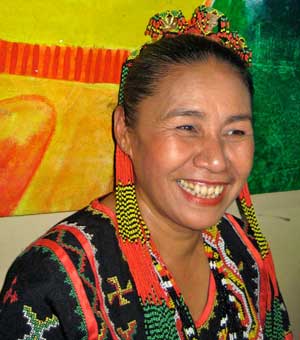
    Photo taken from the Manila Times: https://www.manilatimes.net/manila-collectible-features-…/…/. Image description: A smiling brown-skinned woman with black hair wearing beaded and hand-stitched regalia.

    The word “Nanay” means “mother”, and is a kind of honorific when referring to Nanay Myrna Pula. She is a tribal Elder of the T’Boli people, a culture bearer, and storyteller of epics. She has been preserving and translating the work of her people, having been one of the few folks in her tribe that was sent to Western school but returned to continue the indigenous way of life.

    She’s been recording the work of the chanters, priestesses, and other Elders of her tribe through audio tapes and written papers, and, with the help of generous sponsors like myself and my patrons on Patreon, she will be able to digitally transfer and preserve the work for future generations.

    Nanay Myrna Pula also hopes to begin a School of Living Tradition where she can gather some of the last living Elders of traditional ways and arts in her tribe, and have them live under one village compound to teach the next generation of T’Boli before, after, or as an alternative to going to Western school.

    But why is she everybody’s “mother”? I’ve only spent time with Nanay Myrna Pula in person twice– in a week-long gathering in Mindanao in July 2015, and in another week-long gathering in Luzon in July 2017, both called Pamati.

    Before my second meeting with her, I had a dream sent to me by my Ancestors that I would receive a talisman to remind me of my purpose, and I would receive it during my next trip with indigenous Elders of the Philippines. Sure enough, one day as I was walking around the meeting area of the Pamati 2017 Gathering, Nanay Myrna Pula came up behind me and slipped a beaded gong necklace around my neck, and would not take money for it.

    At another point in the gathering, after many diasporic Filipino/Pilipinx delegates (especially myself) had wept and explained the loss of their culture and connection to the land and mentors to guide them, Nanay Myrna stood and proclaimed that she would be mother and grandmother to us all, that we could dry our tears and lean on her. It is that kindness and generosity of spirit, both to her own tribe, and to us youth and diasporic peoples of different nations than her own, that, for me, has earned her the honorific of Nanay.


    Read the rest of the article here and become a patron today: https://www.patreon.com/posts/20886291


  • Fresh Friday: To the Waters & the Wild

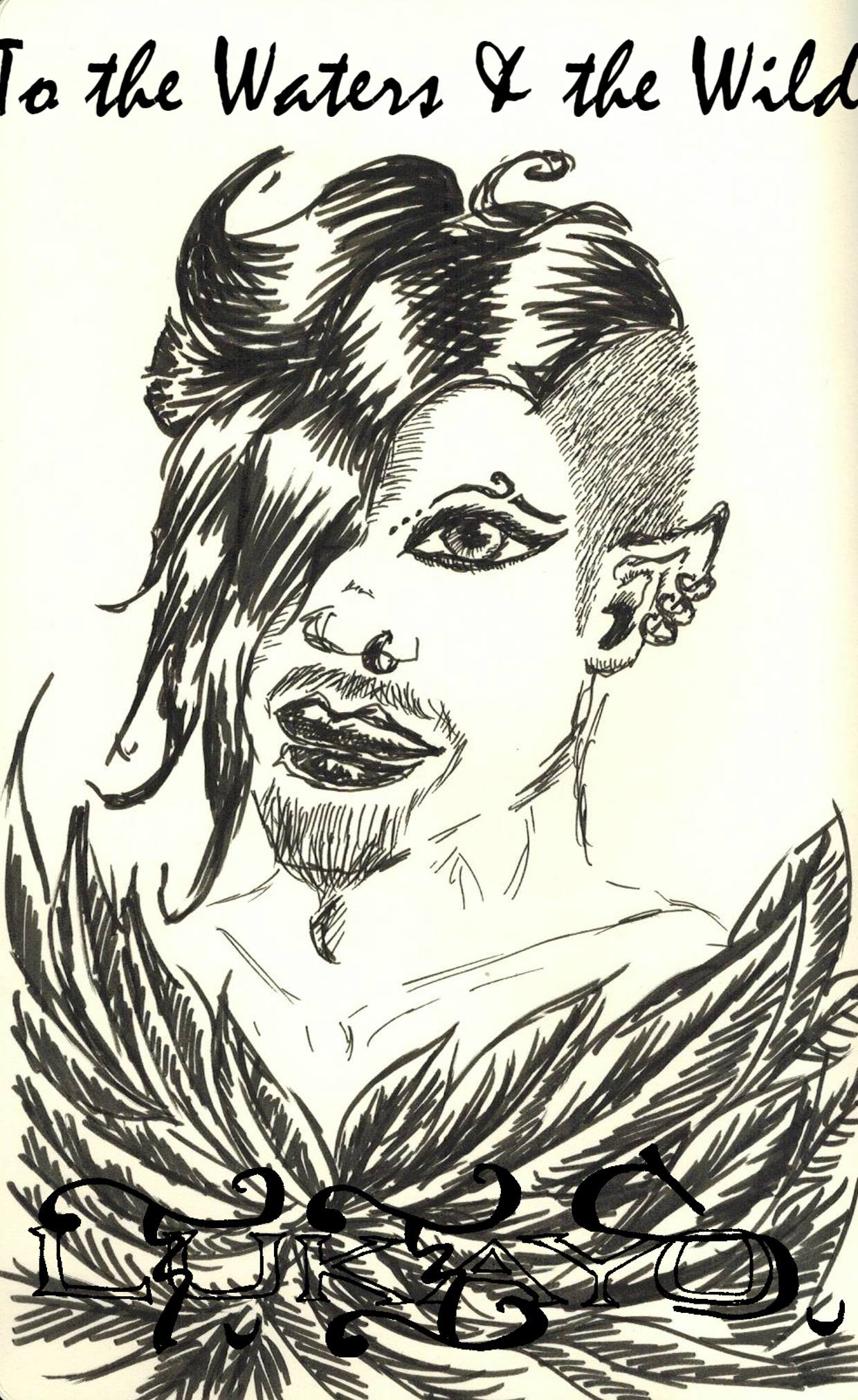
    New song and artwork!

    Fun fact: This song actually came to me in a dream from my Ancestors. I was watching a music video in the dream, and I was shocked to discover that the video was of myself, performing this exact song with a pop punk band. When I woke up, I remembered most of the words and the tune, but had to figure out the chords and title for myself.

    The title comes from this quote:

    Come away, O human child!
    To the waters and the wild
    With a faery, hand in hand,
    For the world’s more full of weeping than you can understand.
    – W.B. Yeats, “The Stolen Child”

    Image description: An inked portrait of a being with facial hair, darkened lips, ear and nose piercings, stylized eyebrows, a shaved undercut, pointed ears, wearing dark feathers. Above the portrait are the words “To the Waters & the Wild”. At the bottom of the portrait, hidden the feathers, is a signature in English and Bikol basahan: “Lukayo”.

    If you want to hear the song, click on the link to become a patron. For as little as $1/month you can support healing work among my communities, and the indigenous Elders that mentor me.

    https://www.patreon.com/posts/fresh-friday-to-20845767

  • Throwback Thursday: Confessional

    Note: The original was written in 2006 but this is the updated 2018 version.

    Content warning: gender dysphoria, cisgenderism, allusion to sexual assault

    This room is my confessional
    And you are all my witnesses
    That I am afraid – I am fucking terrified
    To be…a woman
    That I am terrified
    I’ll never be a good enough man

    And we are born into this world with certain roles laid out for us
    M
    We are born into this world with certain roles laid out for us
    F

    And they tell me, “There’s nothing to fear, lil kid,
    You just ARE a woman.
    You just ARE a man.”

    But they are lying through their toothy smiles
    Their eyes undressing and oppressing me
    Because if it’s all about just BEING a gender
    Then how come I can BE a gender so BADLY?
    How come everything I do and say
    Is not macho enough or some lady-like way?

    Wanna read the rest of the poem and watch the Youtube video performance? Click on the link to become a patron. For as little as $1/month you can support healing work among my communities, and the indigenous Elders that mentor me.

    https://www.patreon.com/posts/20809402

  • Workshop Wednesday: Anti-Oppression Learning Tools

    In any anti-oppression workshop you’re giving, remember that you have to teach your participants the following:
    • What is privilege and oppression?
    • How can I be less oppressive?
    • How can I be a good ally?
    • How can I put on inclusive events?
    • How can I make my group or organization less oppressive?
    • How can my group understand our oppressive dynamics so we can work together better?
    • What are ways to stop oppressive comments?
    • What are ways to stop oppressive events?
    • What are ways to stop oppressive institutions?

    Participants may want more information on one thing instead of another. For example, a local group may want to know more about stopping oppressive institutions while another group wants to know how to run good events. It’s important to ask your audience what they’re looking for and also understand the community you’re serving so that you can choose the right tools for any particular workshop you’re putting on.

    I divide tools into 2 kinds:

    1. Theory & Concepts
    2. Action

    Your workshop should have a mix of theory and action because it’s important for many people to know why the action works that way. For example, it’s impossible to build great allyship without a basic understanding of what privilege is.

    Lastly, I encourage you to make your own tools utilizing your own talents of visual art, spoken word, theatre, gaming, video, and more!


    Want to have access to the chart and other anti-oppression related teaching tools? Click on the link and subscribe for as little as $2/month. By becoming a patron, you support healing work among my communities, and the indigenous Elders that mentor me. 

    https://www.patreon.com/posts/20211678

  • Troubleshoot Tuesday: 3 Ways to Learn The P-Word

    Whether you’re running a presentation for your job, doing a workshop for your community, or trying to have a conversation with that “friend” (you know which one I’m talking about), you may have to struggle with explaining the word that gets 25% of people’s back’s up: privilege.

    (Note: I am not a statistician, so when I write “25%”, I mean, roughly, the amount of eye-rolling, pursed lips, frozen facial expressions, deep-diaphragm-groaning, and spirit-leaving-body experiences I feel with my spidey senses every time I drop the P-word in a crowd.)

    In this first Troubleshoot Tuesday edition, I’m going to take you through three general kinds of ways to explain privilege while comparing the pros and the cons: checklists/flowers/etc., games and gaming analogies, and storytelling and group work activities. Some of these are better for discussions you’re quickly having at a party, while others make more sense if you’re training your collective that’s committed to social justice and solidarity work.

    Regardless, always remember the objective: the point of explaining privilege is not to make people feel bad– it’s to realize the secret powers they never knew they had that can be used for the consensual benefit of their friends, loved ones, and communities.

    That’s why I have a bit of a pet peeve with the term “check your privilege”– I always feel like what people mean to say is “hey bud, you’re not understanding the full context of how oppressive this situation might be and how you benefit from it unintentionally”. Maybe it would make more sense to say “Use your privilege to help me, not hurt me!” Not as catchy though, I know, but keep that in mind as you choose which method of explanation or teaching is right for you and your audience.


    Are you a diversity coordinator, anti-oppression facilitator, or equity officer interested in reading the rest of this article? Click on the link and subscribe for $10/month to get anti-oppression tutorials, videos, posters, hand-outs, and trouble-shooting guides like this one twice a week. By becoming a patron, you support healing work among my communities, and the indigenous Elders that mentor me.

    https://www.patreon.com/posts/20769892

The site will be down Friday, June 12th from 8pm until Midnight EST for webhost transfer and maintenance.

X