
Category: Workshop Wednesday

  • Workshop Wednesday: The Oppression Triangle

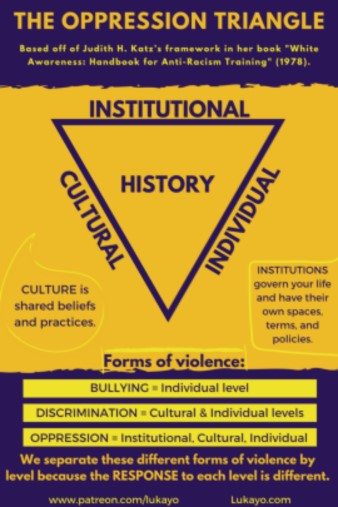
    [Image made using Canva. The poster is in colours of midnight-blue/indigo, mustard yellow, and lemon yellow. The top of the poster is yellow on blue, with the text “THE OPPRESSION TRIANGLE” and “Based off of Judith H. Katz’s framework in her book “White Awareness: Handbook for Anti-Racism Training” (1978)”. The middle part of the poster is blue on yellow. There is a large triangle facing downwards. On the top side of the triangle is the word “INSTITUTIONAL”. On the left side is “CULTURAL” and on the right side is “INDIVIDUAL”. In the centre of the triangle is the word “HISTORY”.  There is a faint yellow speech bubble with the words “CULTURE is shared belief and practices” on the left side. On the right side is a faint yellow speech bubble with the words “INSTITUTIONS govern your life and have their own spaces, terms, and policies”. At the bottom of the triangle is a faint yellow square introducing the next section in blue, with the title: “Forms of violence:”. Each form of violence is in a yellow rectangle with blue text on a blue background. The three forms of violence are “BULLYING = Individual level”, “DISCRIMINATION = Cultural & Individual levels”, and “OPPRESSION = Institutional, Cultural, Individual”. Below these rectangles are yellow text on blue: “We separate these different forms of violence by level because the RESPONSE to each level is different.” At the bottom of the poster are the links: “patreon.com/lukayo” and “Lukayo.com“.]

    “The Oppression Triangle” is a visual tool that can be used for sighted folks in the form of a handout or a poster to explain what oppression is and why anti-oppression is a different form of response to violence compared to anti-bullying and anti-discrimination methods.

    This Workshop Wednesday, we’re covering the following:

    • the different sides of the triangle
    • what each side of the triangle has to do with violence, and specifically the three forms of violence called bullying, discrimination, and oppression
    • how someone can tell the difference between oppressive bullying and non-oppressive bullying, and oppressive discrimination and non-oppressive discrimination
    • why we need to know the different levels of violence by describing the typical anti-violence responses to each
    • group work activities
    • the original photo of the poster

    The Sides of the Oppression Triangle

    The level of the individual has no explanation on the poster because it’s hoped that participants understand what individual interactions are, which are usually one-on-one in nature. Examples of this would be people having a conversation, or one person helping another person cross the street.

    Given that I define “culture” has “shared beliefs and practices”, the cultural level is when a group of people with shared beliefs and practices interacts with another group of people that has a different set of shared beliefs and practices– or a group to an individual. Examples of this would be “alternative lifestyle” cultures like goth and punk, where members of this culture have a shared belief in the concept of “goth” or “punk” (though they can argue exactly what that concept is) and have common practices. Other examples can be a culture based on geography (like Haligonians who are born or reside long-term in Halifax) or based on ethno-religious grounds (like Jewish culture).

    When you get to explaining Western institutions, you can either list the institutions first and ask what they have in common (and ask them not to look at the answer on the poster) or you can ask them to try to name institutions. Common ones are commerce/business/economic, government, military, legal, educational, medical, media, and certain religious institutions. I always add that not all religion is an institution, because not all religions govern your lives. Some religions can fall under culture instead, because it’s a shared belief and practice, but you can choose to opt out of it easier, unlike many of Western society’s institutions. I specify Western, but you can also say Westernized, as there is a possibility that other institutions outside of the West can work that way while others that are not Westernized do not work that way– for example there can be local tribal governments that only meet when needed and there is no permanent location for their meetings.

    History is in the middle of the triangle because in order for something to be all three levels of power (individual, cultural, and institutional), it would have had to take time to get there, thus, there would be a long history of it existing.

    Bullying, Discrimination, and Oppression

    When I talk about violence, I mean all kinds of violence– physical, verbal, social exclusion, negative messaging in images and misrepresentation/lack of representation, emotional, spiritual, etc.

    Bullying is largely regarded as a form of violence that is peer-to-peer and chronic, where a power imbalance between usually two people is created. Sometimes a power imbalance already exists and is used as a reason to bully. Generally regular bullying is on the individual level of violence.

    Discrimination is usually defined as when a person or group of people is violent towards a group, or a person belonging to a group, based on their skin colour, gender, disability status, sexual orientation, or other physical or social aspects that they cannot control. Discrimination is on the individual and cultural levels of violence. Discrimination manifests on the individual level as discriminatory bullying, when someone is chronically targeted by a peer for belonging to a specific group based on an aspect of themselves they can’t control.

    Oppression is institutional violence. This is when an institution, like, for example, the police, consistently targets groups of citizens because of an underlying logic that they are less than human, and so can be treated that way. Oppressive discrimination can manifest in the police force by masculine officers having a separate lounge that does not allow feminine officers (cultural level). Oppressive bullying can manifest in the police force by a cisgender police officer chronically harassing a transgender police officer (individual level). For a specific violent logic to get to the institutional level, there would already be a long history.

    Non-Oppressive Bullying and Non-Oppressive Discrimination

    Folks usually get stuck in trying to figure out what bullying looks like if it’s not discriminatory or oppressive, or what discrimination looks like if it’s not oppressive.

    If we consider bullying as peer-to-peer and chronic, but take away the existing power imbalances of institutions, or cultural groups, or aspects of oneself that you can’t control, then we have bullying that creates a power imbalance. These power imbalances can be based on what sports team people like, or whether they like Stars Wars versus Star Trek. People can choose whatever they want to be violent towards you on a regular basis, but it’s not discrimination or oppression without that cultural or institutional level of power.

    If we consider discrimination that is executed without the historical support of institutions, then we are looking at violence towards people solely based on aspects of themselves that they cannot control. In this regard, it is possible to racially discriminate against folks with pale skin or are considered white, as well it is possible for a group of women to discriminate against men.

    Anti-Bullying, Anti-Discrimination, and Anti-Oppression

    So why should we make all these distinctions that just seem super nit-picky? Well, for one, it helps to lay them out for folks who believe reverse-racism or reverse-sexism is a thing– it’s not. Let’s break this down in the anti-violence responses.

    When regular bullying happens in a school yard or at an office or in a neighbourhood, what would be the courses of action? To stop the violence, usually we’d go to an institutional authority figure– a teacher in the school, the human resources department at work, or the police officer from the nearest precinct. Anti-bullying measures are then put in place by the institution.

    When discrimination happens in those same settings from our peers, we can go to those same authority figures. If they don’t do anything, we can go to legal institutions, such as the Ontario Human Rights Tribunal if the discrimination happened in the province of Ontario. Anti-discrimination punishments are then put in place by the institutions.

    But when bullying and discrimination are oppressive, appealing to these institutions don’t workbecause it’s these very institutions that have the history and current practice of bullying and discriminating against the group that’s being targeted. That’s why common forms of anti-oppression involve collective organizing among oppressed groups and their allies to give alternate services that these institutions should be providing to the oppressed, protecting the oppressed from these violent institutions, and/or exposing and opposing the violence in these institutions through direct action.

    Let’s return to the dilemma of reverse-racism and reverse-sexism. When people get into arguments about this, what’s actually happening is one person is trying to talk about racial and sexist oppression via institutions while the other person is talking about racial and sexist discrimination from groups. If it’s an honest misunderstanding, maybe going through The Oppression Triangle infographic might help them out. However, sometimes these arguments are rooted in the emotionally-based belief that institutions can do no wrong or that these institutions can’t possibly influence people on a social and individual level, which, at best, makes the oppressed sound like they are complaining for no reason, and, at worst, makes the oppressed look like terrorists that are exposing and opposing benevolent social mechanisms. In that case, I would suggest folks conserve their energies for those who truly want to learn once they realize a person refuses to look deeper into history and how institutions are operating in the present day.

    Group Work Activities

    Yikes! This was super long-winded. How are you going to get folks to even stay awake through all these definitions? Here’s some ways to do so by group work activities! Pro-tip: Give space to have groups present via music, dance, art, and theatre, not just by talking!


    Want to have access to the rest of the article, the larger full colour updated poster, the original photograph of the hand-drawn poster, and other anti-oppression related teaching tools? Click on the link below and subscribe for as little as $2/month. By becoming a patron, you support healing work among my communities, and the indigenous Elders that mentor me.
    https://www.patreon.com/posts/21075614

  • Workshop Wednesday Special! Relationship Charts

    In celebration of the Kinaban Patreon reaching our first goal of $150, here’s a freebie post on charting your relationships!

    I’m going to ramble about the following:

    • why chart your relationships?
    • needs, wants, and boundaries
    • the space-time continuum
    • feeling special
    • sharing lives together
    • when to use the charts
    • a link to the relationship charts in .pdf

    Why chart your relationships?

    Some folks like the organic, flowing, magical mystery of getting to know someone bit by incremental bit, or just U-hauling it and figuring it out afterwards. Not me. Well, not 30-something me. Definitely teenybopper me and 20-something-living-catastrophe me was into that high-risk fun and games. Now, as a person with multiple ethical relationships that have varying levels of physical, emotional, sexual, and spiritual intimacy, logistics are a large part of my life– from my Google calendar, to my written agenda, to my online spreadsheets, to these relationship charts. They help me sort out my priorities and how I want to make them reality, while respecting what was negotiated with those closest to me. The charts specifically help me figure out what I want out of my life, and then with whom and how do I want to share my life with.
     
    I also created these charts for political and anti-oppressive reasons. I wanted a way for folks who have relationships that weren’t necessarily heteronormative and/or amatonormative to be able to have a template to create the kinds of relationship networks and communities they want. As charts, they’re not a set of rules or guidelines, but something that can start an idea, or be rearranged and built on depending on who needs them for what. I wanted to give folks an easy way to challenge what society teaches us is “the one true way” to have relationships in our lives by giving them the option to create their own way.


    Needs, Wants, and Boundaries

    “Cool story, Lukayo,” you say, “but how the hell do you know what you want from your life?” Good question, imaginary yet beloved reader. For me, it definitely was trial-by-error, especially because my definition of what a “want” and what a “need” changed so often. I only figured things out after I’d been in a string of relationships that taught me so many lessons. You’re going to have to figure this out for yourself, too. If you already have, awesome! Then you can just fill out the charts based on order of priority. If you haven’t figured stuff out completely, you can use these charts by taking the titles of each row and considering these questions:

    • Is this something that I need absolutely in my life?
    • Is this something I want but it’s okay if it’s not in my life ever?
    • Is this something I absolutely do not want ever, and thus is a boundary?

    That way you can start figuring out your basic needs, wants, and boundaries without anyone else in the picture first. You can put N, W, or B beside each row that corresponds to the concept of each letter. Or you can make up your own questions based on your own definitions of what a need, want, and boundary is! I’d love to read about them in the comments.

    The Space-Time Continuum

    Obviously, we all need time and space as 3-dimensional (4-dimensional?) beings. But before you fill out this chart with other people in mind, first ask yourself, how much time do I need to myself? Will I climb up the walls and want to run away to the woods if I constantly see people every single day from when I wake up to when I go to bed? Or will I love the hell out of it and cry if I wake up alone? Also, how much space do you want? Can you never absolutely share another bed with a person? Another room? Do you need your own bathroom and kitchen?

    After thinking about what’s important to you, then you can start thinking about how much you’re willing to share with others. Is there some kinds of relationship you’re willing to give more time and space to? Traditional Western monogamy prioritizes a single person for all your emotional, romantic, and sexual needs. Are you also willing to give “best friends” some time and space? If you spend all your time with a romantic partner, are you content, or will you flip out because you’re not spending time with your pals or in community work? Are you okay ever living with complete strangers or do they have to be friends or partners?

    If you’re thinking about giving this chart to someone, then you can also fill out this section based on how much time and space you’re okay with spending with this particular person. You can also add how much you may be willing to spend in the future as your maximum amount, just to add some clarity and to show, if that’s where you’re at, that you’re thinking of this person in the long-term.

    Feeling Special

    This section of the charts, entitled “Am I Special to You?”, can be filled out like the previous one, in that you first consider how you make yourself feel special, how you’d like others to make you feel special in general, how you’d like other to feel special in general, and/or how you’d like the specific person who is receiving your chart to feel special.

    For “Titles/Names”, I’d like to suggest that you don’t have to choose titles that already exist or are common. You can have a new name for a non-romantic, non-sexual committed relationship because this person shares over 5 areas of their life with you in a long-term way. Examples of alternate names of relationship types or partners include: queerplatonic, quasiplatonic, zucchini, relationshipmate, cupcake, honeybee, packmate, etc.

    I especially like this section because it gives options to aromantic, asexual, polyamorous and/or relationship anarchistic folks. Monogamy clearly spells out that you’re one, chosen sexual and romantic partner is the one that gets the special title, has special ceremonies (anniversaries and weddings), attends events together as the “plus one”, has tokens like rings, and is the one you exclusively have sex and kids with.  For those that don’t have sexual partners, or romantic partners, or have multiple sexual and romantic partners, there are other ways to express your caring for other folks to show how important they are, and you can plan that out together.

    Sharing Lives Together

    In the two-paged chart “What part(s) of your life do you want to share with me?”, I know the title focuses on the “sharing” part, but actually you should start with “is this area even important to me?” for each row before you consider if you want to share it with somebody else. Another exercise you could do with this chart is  figure out how many people you want to share each area with. Maybe only 1 person gets to share the sexuality/kink parts of your life, but hundreds of people can share in your community work. You can also denote what parts of the chart have a limited boundary, where there needs to be more time and trust built for someone to access that area (like children or being an emergency contact) versus you’ll manage with whoever gets stuck with you (like work). These categories are also really broad– you can make sub-categories, especially if you want different folks fulfilling them. You might want a different buddy to go to the gym with you versus go to the spa with you (both fall under “Physical Maintenance”) or you may keep your hockey game watching bros strictly separate from your Live Action Roleplaying community (which can either be “Social Events” or “Hobbies/Creativity”). Lastly, don’t forget to add new categories! I don’t know your lives better than you do, and if there’s an area that you prioritize and/or want to share, put it on there!

    When to Use the Charts

    Though you’re free to use the charts whenever you want, here are a few suggestions on possible ways you could use them:

    • when you feel stuck in your own life and want to figure out whether you’re spending enough time with yourself or what areas of your life need more attention
    • when you’re not in any chosen relationships and you’re trying to consider what you want out of your social life and/or friendships and/or romance
    • when you’re starting a new relationship and want to communicate what you’d like to offer to another person
    • when you’re in a relationship with another person and you’re unclear what they want from you, so you ask them to fill out this chart
    • when one of your relationships needs to transition into another form and you’d like to work that out with the other person as to what will decrease, increase, end, change, or be maintained in the relationship

    Hopefully this gives you some ideas of when and how to use these charts! Though they’re good for organizing, always remember that they can’t replace good ol’ communication.

    Link to the charts: Relationship Charts


    Want access to more awesome educational content like this? Check out and subscribe to www.patreon.com/lukayo.

  • Workshop Wednesday: Calling Out and Calling In

    Both posters were made using Canva.

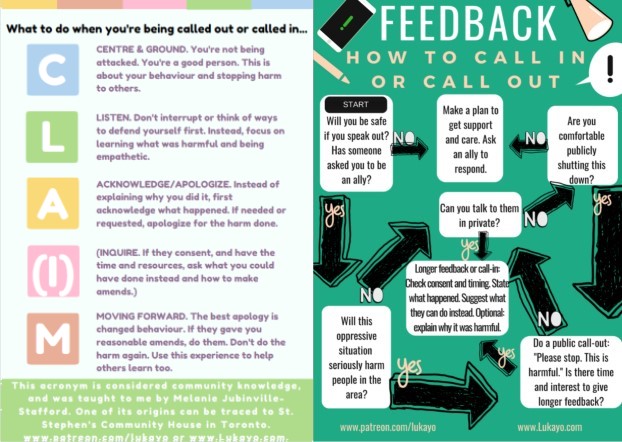
    This Workshop Wednesday, we’re going to explore the tricky subject of call-outs and call-ins, a.k.a. giving feedback, using the two posters above. Here’s what we’re going to cover:

    • Where these posters came from
    • Benefits of using these posters
    • How to explain these posters
    • Problems and controversies with these posters (e.g. abusive dynamics, tone policing and respectability politics, etc.)
    • Image descriptions of the posters for screen readers and folks with certain neurodivergence
    • The original photos of the hand-drawn version of these posters

    Source of the Posters

    Ever since the amazing RJ Jones created a graphic of the CLA(I)M poster, I’ve been getting a lot of inquiries and a lot of praise for “inventing” it, as well as questions about whether folks had permission to use it. This is a complicated subject. The “How To Give Feedback” poster I totally did make up, so absolutely credit me on that one. But the CLA(I)M acronym I learned from Melanie Jubinville-Stafford at Project Acorn, probably circa 2012. We can trace one of the origins to St. Stephen’s Community House in Tkaronto/Toronto, but it’s considered community knowledge. Each facilitator who uses the acronym adapts their own unique knowledges to it. For example, I made up each paragraph on the poster that explained each letter of the acronym. Lastly, instead of paying me for the use of these graphics/posters, I would prefer folks become patrons to the causes I’m supporting, or hire me or other anti-oppression facilitators for your communities.

    Benefits

    If you need an easy couple of tools on giving and receiving feedback in an anti-oppressive educational environment for a group of sighted folks that learn best visually, these posters are great to use.

    Framing

    These posters are best used together, paired up, in the context of a workshop on any kind of anti-oppressive topic with a facilitator who can explain and troubleshoot situations regarding the posters, as well as frame these concepts in different ways for a variety of learners and folks with varying abilities. 

    I prefer to use these posters at the beginning of a workshop, when we’re doing “Community Agreements”. Standard Community Agreements usually range from “make space for everyone and yourself”, “respect people’s pronouns”, “don’t assume gender/race/disability/etc”, to “trigger warnings” and “check on people if they leave the space abruptly”. After those agreements, I ask the group how they’d like to give each other feedback. If folks don’t have ideas, or after they share their ideas, I then introduce these posters and ask their opinions about them.

    Issues/Controversies

    These posters don’t make enough sense out of context. I know the CLA(I)M one got circulated without comment for awhile, and I think that’s my fault for letting it happen as I didn’t quite understand how virally it would spread around the Internet. I thought the poster would just circulate with folks that have taken my anti-oppression workshops. I believe that without an explanation about what calling in and calling out is, the CLA(I)M poster can be very dangerous. Folks can attempt to enforce these suggestions as rules on people in situations where they’re abusing someone or where they’re actually in a place of privilege trying to get an oppressed person to “listen”. Without the context of a workshop where people feel it’s okay to challenge the guidelines and create their own, folks can believe that CLA(I)M is “the one true way”, and that’s not it at all. Anti-oppression should be a collaborative, collective approach. I, or any of the work I do, should not have a “one true way” because people and society are always evolving and growing together, introducing new contexts and nuances.

    Even when CLA(I)M is paired up with the Feedback poster to explain what calling out and calling in is, it’s still just a reductionist, simplified explanation of a constantly evolving and nuanced subject. Also, this is just one opinion/suggestion on what calling out and calling in is. A common and fair criticism from various communities is that call-outs should not just be reserved for emergencies, and that some people result to “call-out culture” because they’re powerless in other avenues of their life and this is the only way they can stand up to power. It’s an ongoing discussion/debate as to whether criticizing “call-out culture” is tone policing and respectability politics, or whether letting “call-out culture” go unchecked becomes abusive and disposability politics. In a workshop, I’d be happy to support and continue these discussions with a group that’s learning together and has already made agreements to care for each other in that context, but without that social and physical container, these posters can cause damage, confusion, or further division among activists and their communities.

    Last but not least, these posters are not accessible to blind folks and folks with specific neurodivergence where posters of this kind are confusing or difficult to understand. Though I have included image descriptions below, there are probably easier ways to convey these concepts to blind folks than having these posters described to them.

    Image Descriptions

    The first poster is in pastel shades of yellow, pink, brown, blue, green, and purple. The title is written as follows: “What to do when you’re being called out or called in…” Vertically is the word CLAIM in all caps, but the letter “I” is in brackets to show that it is optional, so it could be read as CLAM or CLAIM. Each letter has a paragraph. The paragraph for the letter C is as follows: “CENTRE & GROUND. You’re not being attacked. You’re a good person. This is about your behaviour and stopping harm to others.” The paragraph for the letter L is as follows: “LISTEN. Don’t interrupt or think of ways to defend yourself first. Instead, focus on learning what was harmful and being empathetic.” The paragraph for the letter A is as follows: “ACKNOWLEDGE/APOLOGIZE. Instead of explaining why you did it, first acknowledge what happened. If needed or requested, apologize for the harm done.” The paragraph for the letter I is as follows: “(INQUIRE. If they consent, and have the time and resources, ask what you could have done instead and how to make amends.)” The paragraph for the letter M is as follows: “MOVING FORWARD. The best apology is changed behaviour. If they gave you reasonable amends, do them. Don’t do the harm again. Use this experience to help others learn too.” At the bottom of the poster is a green square with white text, which is as follows: “This acronym is considered community knowledge, and was taught to me by Melanie Jubinville-Stafford. One of its origins can be traced to St. Stephen’s Community House in Toronto. patreon.com/lukayo or Lukayo.com.”

    The second poster has a green-blue background. At the top is the word “FEEDBACK”, followed by the sentence “How to call in or call out”. There are stylized pictures of a white cell phone, a beige pencil, a beige megaphone, and a white speech bubble. Inside the cell phone is a green exclamation mark. Inside the speech bubble is a black exclamation mark. Below the title there are white rectangles with text that have questions, and YES in beige or NO in white that have black arrows leading to other white rectangles depending on how you choose the answer each question. The first white rectangle on the far left is the one with a black rectangle inside it. The black rectangle has the word START. The while rectangle has text underneath the black START rectangle, which is as follows: “Will you be safe if you speak out? Has someone asked you to be an ally?” If you choose NO, an arrow leads you to a white rectangle that has the following: “Make a plan to get support and care. Ask an ally to respond.” If you choose YES, a black arrow leads you to a white rectangle that has the following: “Will this oppressive situation seriously harm people in the area?” If you choose NO to this question, a black arrow leads you to a white rectangle that has the following: “Can you talk to them in private?” If you choose YES to “Will this seriously harm people in the area?”, a black arrow leads you to a white rectangle that has the following: “Do a public call-out: “Please stop. This is harmful.” Is there time and interest to give longer feedback?” If you choose NO to “Can you talk to them in private?”, a black arrow leads you to a white rectangle that has the following: “Are you comfortable publicly shutting this down?” If you choose YES to “Can you talk to them in private?”, a black arrow leads you to a white rectangle that has the following: “Longer feedback or call-in: Check consent and timing. State what happened. Suggest what they can do instead. Optional: explain why it was harmful.” If you choose NO to “Is there time and interest to give longer feedback?”, a black arrow leads you to a white rectangle that has the following: “Can you talk to them in private?”, which leads to the options previously written. If you choose YES to “Is there time and interest to give longer feedback,” a black arrow leads to the white rectangle that has the longer feedback text already covered. If you choose NO to “Are you comfortable publicly shutting this down?”, a black arrow leads you to a white rectangle that has the following: “Make a plan to get support and care. Ask an ally to respond.” If you choose YES, the black arrow leads to the white rectangle that has the public call-out text, and the options that were already given. Underneath the white rectangles are the words “www.patreon.com/lukayo” and “www.Lukayo.com” in beige.


    Want to have access to the larger full colour updated posters, the original photographs of the hand-drawn posters, and other anti-oppression related teaching tools? Click on the link below and subscribe for as little as $2/month. By becoming a patron, you support healing work among my communities, and the indigenous Elders that mentor me.

    https://www.patreon.com/posts/20896668

  • Workshop Wednesday: Anti-Oppression Learning Tools

    In any anti-oppression workshop you’re giving, remember that you have to teach your participants the following:
    • What is privilege and oppression?
    • How can I be less oppressive?
    • How can I be a good ally?
    • How can I put on inclusive events?
    • How can I make my group or organization less oppressive?
    • How can my group understand our oppressive dynamics so we can work together better?
    • What are ways to stop oppressive comments?
    • What are ways to stop oppressive events?
    • What are ways to stop oppressive institutions?

    Participants may want more information on one thing instead of another. For example, a local group may want to know more about stopping oppressive institutions while another group wants to know how to run good events. It’s important to ask your audience what they’re looking for and also understand the community you’re serving so that you can choose the right tools for any particular workshop you’re putting on.

    I divide tools into 2 kinds:

    1. Theory & Concepts
    2. Action

    Your workshop should have a mix of theory and action because it’s important for many people to know why the action works that way. For example, it’s impossible to build great allyship without a basic understanding of what privilege is.

    Lastly, I encourage you to make your own tools utilizing your own talents of visual art, spoken word, theatre, gaming, video, and more!


    Want to have access to the chart and other anti-oppression related teaching tools? Click on the link and subscribe for as little as $2/month. By becoming a patron, you support healing work among my communities, and the indigenous Elders that mentor me. 

    https://www.patreon.com/posts/20211678

The site will be down Friday, June 12th from 8pm until Midnight EST for webhost transfer and maintenance.

X